Car Hauler Trailers. The Complete Guide.

A car hauler is an open trailer built to carry vehicles, with a low deck, integrated ramps, fender clearance for open doors, and tie-down points where cars actually need them. Buy by deck length against your longest vehicle, payload against your heaviest, and ramp style against how low that vehicle sits. An 18-foot 7,000-pound tandem covers most single-car buyers.
What a car hauler actually is
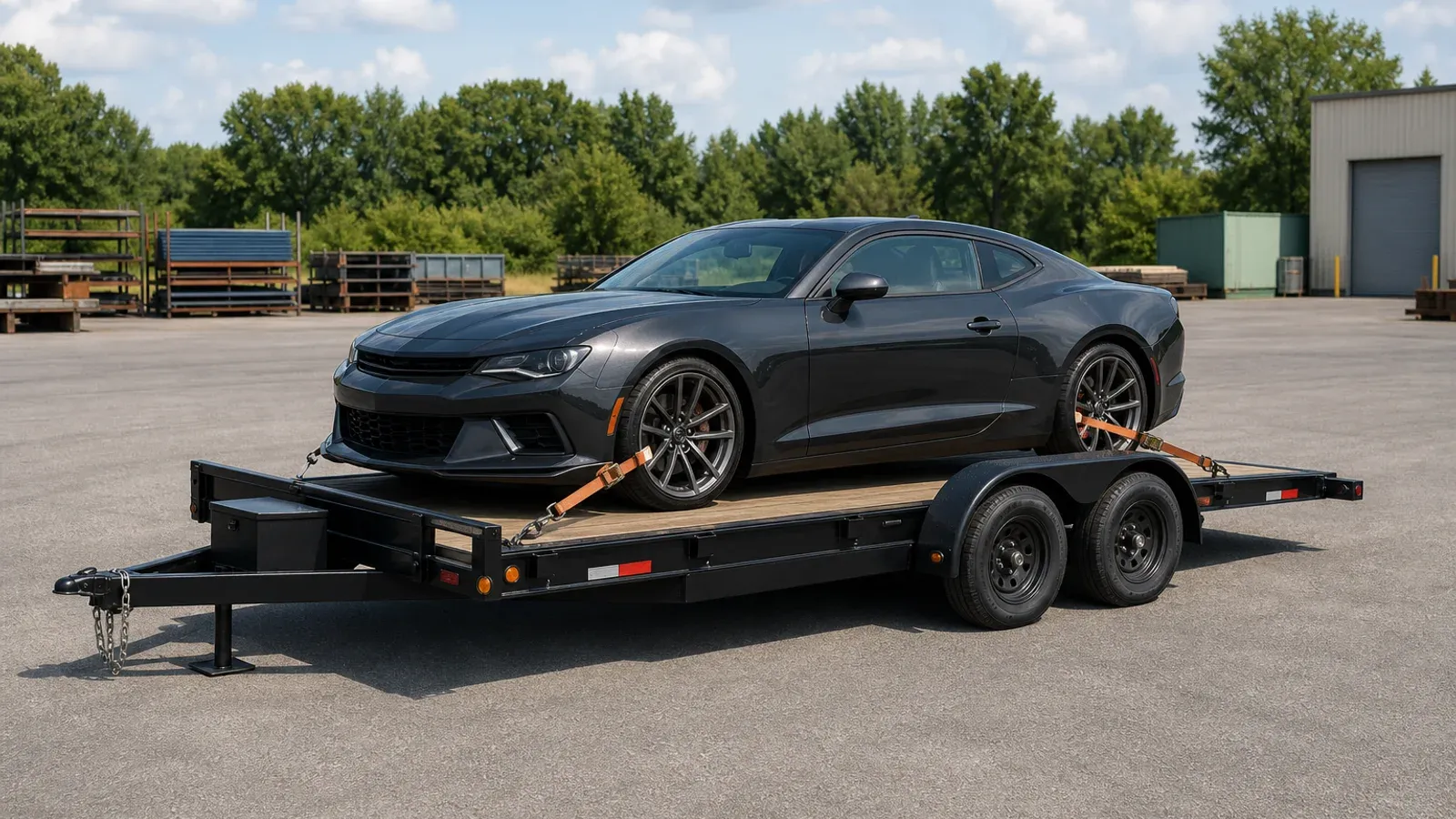
A car hauler is a flatbed that went to trade school. The deck sits low between the fenders, the rear carries ramps as standard equipment, the fenders are shaped so doors open over them, and the tie-down hardware is placed for suspension and frame points instead of general freight. Every one of those details exists because a vehicle is a specific cargo with specific problems.
The open car hauler on this page is one of two ways to move a car. The other is the enclosed car hauler, the same job inside a box, for vehicles worth protecting from weather and eyes. Open haulers win on price, weight, visibility while loading, and towing ease. Enclosed wins on protection and security. Most weekend movers and shop operators run open, and most six-figure-car owners don't.
The neighbor to rule out is the plain flatbed with a dovetail. It hauls a car occasionally and hauls everything else the rest of the year. The purpose-built hauler earns its place when vehicles are the regular cargo, auto transport as a side business, track weekends, auction runs, or the project-car shuffle. Occasional movers borrow or rent. Regular movers buy the right tool.
Here's who's buying: auto haulers running single-car transport, racers and restorers, dealers moving inventory, and multi-car operators stepping up to wedge and stacker territory. The trailer scales with the operation, from one 18-footer to a gooseneck three-car wedge.
Ramps, angles, and holding a car still
Loading is geometry. A car climbs the ramps, crests the transition onto the deck, and settles with its weight balanced slightly forward of the trailer's axles. Every problem in that sentence has a spec attached. Ramp length and dovetail angle decide whether the front bumper survives the climb. Deck height decides the angle. Tire width versus ramp width decides the pucker factor. Low cars want long ramps, a gentle tilt deck, or the wedge shape, and the tilt versus ramp comparison exists because this exact problem sells trailers.
Ramp storage styles matter daily. Slide-in ramps tuck under the rear deck, light and simple, but mind their rated capacity. Stand-up ramps stay attached and swing down, faster and heavier, and always with you. The ramp styles page covers the tradeoffs, and the buying rule is simple: deploy them yourself at the dealer, because you'll do it a thousand times.
Holding the car still is its own discipline. Wheel straps over the tires are the modern standard, since they secure the car through its suspension travel instead of fighting it. Frame chains to D-rings still serve heavy and vintage applications. Either way you want four points, rated hardware, and anchor placement that matches a car's footprint, which is exactly what the purpose-built hauler provides and the improvised flatbed doesn't. The tie-down and winch page goes deep, and a winch earns its cost the first time a car arrives that doesn't run.
Deck surface splits the category. The wood deck is standard, grippy, and repairable. The steel deck shrugs off fluid leaks and winch abuse. Open steel-runner decks drop weight and let road spray through. The steel versus aluminum car hauler question adds the frame material layer for high-mileage operators counting every pound of payload.
Car hauler sizes and real payload
Car hauler math starts with two measurements, your longest vehicle and your heaviest. Deck length needs the wheelbase plus walking room, and payload, which is GVWR minus the trailer's empty weight, needs the vehicle plus fuel, gear, and the spare parts that always come along.
| Class | Typical GVWR | Typical Payload | Common Fit |
|---|---|---|---|
| 16 ft, 7,000 lb | 7,000 lb | 5,000 to 5,400 lb | Compacts, classics, light cars |
| 18 ft, 7,000 lb | 7,000 lb | 4,900 to 5,300 lb | The standard single-car answer |
| 20 ft, 9,900 lb | 9,900 lb | 7,200 to 7,800 lb | Trucks, SUVs, heavy builds |
| Multi-car / wedge | 14,000 to 24,000 lb | 10,000 to 18,000 lb | Two and three-car operations |
The 18-foot 7K tandem is the category's default for a reason: it fits everything from a Miata to a full-size sedan with margin. Modern trucks and SUVs broke the old math, since a crew-cab pickup can weigh 6,000 pounds and stretch past an 18-foot deck, which pushes buyers into the 20-foot 9,900-pound class. Weigh and measure the actual vehicle, because the one in your head is lighter and shorter than the one in your driveway.
The tow vehicle math compounds, because you're towing a vehicle with a vehicle. An 18-footer with a 4,000-pound car aboard grosses around 6,200 pounds, fine for a properly equipped half-ton. A 20-footer with a heavy truck aboard pushes 9,500 and wants three-quarter-ton equipment. Tongue weight at 10 to 15 percent rides the truck's payload, and the car's position on the deck is how you tune it, which is a car hauler superpower, the load moves.
Multi-car changes leagues entirely. Wedge and stacker configurations run gooseneck connections, one-ton trucks, and commercial rules including the CDL math once combined ratings pass 26,000 pounds. The wedge page and multi-car page cover that world.
Car hauler sub-types
Deck choice is a maintenance-and-cargo call, wood for grip and repair, steel for leaks and abuse. Wedge and multi-car are business decisions dressed as trailers, and they earn their premium when cars-per-trip is the number that pays the note.
The features that actually matter
Skip the appearance tier unless the trailer is part of a business image, and even then, polished wheels haul zero additional cars. The winch budget beats the chrome budget every single time.
Car hauler brands
Car haulers are a core line for the open-trailer majors and a specialty for a few, which puts real spec variance behind similar-looking decks.
Big Tex and PJ own the volume with proven single-car models and dealer coverage. Kaufman built its name in this exact category shipping direct, so factor freight and local service into that comparison. Load Trail and Sure-Trac compete on spec value, and Diamond C brings the premium finish that buyers of nice cars tend to appreciate. Compare deck height, ramp rating, and tie-down layout first, since those are the category-specific specs the price sign hides.
What car haulers cost
Open car hauler pricing opens in the mid four figures for the 16 and 18-foot 7K classes and steps up through the 20-foot 9,900-pound tier. Multi-car and wedge configurations price like the goosenecks they are, well into five figures. Against the equivalent flatbed, the purpose-built hauler carries a modest premium for the dovetail, ramps, and tie-down layout, which is cheap for what it does to loading day.
The padding pattern is standard, freight, prep, doc fees, and accessory markups, with one category special, the ramp-and-winch bundle. Dealer-installed winches routinely double the parts cost. Take the factory mount and wiring, buy the winch online, and spend an hour with a wrench.
The buying mistake of the category is sizing for the current car. Cars multiply, projects get heavier, and friends discover you own a trailer. The step from 16 to 18 feet costs little at purchase and saves a whole second transaction later. The step from 7K to 9,900 pounds is the same story for anyone whose taste runs to trucks and classics with real steel.
Enclosed-versus-open is the other money fork. The open hauler costs a fraction of the box and tows easier. The enclosed comparison is worth reading before you assume either way, since weather exposure is cheaper than it looks and security is pricier.
Know the fair price before you go
The free Price Guide lists current dealer and MSRP prices for hundreds of new trailer models, brand by brand, with a confidence label on every number.
Get the Price GuideCar hauler FAQ
What size car hauler do I need?
Deck length from your longest vehicle's footprint plus room to work, payload from your heaviest plus gear. The 18-foot 7,000-pound tandem covers most single-car buyers. Modern trucks push into the 20-foot 9,900-pound class.
Can a half-ton tow a car hauler with a car on it?
Usually, for standard cars. An 18-footer plus a 4,000-pound car grosses around 6,200 pounds, inside most half-ton ratings. A heavy truck aboard changes the answer, so run the payload math, not just the tow rating.
Open or enclosed car hauler?
Open for price, weight, and everyday hauling. Enclosed for weather protection and security on vehicles that warrant it. The comparison runs the tradeoffs honestly.
How do I haul a low car without scraping?
Longer ramps, a gentler dovetail, race ramps as extensions, or a tilt deck. Measure the car's approach angle against the trailer's before buying, not after.
Wheel straps or frame chains?
Wheel straps for most modern vehicles, since they work with the suspension instead of against it. Frame chains for heavy iron and anything without usable wheel access. Four rated points either way.
Do I need a winch?
The day a car arrives that doesn't run, yes, and that day comes for everyone eventually. At minimum, take the factory winch mount and wiring, the winch itself can wait.
Do car haulers need brakes?
Tandems in this class carry brakes on at least one axle by law nearly everywhere, and both axles is the better spec for a rolling load this valuable. Your truck needs a controller to match.
Steel deck or wood deck?
Wood grips and repairs cheap, steel shrugs off leaks and winch abuse. The full comparison covers it. Shops and haulers lean steel, weekenders do fine with wood.