Five Trailer Features You're Paying For and Don't Need

The trailer itself may be priced tightly. The option sheet often is not. The goal is not to reject every add-on. It is to separate working equipment from appearance packages, duplicated factory equipment, and accessories you can buy later for less.
Ask three questions about every option: Does it increase legal payload, safety, uptime, or labor savings? Is it difficult to add later? Is the installed price competitive? If the answer is no three times, keep your wallet closed.
1. Appearance wheels on a work trailer
Polished or decorative wheels can look sharp, but they do not increase payload unless the replacement wheel carries a genuinely higher rating. Some are heavier, harder to match after damage, and quickly lose their shine around gravel, road salt, brake dust, and jobsite mud.
Spend based on the stamped wheel rating, tire load range, replacement availability, and correct offset. Plain steel wheels are inexpensive, repairable, and easy to replace. A work trailer should be handsome in the way a good hammer is handsome.
2. A dealer-priced spare tire package
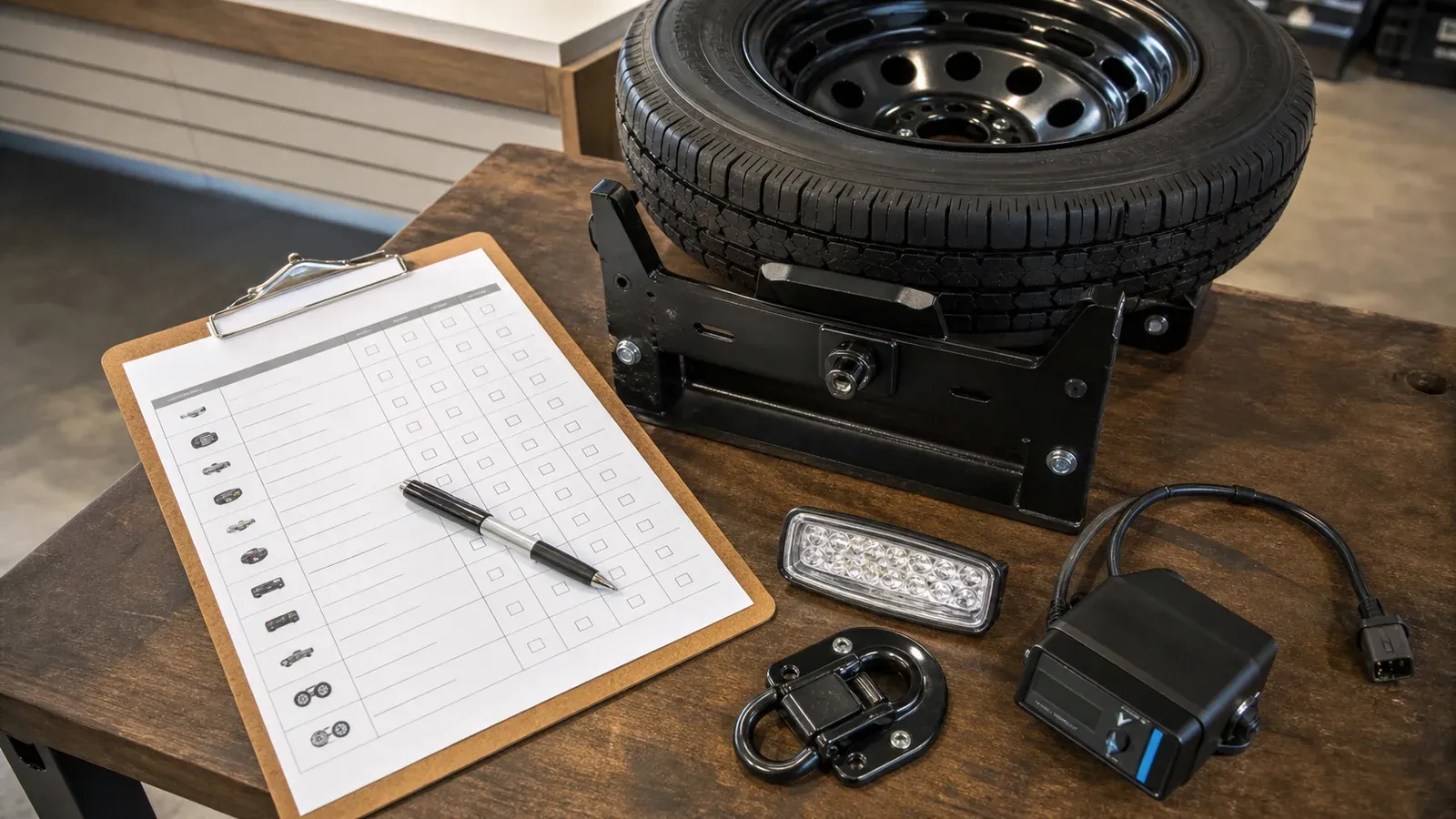
A spare is useful. A heavily marked-up spare, mount, and cover package may not be. Compare the dealer’s installed price with the cost of the exact tire, rated wheel, mount, hardware, and labor elsewhere.
Make sure the spare matches the working tires in size, load range, bolt pattern, wheel capacity, and overall diameter. A bargain spare that cannot carry the loaded axle is decoration. Mount it where it will not reduce turning clearance, block lights, overload a thin panel, or collect road damage.
3. Toolboxes selected before the trailer is loaded
Dealer-installed tongue and underbody boxes can be convenient. They can also interfere with jack handles, gooseneck clearance, weight-distribution brackets, battery access, tarp systems, or the truck in a tight turn.
Load the trailer plan before buying storage. Decide what tools must live aboard, measure the available space, calculate added tongue weight, and compare boxes by material, weather sealing, hinge support, lock quality, and replacement parts. The right toolbox earns its spot. The wrong one is an expensive place to keep wet straps.
4. An extended warranty with vague coverage
Do not reject a service contract simply because it is optional. Reject it when the document excludes the components most likely to need service, pays little labor, requires long transport, duplicates factory coverage, or gives the administrator broad authority to deny wear-related claims.
Ask for the contract before purchase. Identify the provider, term, deductible, covered parts, exclusions, labor rate, transport responsibility, cancellation terms, and claims process. Compare that price with a maintenance reserve. Axles, tires, batteries, brakes, bearings, wiring, hydraulic seals, and finish may each have different factory or component coverage.
5. An LED upgrade when LEDs are already standard
Many current trailers already include sealed LED lighting. An upgrade package may change only the number, shape, trim ring, or branding of the lamps. Read the base specification and inspect the actual unit before paying twice for the same technology.
What matters is sealed lamps, protected wiring, sound grounds, accessible junctions, proper side markers, and replacement availability. A premium lamp attached to an exposed wire with a bargain crimp is still an electrical appointment waiting to happen.
Options that often do earn the money
The useful upgrades depend on the job, but these deserve serious consideration:
- Brakes on every axle when appropriate for the rating and use
- Correctly rated tires and wheels with local replacements available
- A stronger frame, floor, ramp, or gate for concentrated loads
- More tie-down points in locations that match the cargo
- A tarp system for loose material and legal securement
- Spring-assist gates or hydraulic functions that save repeated labor
- A charger and properly sized battery for hydraulic trailers
- Corrosion protection that matches local weather and road treatment
The best options are usually hard to retrofit or directly tied to the work. Paint accents are easy. Adding crossmembers after the deck starts bending is less relaxing.
Compare the out-the-door package
Do not negotiate from the advertised base price. Ask for a written quote showing the trailer, factory options, dealer-installed accessories, freight, preparation, documentation fees, taxes, registration, financing products, and delivery.
Then compare matching specifications. One quote may include a spare, ramps, tarp, battery, charger, and brake-away kit while another presents each item after you arrive. The lower headline price can become the higher delivered price before lunch.
Big Wade’s quick option test
| Ask this | Good reason to buy | Reason to pause |
|---|---|---|
| Does it improve safety? | Adds required braking, securement, visibility, or rated capacity | Mostly changes appearance |
| Is it hard to add later? | Requires factory reinforcement, wiring, or structural work | Bolts on with common tools |
| Does it save labor often? | Used every workday and shortens a repeated task | Solves a rare inconvenience |
| Is the price competitive? | Installed cost is close to parts plus fair labor | Package hides a large markup |
| Is it serviceable? | Common parts and clear warranty support | Proprietary parts with uncertain supply |
What to spend on instead
Put the first dollars into the correct trailer type, payload, axle capacity, frame, floor, brakes, tires, hitch, ramps, and securement. Those choices decide whether the trailer can do the job. Accessories should support that foundation.
Use the new trailer buyer’s checklist before signing, get the out-the-door number in writing, and check it against the Price Guide. The option sheet should make the trailer work better, not make the sales desk work better.