Utility Trailers. The Complete Guide.

A utility trailer is an open trailer with low sides and a rear gate, built for the everyday hauling that doesn't justify a specialized rig. It's the most-bought trailer type in America because it does 80 percent of what most people haul. Buy by payload, axle count, gate style, and frame build, not by price per foot.
What a utility trailer actually is
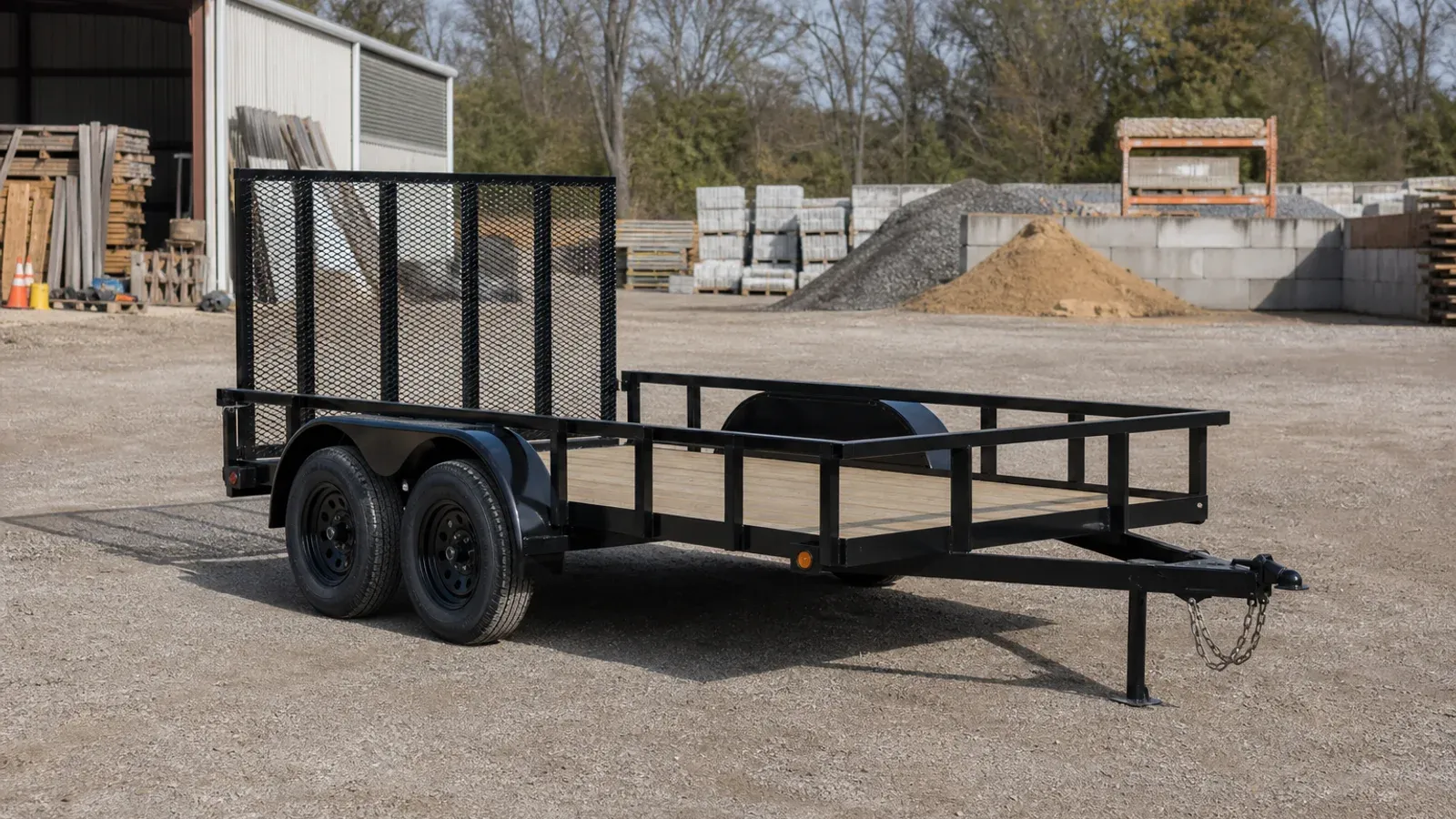
A utility trailer is the plain workhorse of the towable world. An open steel or aluminum deck, short mesh or solid sides, a rear gate that folds down into a ramp, and one or two axles underneath. No hydraulics, no walls, no drama. That simplicity is exactly why it outsells everything else on the lot.
The honest definition is by what it isn't. It isn't a landscape trailer, though the line blurs, landscape models are utility trailers dressed for one trade. It isn't a flatbed, which drops the sides entirely for oversized loads. And it isn't a dump trailer, which adds hydraulics to unload for you. A utility trailer makes you do the unloading. In exchange it costs a fraction of the price and almost never breaks.
What people actually haul on them. Mowers and small equipment, ATVs and side-by-sides, mulch and brush, furniture and household moves, building materials, firewood, appliances, and the weekend dump run. If the load fits between the rails and under the weight rating, the utility trailer hauls it.
The buying mistake is treating them as interchangeable. A $1,500 single-axle with a 2,990-pound rating and a $6,000 heavy-duty tandem with 7,000 pounds of capacity are both "utility trailers" on the price sign. They are different machines for different jobs. Start with your heaviest realistic load and work backward.
Axles, gates, and what holds it together
The axle decision defines the trailer. A single axle is lighter, cheaper, easier to move by hand, and simpler to maintain, with one set of bearings and two tires. A tandem axle doubles the tire contact, adds brakes on at least one axle, tows more stably at highway speed, and survives a blowout without drama. The rule that holds up: under 3,000 pounds of cargo and mostly local, go single axle. Over that, or with regular highway miles, go tandem.
Brakes follow the axle choice. Most single-axle utility trailers under 3,000 pounds GVWR skip brakes legally in most states. Tandems almost always carry electric brakes on at least one axle, which means your truck needs a brake controller. Check your state's threshold before assuming, the cutoffs vary and the fine sits with the driver, not the dealer.
The gate matters more than buyers think. A standard fold-down ramp gate is fine for rolling loads. A reinforced gate with a spring assist saves your back twice a day. Mesh gates flex under ATV weight over time, tube-frame gates don't. Some models offer a bi-fold gate that halves the swing clearance behind the trailer, worth it if you load in tight spots.
Frame construction separates the disposable from the durable. Angle-iron frames are the economy tier, fine for light duty. Channel and tube frames carry real weight without flexing. Look at the tongue, a wrapped tongue that extends under the deck frame beats a bolted-on stub. Crossmember spacing tells the truth about the floor, 24-inch spacing is standard, 16-inch is better under heavy point loads.
Utility trailer sizes and real payload
Utility sizing runs on two numbers, deck dimensions and payload. GVWR minus the trailer's empty weight is what you can actually load. A 5x8 single-axle rated at 2,990 pounds that weighs 900 empty carries about 2,000. Dealers quote GVWR. Your load cares about payload.
| Class | Typical GVWR | Typical Payload | Common Fit |
|---|---|---|---|
| 5x8 to 5x10 single axle | 2,000 to 2,990 lb | 1,300 to 2,100 lb | Mowers, dump runs, light hauling |
| 6x10 to 6x12 single axle | 2,990 to 3,500 lb | 2,000 to 2,600 lb | ATVs, small equipment, household |
| 6x12 to 7x14 tandem | 7,000 lb | 5,000 to 5,600 lb | Side-by-sides, materials, trade use |
| 7x16 to 7x18 heavy-duty tandem | 9,900 to 14,000 lb | 7,500 to 11,000 lb | Compact equipment, commercial daily use |
Width is the quiet constraint. A standard 5-foot deck won't take a full-size side-by-side. Most UTVs need the 6.5-foot or 7-foot deck, and some need it between the fenders, not over them. Measure the machine, then the deck, in that order.
The common sizes cluster around 5x8, 6x10, 6x12 and 7x14 because those match how people actually haul. If you're between sizes, take the longer deck. Nobody has ever complained about two extra feet of trailer while strapping down a load. Plenty have complained about the opposite.
Match the trailer to the truck last. A 7,000-pound tandem loaded near its rating wants a real tow rating and roughly 10 percent of loaded weight on the hitch as tongue weight. Most half-tons handle a loaded utility trailer fine. Verify anyway. The smallest rating in the chain wins.
Utility trailer sub-types
The sub-types stack. A high-side tandem exists, so does a heavy-duty single. Pick axle count from weight, side height from what you haul, and duty rating from how often you haul it. A homeowner hauling monthly buys differently from a crew hooking up every morning, even at the same weight.
The features that actually matter
Skip the upsells that don't haul anything. Chrome wheels, decorative fenders, and dealer-installed spare tire mounts priced at four times the parts-store number. Put that money into the frame tier or the brake axle instead. The paint fades either way.
Utility trailer brands
Utility trailers are where brand quality spreads widest, because the entry price war invites corner cutting you can't see from the parking lot. Two trailers that look identical at 50 feet can differ in frame steel, axle brand, wiring, and weld quality by a full tier.
Big Tex and PJ run the deepest utility lines with the widest dealer coverage. Sure-Trac has a strong reputation in tube-frame builds. Carry-On owns the entry tier at big-box retailers, fine for light duty, spec it honestly. Top Hat and the Texas regional builders like Ranch King and Texas Bragg compete hard on build-per-dollar in the launch market. Compare the actual spec sheet, axle brand, frame steel, and gate build, then let the price argue.
What utility trailers cost
Utility pricing spans a wider multiple than any other type, because the type spans everything from a big-box 5x8 to a commercial 7x18. Entry single-axles start under $2,000. The workhorse 6x12 and 7x14 tandem class clusters in the mid four figures. Heavy-duty commercial tandems push toward five figures with the right axles and options.
The spread between fair and padded lives in the same places as every trailer deal. Freight and prep fees, dealer-installed accessories at boutique prices, and the financing office. Get the out-the-door number in writing, compare three quotes on matched specs, and price the gate, spare, and brake controller install separately so nothing hides.
The classic utility mistake is buying the price instead of the trailer. The $1,800 special with an angle-iron frame, no brakes, and load-range C tires is a fine trailer for eight dump runs a year. Hook it to a landscaping route and it's a rolling liability with a one-year countdown. Match the duty rating to the duty.
The second classic mistake is capacity theater. A 14,000-pound heavy-duty utility behind a truck that can't legally tow it loaded is money spent on numbers you can't use. Buy the capacity your truck and your loads support, then stop.
Know the fair price before you go
The free Price Guide lists current dealer and MSRP prices for hundreds of new trailer models, brand by brand, with a confidence label on every number.
Get the Price GuideUtility trailer FAQ
What size utility trailer do I need?
Size from your bulkiest regular load, then check payload against your heaviest one. The 6x12 tandem is the most versatile single answer, big enough for a UTV or a serious material load, small enough to store and tow easily.
Single axle or tandem axle?
Under 3,000 pounds of cargo and mostly local trips, single. Regular highway miles, equipment hauling, or anything near 3,000 pounds, tandem. The full comparison covers braking, sway, and blowout behavior.
Do utility trailers need brakes?
Depends on GVWR and your state. Most states require brakes somewhere between 3,000 and 4,500 pounds GVWR. Nearly all tandems come braked on one axle. Check your state's rules before buying bare.
Can a car or SUV tow a utility trailer?
A small single-axle, often yes. Check the vehicle's tow rating, the hitch class, and whether the load plus trailer stays under both. Most SUVs handle a 5x8 with a light load without complaint.
Wood floor or mesh floor?
Wood for point loads and repairability, mesh for drainage and loose debris. Landscapers tend to run wood decks with mesh gates and get both.
How much does a utility trailer weigh?
Roughly 700 to 1,100 pounds for single-axles, 1,400 to 2,200 for standard tandems, more for heavy-duty builds. The certification label carries the real number, and payload is GVWR minus that number.
What's the difference between a utility and a landscape trailer?
A landscape trailer is a utility trailer configured for the trade, taller sides, a reinforced gate for mowers, and often racks for trimmers and tools. Same bones, specific outfit. The landscape guide covers the differences.
New or used?
We cover new only. On utility trailers the new premium is smaller than any other type, and it buys a known frame, fresh wiring, current axles, and a warranty. The math favors new here more than anywhere.