Tongue Weight Explained.

Tongue weight is the downward force the trailer's coupler puts on the hitch, and the rule is 10 to 15 percent of the loaded trailer's weight for bumper-pulls, 15 to 25 percent pin weight for goosenecks. Too little causes sway, the dangerous direction. Too much overloads the truck's rear and lightens its steering. Where the cargo sits on the deck sets it, a scale measures it, and it's worth getting right every load.
The force on the ball
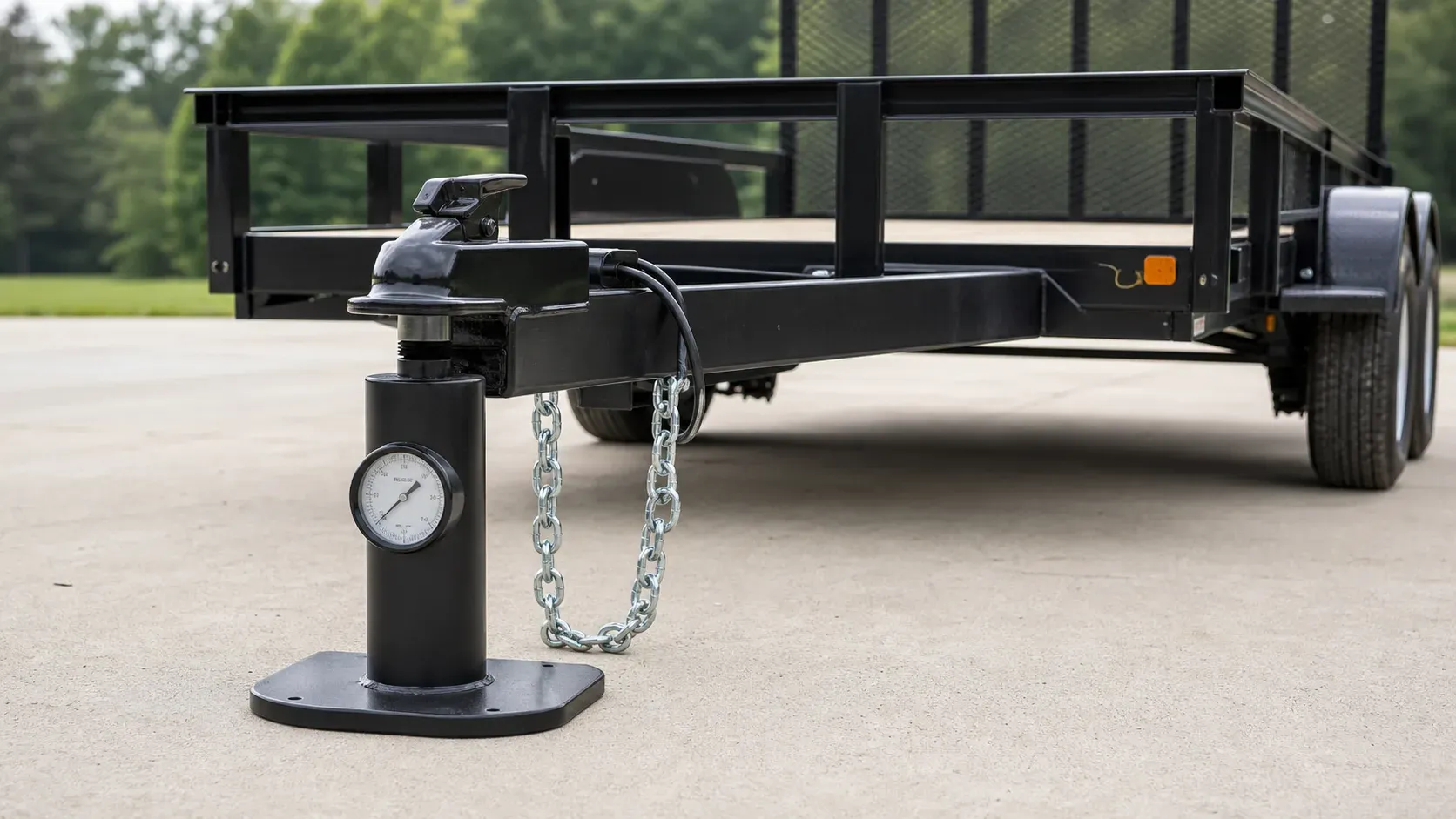
Tongue weight is the share of the trailer's weight that presses down on the hitch instead of riding the trailer's axles, and it's set entirely by where the load sits relative to those axles. Cargo forward of the axles adds tongue weight, cargo behind them subtracts it, and that balance is the single most consequential number in how the combination behaves at speed.
The percentages are the working law. Bumper-pull trailers want 10-to-15 percent of loaded weight on the ball, so a 10,000-pound trailer carries 1,000-to-1,500 pounds of tongue. Goosenecks and fifth wheels run 15-to-25 percent on the pin, the bed connection carrying a share the receiver never could. The bands come from stability physics, not preference, and both ends of each band are enforced by the highway.
Where the weight goes matters as much as the number, because tongue weight spends the truck's payload, the arithmetic that page runs in full. The two pages are one lesson. The trailer's balance sets the force, and the truck's placard absorbs it or doesn't.
Sway, squat, and the two failure directions
Too little tongue weight is the dangerous direction. A tail-heavy trailer pivots around its axles like a pendulum, small steering and wind inputs amplify instead of damp, and the result is sway, the oscillation that starts polite and builds until it owns the lane. It lives under 10 percent, it arrives at highway speed rather than in the driveway, and the classic causes are rear-loaded cargo, per every loading page on this site, and the long-load overhang creep that migrates balance rearward without your noticing.
Too much is the slower failure. Excess tongue squats the truck's rear, unloads its steering axle, lengthens stops, points the headlights at the trees, and overloads the rear axle and tires the payload placard was protecting. Above 15 percent the bumper-pull combination steers progressively worse, and the weight-distribution hitch exists to civilize the legitimate top of the band, never to license exceeding it.
The gooseneck's wider band is a gift of geometry. Pin weight rides over the truck's rear axle rather than levering behind it, per the comparison, which is why heavy trailers moved to the bed in the first place.
Measuring and setting it
Measuring ranks by accuracy. A truck scale does it definitively, weigh the truck alone, then hitched with the trailer's axles off the scale, and the difference is tongue weight, five minutes and a few dollars. A tongue-weight scale under the coupler reads it directly in the driveway, worth owning at the heavy classes. The bathroom-scale lever trick works for light trailers, with the beam math printed on a hundred forum posts. The eyeball method, watching the truck's squat, catches gross errors and misses the fine ones, so calibrate it against a real measurement once.
Setting it is a loading habit, not a purchase. Put heavy cargo forward of the trailer's axles as the default, the 60-40 front bias rule serving most decks, park machines at the deck mark found once and painted, per every equipment page's procedure, and mind long material for the rear-overhang creep that subtracts tongue silently. Re-check water, fuel, and shifting loads, because tongue weight is a property of this load, not the trailer.
The adjustment tools rank in order. Move the cargo, and for most owners that's the whole list. Adjustable couplers and repositioned accessories fine-tune the rest. A trailer that can't reach its band with sensible loading was sized or specced wrong, a conversation for its class page rather than the scale house.
Tongue weight FAQ
What should my tongue weight be?
Ten-to-15 percent of the loaded trailer's weight for bumper-pulls, 15-to-25 percent pin weight for goosenecks. A loaded 8,000-pound bumper-pull wants 800-to-1,200 pounds on the ball.
What happens if tongue weight is too light?
Sway, the pendulum oscillation that arrives at highway speed and builds. It's the dangerous direction, and rear-heavy loading is almost always the cause.
What happens if it's too heavy?
Rear squat, light steering, longer stops, and an overloaded rear axle. It's the slower failure, caught by the placard math and the truck's posture.
How do I actually measure it?
A truck scale, truck alone versus hitched with the trailer's axles off the pad, and the difference is the tongue. Tongue scales and the bathroom-scale lever serve the driveway.
Does tongue weight count against my truck's payload?
Every pound, alongside passengers and cargo, per the payload page. It's usually the biggest single line on the placard's budget.
Can a weight-distribution hitch fix bad tongue weight?
It redistributes legitimate tongue weight for level and control, per its page. It doesn't fix a percentage outside the band, loading does.