How to Find the VIN Number on a Trailer and Read Every Sticker

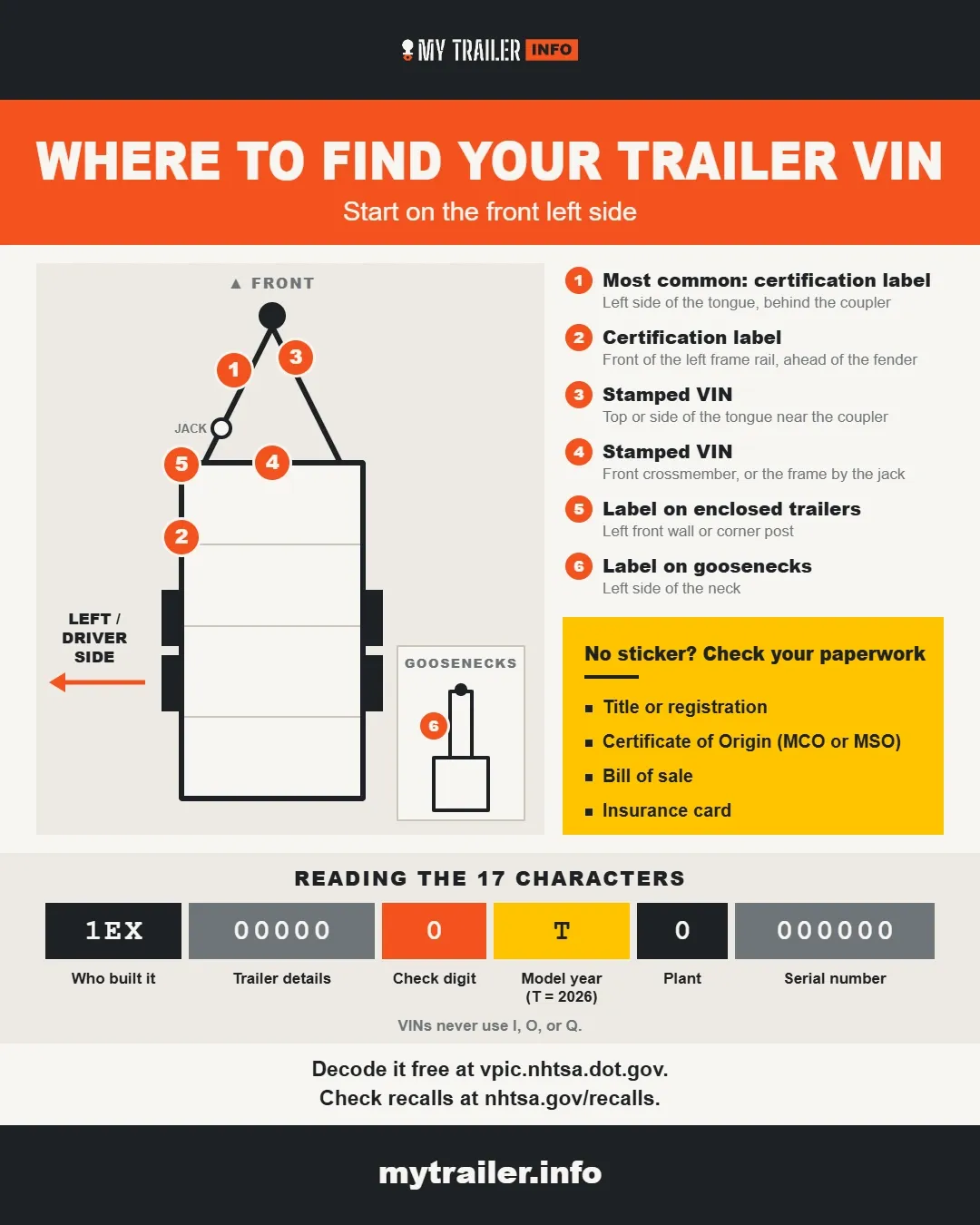
Where to find your trailer VIN
Start on the front left side. The certification label is usually on the tongue or the front of the frame rail, and many builders also stamp the VIN near the coupler. No sticker? The VIN is on your title and paperwork too.
Every location, explained →Tap the chart to open it full size. Save it to your phone for the lot.
Short answer first. Here’s how to find the VIN number on a trailer. On most trailers built for U.S. roads, the VIN is printed on the federal certification label on the front half of the left (driver) side, usually on the tongue or the front of the frame rail. Many builders also stamp the same 17 characters into the tongue or front crossmember. If the sticker is gone, the VIN is also on the title, the registration, and the manufacturer’s certificate of origin.
Have the VIN already? Paste it into our free trailer VIN decoder to see the manufacturer, model year, trailer type, and recalls.
Do trailers have VINs?
Yes. Every trailer built for U.S. roads since the 1981 model year has a 17-character VIN, the same format as cars and trucks. Older trailers may have a shorter serial number instead. Homemade trailers often have no VIN at all, and most states assign one after an inspection before the trailer can be titled.
Where is the VIN on a trailer?
The VIN number on a trailer is always 17 characters, and federal rules require a trailer’s certification label on the forward half of the left side, placed so you can read it from outside the trailer. In practice that puts it in one of a few spots:
- The left side of the tongue, a little behind the coupler. This is the most common spot on utility, dump, equipment, and car hauler trailers.
- The front of the left frame rail, just ahead of the fenders.
- The left side of the neck on gooseneck trailers, near where the neck meets the deck.
Enclosed trailer VIN location
Where is the VIN on an enclosed trailer? On an enclosed cargo trailer, the label is usually on the outside of the left front wall or corner post, low and toward the front. Some builders put it just inside the front of the side door frame, or near the front left marker light. If the outside skin was replaced or wrapped, check the tongue and the front of the frame under the wall for the stamped VIN.
The stamped VIN is a separate thing and its location varies by brand. Check the top or sides of the tongue near the coupler, the front crossmember, and the frame rail behind the jack. Wire-brush rust and paint gently and read it with a flashlight held at a low angle.
If you can’t find either one, look in your paperwork. The VIN is on the title or registration, the Manufacturer’s Certificate (or Statement) of Origin from the dealer, the bill of sale, and your insurance card.
What’s printed on the certification label
The label is the trailer’s birth certificate. Here’s what it shows and why you care.
| Label line | What it means | Why it matters |
|---|---|---|
| Manufacturer | The company that built and certified the trailer | Tells you who to call about warranty and recalls |
| Date of manufacture | Month and year it was built | Can differ from the model year in the VIN |
| GVWR | Gross Vehicle Weight Rating, the most the trailer plus cargo may weigh | Your hard limit. Payload is GVWR minus the empty weight |
| GAWR | Gross Axle Weight Rating for each axle | Shows how much weight each axle, spring, hub, and tire set is rated for |
| Tires and rims | Tire size, rim size, and cold inflation pressure | Run that pressure, cold, before every trip |
| VIN | The 17-character Vehicle Identification Number | Needed to title, register, insure, and check recalls |
| Vehicle type | Usually “TRAILER” | Confirms how it should be titled |
| Compliance statement | A line saying it meets federal safety standards in effect on the build date | Missing or altered labels are a red flag on a used trailer |
GVWR is the number people get wrong most often. A 7,000-pound GVWR trailer that weighs 1,900 pounds empty can carry about 5,100 pounds of cargo, not 7,000. Weigh the empty trailer at a CAT scale or ask the dealer for the empty weight in writing. Our weight and capacity guides walk through the math for each class.
Trailer VIN breakdown, character by character
Here’s the trailer VIN breakdown. Trailer VINs follow the same format as car and truck VINs. They never use the letters I, O, or Q, because those look too much like 1 and 0.
- Characters 1 to 3, World Manufacturer Identifier. Who built it and where. Smaller builders that make fewer than 1,000 vehicles a year use a 9 as the third character, and characters 12 to 14 finish their ID.
- Characters 4 to 8, trailer details. Each manufacturer sets its own code here, usually type, length, axle count, or body style.
- Character 9, check digit. A math check that catches typos and fake VINs. If a decoder says the check digit is wrong, re-read the plate before you buy.
- Character 10, model year. For example, R is 2024, S is 2025, T is 2026, and V is 2027.
- Character 11, plant. The factory that built it.
- Characters 12 to 17, serial number. The trailer’s own production number.
Free trailer VIN decoder and recall check
You don’t need a paid trailer VIN decoder to get the basics.
- Decode it. Use our free trailer VIN decoder, or enter the VIN in NHTSA’s free decoder at vpic.nhtsa.dot.gov/decoder. It works as a free trailer VIN number decoder and returns the manufacturer, model year, plant, and whatever trailer details the builder reported.
- Check recalls. Enter the VIN at nhtsa.gov/recalls. Trailer recalls are common for axles, couplers, tires, brakes, and wiring. Some small builders don’t support VIN lookup there, so also search by make and year.
- Check theft and title records before buying used. The free NICB VINCheck shows reported thefts. Your state DMV can confirm whether the title is clean.
Other stickers and stamps worth reading
The certification label isn’t the only rating on the trailer. Each part has its own, and the lowest rating in the chain is the real limit.
- Coupler. Stamped or labeled with its ball size and rating, for example “2-5/16 in. 14,000 lb.” It must match the ball on your truck.
- Safety chains. Rated chains carry a tag or have a grade stamped into the links. Their rating should at least match the trailer’s GVWR.
- Axles. Most have a tag or sticker on the tube with the axle maker, capacity, and serial number. That’s how you order the right hubs, bearings, and brake parts.
- Tires. The sidewall shows load range, maximum load, and maximum pressure. The last four digits of the DOT code are the build week and year, so “2124” means week 21 of 2024. Trailer tires usually age out before they wear out.
- Jack. The tongue jack has its own lift rating and should handle the loaded tongue weight.
- Brakes and breakaway. Electric brake trailers usually have a breakaway battery box with its own label. Hydraulic surge couplers list their rating on the actuator.
- Ramps and winches. Car haulers and equipment trailers often rate ramps per pair. Don’t assume ramps carry the full GVWR.
When the label is missing or doesn’t match
Labels peel, fade, and get painted over. If the trailer is yours and the stamped VIN or paperwork is intact, contact the manufacturer with the VIN and proof of ownership. Many will send a replacement label.
On a used trailer for sale, a missing, damaged, or mismatched label is a reason to slow down. Make sure the VIN on the trailer, the title, and the seller’s ID all line up before money changes hands. Homemade trailers and trailers with no VIN usually need a state inspection to get an assigned VIN. The process differs by state, so check with your DMV first.
The quick checklist
- Find the label on the front left side and take a photo of it the day you buy.
- Write down the VIN, GVWR, each GAWR, and the tire pressure.
- Decode the VIN and run a recall check.
- Check the coupler, chains, axles, tires, and jack ratings. The lowest one wins.
- Keep the certificate of origin or title somewhere safer than the glovebox.
Shopping for a new trailer instead? Our buying guides cover what to check on the label before you sign.