Dump Trailer Hydraulics, Without the Sales Pitch

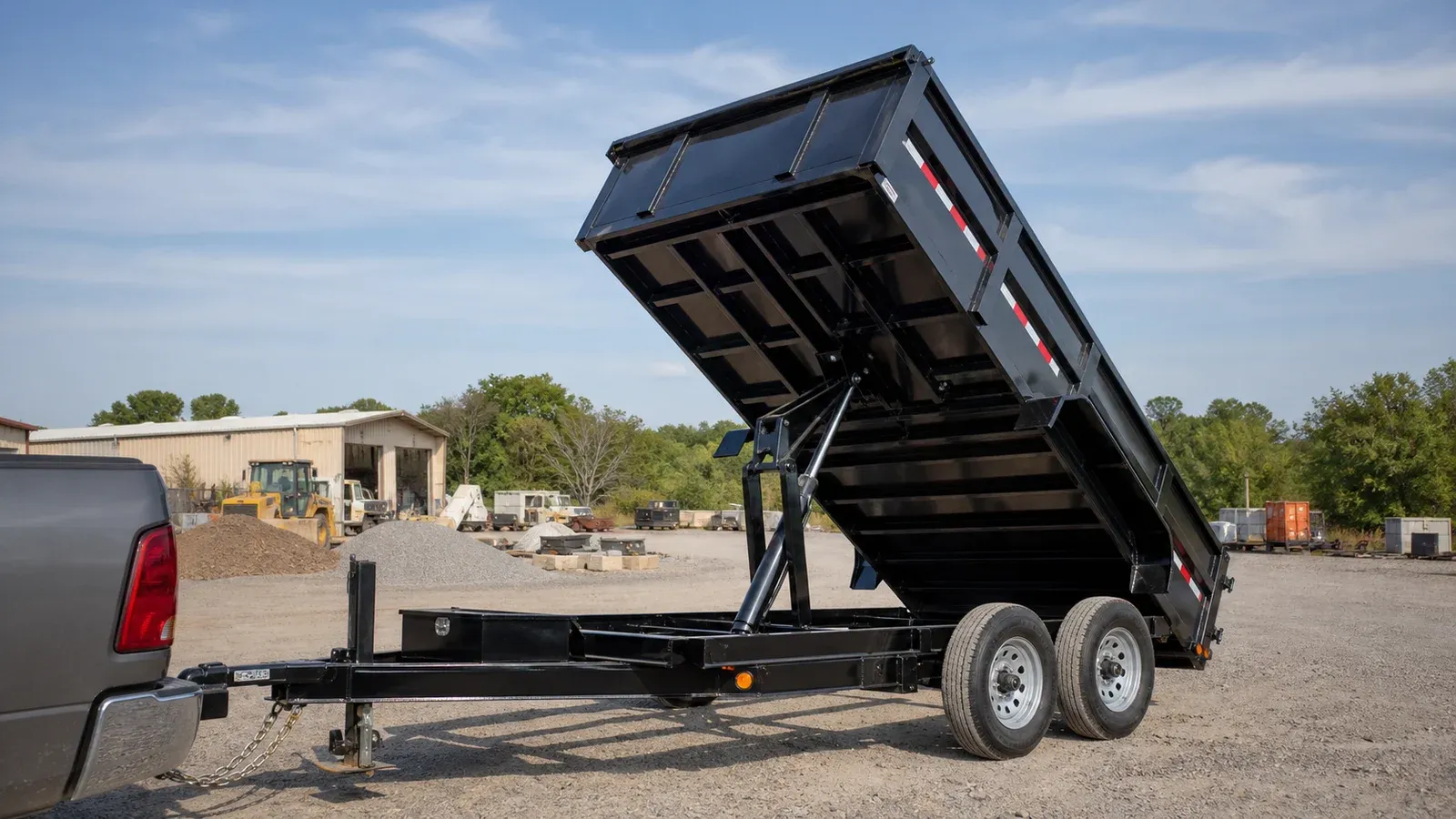
The best dump trailer hydraulic system is not simply the one with the most cylinders. It is the one with sound lift geometry, enough cylinder force, a properly sized pump and battery, protected hoses, strong hinge points, and a mechanical bed prop you can trust.
For most buyers moving gravel, soil, roofing, or demolition debris, a well-built scissor lift is a dependable all-around choice. A good direct-push system can work just as well when its geometry matches the bed and load rating. The badge on the cylinder tells you less than the engineering around it.
That is the short answer. Now let’s look under the bed, where the expensive answers live.
What is actually doing the lifting
A dump trailer lift is a chain of parts, and every link has to cooperate:
- The battery supplies current to the electric motor.
- The motor turns the hydraulic pump.
- The pump moves fluid from the reservoir through the control valve.
- Pressurized fluid extends the cylinder or cylinders.
- The lift structure transfers that force into the bed.
- The rear hinge lets the bed rotate to its dump angle.
The system has its hardest job near the beginning of the lift. At that point, the bed is nearly horizontal and the load has poor mechanical leverage. A trailer that raises an empty bed on a dealer lot has not proved much. You want to know how the system behaves near its rated payload, with the load placed correctly.
System pressure, cylinder bore, cylinder angle, mounting location, and bed geometry all affect lifting force. That is why comparing trailers by cylinder count alone is about as useful as comparing trucks by cupholder count.
The common lift systems
Scissor lift
A hydraulic cylinder opens a hinged steel framework under the center portion of the bed. The linkage changes the cylinder’s force and helps keep the push centered.
Scissor systems are popular because good designs provide strong breakaway force at the start of the lift and resist side loading better than poorly arranged direct-push systems. They are a sensible fit for dense material and routine commercial use.
Do not assume every scissor is equal. Look at the thickness of the linkage plates, the size of the pivot pins, weld access, grease points, and how broadly the assembly transfers load into the frame. A stout cylinder attached to light brackets is still a light system.
Direct-push single ram
A single cylinder pushes directly against the bed, usually from a central mounting point. These systems are simple, have fewer pivot points, and can be very effective when the cylinder angle and mounting geometry are right.
The weak version starts with the cylinder lying too flat. That makes it work brutally hard during the first few inches of travel. The strong version uses thoughtful mounting geometry, adequate cylinder bore, reinforced brackets, and a bed designed to accept the concentrated force.
If you are choosing between these two designs, read our full single-ram vs. scissor-lift comparison. The useful question is not which name wins. It is which complete system is better built for the trailer’s rated load.
Dual ram
Two cylinders push the bed from separate mounting points. This layout can distribute lifting force, but the bed and frame must be rigid enough to keep both sides aligned. An uneven load, a twisted bed, trapped air, or unequal cylinder performance can make one side lead the other.
Inspect the cylinder mounts and the crossmembers around them. Look for gussets, clean welds, and enough structure to handle repeated cycles. Dual cylinders do not automatically mean twice the strength. They do mean twice as many rods, seals, hoses, and mounting points to inspect.
Telescopic cylinder
A telescopic cylinder uses nested stages to create a long stroke from a compact retracted package. It is commonly mounted near the front of the bed and can support a steep dump angle, which helps release sticky material.
Telescopic designs can be excellent, especially on larger trailers, but they deserve careful inspection. Check that the extended stages are protected from impact and contamination. Ask whether replacement seals and cylinder service are available locally. Long reach is useful. Long waits for a proprietary part are not.
The power unit matters as much as the lift
Most compact dump trailers use a 12-volt electric-over-hydraulic power unit. The motor draws substantial current during a lift, especially when the load first breaks free. Weak voltage makes the motor slow down, increases heat, and can produce the familiar click-with-no-lift routine.
Look for a true deep-cycle or dual-purpose battery sized to the manufacturer’s requirements. The battery should be secured in a ventilated, weather-resistant box, with heavy cables, clean crimped terminals, and a short, solid ground path. Electricity is not impressed by the logo on the fender.
A charge wire from the tow vehicle helps replace energy between dumps, but it is not a substitute for charging the battery properly. The truck connector and wiring may provide only modest current. If the trailer works several cycles in a day, plan to monitor state of charge and use an appropriate charger between workdays.
Inspect the breakaway battery arrangement too. Some trailers use a separate small battery, while others integrate functions differently. Either way, the emergency brake system must remain functional even after repeated dump cycles. Our trailer wiring and connector guide covers the truck-to-trailer side of the system.
Five specifications worth asking for
Dealers do not always publish the numbers, but these questions quickly separate a useful conversation from brochure reading.
1. Cylinder bore, rod diameter, and stroke
The bore helps determine how much pushing force the cylinder can produce at a given pressure. Rod diameter affects strength and resistance to bending. Stroke determines how far the mechanism can travel. None of the three should be judged alone because lift geometry changes the result at the bed.
2. Pump pressure and relief setting
The relief valve protects the system by limiting pressure. A seller should not suggest turning it up to make an overloaded trailer lift. That trades one obvious problem for damaged hoses, seals, mounts, or frame members.
3. Reservoir capacity and fluid specification
The reservoir must hold enough fluid for the cylinder volume while allowing for expansion, cooling, and proper pickup. Ask which hydraulic fluid the manufacturer specifies for your climate. Mixing random fluids because both containers say hydraulic is avoidable trouble.
4. Maximum dump angle
Dump angle affects how readily material slides. Dry gravel releases more easily than wet clay, compacted soil, mulch, or frozen debris. A steeper angle helps, but a smooth bed floor, sensible sidewall shape, and correct load placement matter too.
5. Duty cycle and expected dumps per charge
Treat any fixed dumps-per-charge claim carefully. Battery condition, temperature, load weight, lift time, wiring resistance, and charging between cycles change the answer. Ask what battery was used for the estimate and under what test conditions.
A 10-minute dealer-lot inspection
Bring a flashlight. Nice paint is visible from across the lot. The parts you need to inspect are underneath it.
- Start at the rear hinge. Look for substantial pins, proper retention, grease fittings, and solid attachment to the frame. Check whether both sides appear aligned.
- Follow the load path. Trace the cylinder or scissor mounts into the crossmembers and main frame rails. Look for gussets and broad reinforcement, not a small tab carrying a large load.
- Inspect every hose. Hoses should not rub sharp steel, pinch through the lift cycle, hang below the frame, or sit where dumped material can strike them.
- Check cylinder rods. The polished surfaces should be straight, smooth, clean, and free of rust, pitting, or wrench marks.
- Open the power-unit box. Check battery restraint, terminal covers, cable size, corrosion protection, fuse or circuit protection, and whether service items are reachable.
- Find the bed prop. Confirm there is a positive mechanical support for maintenance and that it can be engaged without placing your body under an unsupported bed.
- Cycle the empty bed. Listen for pump tone changes, chatter, scraping, and hard contact. Watch the hoses and cables through the full movement.
- Lower it slowly. The bed should descend smoothly and seat squarely. A violent drop, repeated jerking, or one side arriving first deserves an explanation.
Ask the dealer to demonstrate the safety prop and the correct fluid-check procedure. If nobody can find the prop, that is useful information before the sale.
What common symptoms usually mean
Hydraulic symptoms overlap, so diagnose before buying parts. Start with voltage and basic inspection because they are fast, cheap, and responsible for a remarkable amount of drama.
| Symptom | Likely places to check first |
|---|---|
| Solenoid clicks but bed does not rise | Battery voltage under load, loose or corroded terminals, ground connection, solenoid contacts |
| Motor runs slowly or changes pitch | Weak battery, voltage drop in cables, poor ground, excessive load, pump strain |
| Bed rises empty but stalls when loaded | Low voltage, overload, poor load placement, relief valve opening, worn pump, lift geometry problem |
| Bed moves in jerks | Low fluid, air in the system, restricted pickup, mechanical binding, contaminated fluid |
| Bed creeps down while held up | Control valve leakage, cylinder seal bypass, external leak, connection problem |
| One side leads on a dual-ram system | Uneven load, frame or bed twist, air, binding pivot, cylinder or hose-flow difference |
| Fluid appears around the rod | Damaged rod seal, pitted rod, contamination, side load on the cylinder |
Never troubleshoot beneath a raised bed supported only by hydraulic pressure. Lower it fully or engage the manufacturer’s mechanical bed prop on firm, level ground. A control valve is not a jack stand.
Load placement changes everything
Hydraulics cannot rescue a badly loaded or overloaded trailer. Dense material can reach the trailer’s payload limit long before the bed looks full. Know the empty trailer weight, GVWR, legal payload, axle ratings, tire ratings, and coupler rating before loading.
Keep the load centered side to side. Follow the manufacturer’s guidance for front-to-rear placement so the trailer maintains proper tongue weight without putting unnecessary demand on the lift. Avoid dropping large chunks from height onto the bed floor or lift structure.
If the bed will not start with a known legal load, stop. Do not have someone stand on a fender, bump the control repeatedly, or raise system pressure. Verify the load, battery voltage, connections, and manufacturer procedure. Read the broader dump trailer guide for payload, construction, towing, and loading details.
A maintenance routine that prevents surprises
Before each workday
- Check for fresh fluid beneath the trailer and inside the power-unit box.
- Inspect visible hoses, fittings, cylinder rods, pins, and retainers.
- Confirm the battery is charged and its terminals are tight.
- Test the controls with the bed empty.
- Make sure the mechanical bed prop is present and usable.
Every month during regular use
- Grease the hinge and lift pivots at the intervals in the owner’s manual.
- Check cable routing, terminal corrosion, battery restraint, and the charging connection.
- Inspect hoses through the complete lift cycle for rubbing or pinching.
- Check hydraulic fluid using the manufacturer’s procedure, usually with the bed fully lowered.
- Examine mounting brackets and nearby welds for cracking, distortion, or fresh rust lines.
Seasonally or before heavy use
Load-test the battery, inspect the pump and valve connections, and check the fluid condition. Milky fluid may indicate water contamination. Dark fluid or a burnt smell can indicate heat or contamination. Follow the manufacturer’s service interval rather than inventing one from internet folklore.
Cold weather can thicken fluid and expose a marginal battery. If the trailer works through winter, use only the approved fluid and keep the battery fully charged. Do not thin hydraulic fluid with a homebrew mixture.
Questions to ask before buying
- What is the lift design, cylinder size, system pressure, and maximum dump angle?
- What battery size and type does the manufacturer require?
- Is a battery charger included, and how does the tow vehicle charge line connect?
- Where are the pump, valve, cylinder, hoses, and seals sourced?
- Can the dealer service the power unit and rebuild or replace the cylinder?
- Which parts are covered under the structural and component warranties?
- Does the trailer include a mechanical bed prop, remote control, and protected hose routing?
- May I see the owner’s manual and hydraulic schematic before purchase?
The final question is particularly revealing. A serviceable trailer comes with information that lets someone service it.
Sparks’ decision rule
For frequent dense loads, start by comparing well-reinforced scissor systems with properly engineered direct-push designs. For sticky loads or applications that benefit from a steep dump angle, give telescopic systems a close look. For dual-ram trailers, pay special attention to frame stiffness, cylinder alignment, and load balance.
Then ignore the cylinder count for five minutes. Inspect the battery, cables, hose routing, rear hinge, mounting structure, parts availability, and bed prop. Those details will tell you more about ownership than a polished cylinder ever will.
Use our dump trailer buying guide to compare the rest of the trailer, and get the price in writing with the battery, charger, tarp, remote, spare tire, and delivery included. Hydraulics are only one line on the quote, but they have a habit of becoming the whole afternoon when corners were cut.