Single-Ram vs. Scissor-Lift Dump Trailers. Which Lift to Buy.

The scissor lift pushes strong, steady force through the whole stroke and forgives heavy, wet, off-center loads. The single ram costs less, runs simpler, and tips to a steeper dump angle, but it's the first to stall when loads get heavy and lopsided. Under 10K with even loads, take the ram and keep the money. In the 14K working class, take the scissor. The market already did.
Ram vs. scissor at a glance
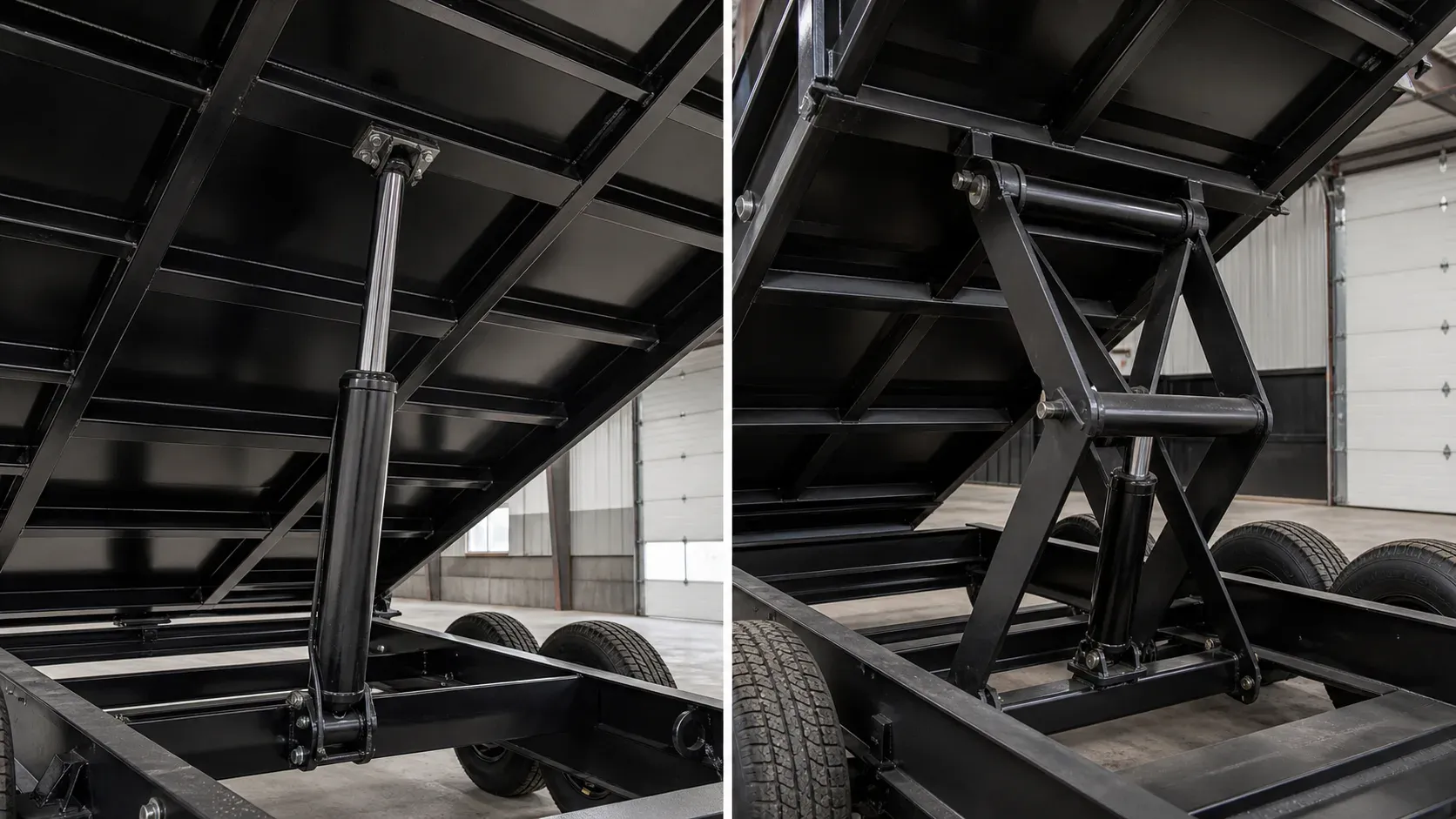
| Single Ram | Scissor Lift | |
|---|---|---|
| Mechanism | One telescopic cylinder, front-mounted | Folding steel arms, one cylinder |
| Force through stroke | Strong start, weak mid-lift | Strong and flat throughout |
| Off-center loads | Twists, struggles | Cradled, forgiven |
| Max dump angle | Steeper, sheds sticky loads | Slightly shallower |
| Price | The baseline | A real premium |
| Empty weight | Lighter | A couple hundred pounds more |
| Wear points | Stage seals, few pins | Many pivot pins, easy cylinder |
Both lifts do the same job on the same dump trailers, and both are proven across millions of cycles. The difference is geometry, where the force comes from and where it goes, and that decides which loads each one handles gracefully. The single-ram page and scissor page go deep on each mechanism. This page just referees.
Simple, steep, and cheaper
The ram's first argument is price. One telescopic cylinder is cheaper than a fabricated steel mechanism, and the savings is real in every class where both are offered. In the light classes, the scissor buys capability those loads never touch. A 6x10 hauling mulch and yard debris will never find a ram's limits, and paying the scissor premium there is just charity to the dealer.
The second is the angle. Telescopic stages keep extending, so single-ram beds commonly tip steeper than a scissor can reach. That matters when the load is wet clay, packed leaves, or anything else that grips the floor. A steep ram sheds loads a shallow lift holds, and the brake-bump trick every dump owner knows lives mostly on the shallow side of this comparison.
Third is simplicity. Fewer pins, one mechanism, and a wear list short enough to memorize: keep the chrome stages clean, the fluid fresh, and the base pins greased. When something acts up, the diagnosis is quick too.
The other side of the ledger. Mid-lift is the ram's hard mile, where the geometry works its worst angles while the bed is still heavy, and marginal loads stall right there. Off-center weight is the second weakness, since one lifting point lets lopsided loads twist the box, and real loader operators pile loads lopsided all day. The ram forgives neither the way a scissor does.
Force where the work is
The scissor's argument is the force curve. The folding arms deliver their best leverage at the bottom of the stroke, right where the full bed weighs the most, and they hold that force flat through the lift. The mid-stroke stall that defines the ram's limit just isn't part of how a scissor works, and for heavy, wet, working loads that reliability is the whole product.
The second is the cradle. Centered arms spread the force across the frame, so off-center loads, rear-heavy loads, and the general sloppiness of production loading get absorbed instead of amplified. Contractors don't supervise every bucket, and the scissor doesn't need them to.
Third is the cylinder's easy life. It's short and straight, tucked inside the mechanism, with fewer seal surfaces than a telescopic stack and better working angles. The pin set inherits the maintenance instead, with more pivots to grease on schedule. Call it an even trade that favors whoever actually greases.
The costs are real. The premium is real money, and the mechanism's steel is real payload, a couple hundred pounds off the payload math. The slightly shallower maximum angle occasionally leaves the stickiest clay wanting a brake bump a tall ram wouldn't need.
Which lift you actually need
Take the ram below 10,000 pounds GVWR with predictable, evenly loaded material. Think homeowner and light-trade compact dumps, mulch-and-debris duty, and budgets that would rather keep thousands in pocket than hold capability in reserve. The market ships these classes with rams as standard because the match is honest.
Take the scissor in the 14K working class and up, or anywhere heavy, wet, off-center loading is the daily reality. That means contractors, gravel and dirt volume, loader-filled boxes, and any bed that regularly leaves the pit heavier than planned. The class ships scissor-standard because a generation of stalled rams settled the argument.
If you're genuinely split, mid-size trailer, mixed loads, weigh two questions. Who loads it, careful you or a hurried operator? And what's the wettest thing it'll carry in a given month? Careless loading and wet material both point to the scissor. Either way, commit to the battery, pump, and hinge maintenance habit, because the lift style matters less than the power system running it.
Ram vs. scissor FAQ
Which lifts more weight?
Spec'd properly, both lift their rated box. The scissor delivers force more evenly through the stroke, so at the margins, heavy, wet, off-center, it works where the ram stalls mid-lift.
Which dumps at a steeper angle?
Usually the telescopic ram, since its stages keep extending past scissor geometry. That difference matters for the stickiest loads and little else.
How much more does the scissor cost?
A meaningful premium where both are offered, and it varies by builder and class. In the 14K class it's usually standard and already priced in.
Which needs more maintenance?
Different lists, similar effort. The ram wants clean stages and fresh fluid, and the scissor wants its pivot pins greased on schedule. Neglect punishes both.
Can I upgrade a ram trailer to a scissor later?
Not practically. The mounts and geometry differ structurally. Buy the lift for the loads you'll have, not the ones you have this month.
Does lift type change the truck requirement?
No, the class does. Same GVWR and the same truck math either way, though the scissor costs you a little payload.