What Can a Three-Quarter-Ton Truck Tow?

The three-quarter-ton is the working trailer world's honest truck, 2,800 to 3,600 pounds of payload carrying the 14,000-pound trailer class's tongue with margin, and tow ratings of 14,000 to 20,000 that the placard actually backs. It's the right answer for the 10K-to-14K tier the half-ton only advertises, and the light-gooseneck gateway before pin weights start demanding the one-ton.
The working tier's honest truck
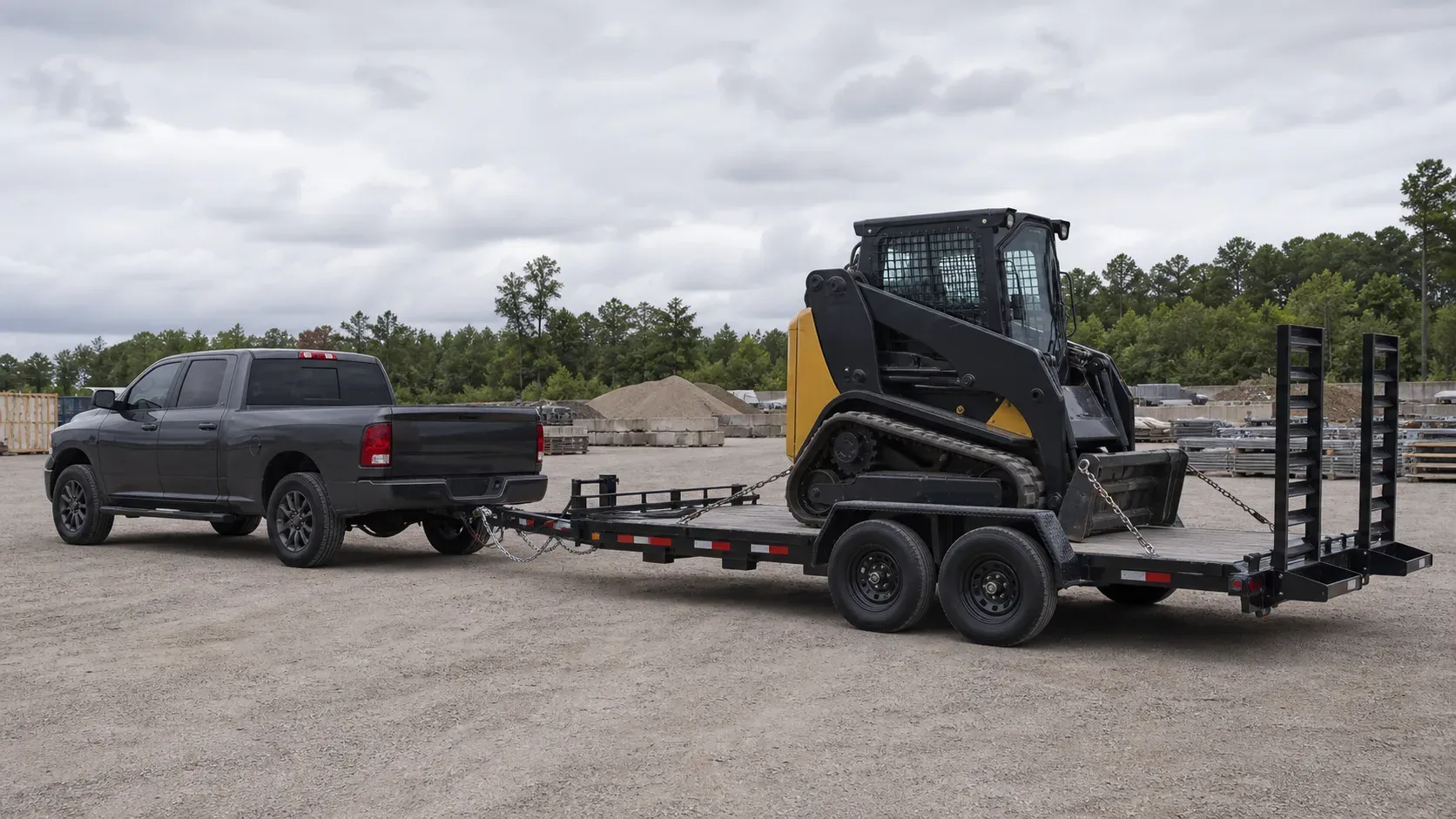
The three-quarter-ton, F-250, Ram 2500, Silverado and Sierra 2500HD, is where truck arithmetic stops being aspirational. Payload placards run 2,800 to 3,600 pounds on common configurations, more on gas work trims, and the payload math that embarrasses half-ton brochures clears honestly here. A 3,200-pound placard minus life's 600 leaves a 2,600-pound tongue budget, which at the band's midpoint carries the 14K trailer class loaded, with margin.
The diesel question is the class's fork. The diesel option buys torque, exhaust braking, and the 18,000 to 20,000-pound tow ratings, and it costs a purchase premium plus 700-ish pounds of its own weight straight off the payload placard. Heavy bumper-pull work often favors the gas engine's payload, heavy gooseneck aspiration favors diesel's pull, and the buyer hauling grades daily stops debating at the first long descent behind an exhaust brake.
Trailers the class honestly serves
| Trailer | Loaded Reality | The Verdict |
|---|---|---|
| Equipment, 14K | 12,000 to 14,000 lb | The classic partnership |
| Dump, 14K | 12,500 to 14,000 lb | The contractor standard |
| Flatbed, heavy-duty | 12,000 to 16,000 lb | The class's daily work |
| Deckover, bumper-pull | 12,000 to 15,000 lb | Honest with the WD hitch |
| Car hauler, 9,900 | 8,500 to 9,900 lb | Easy money |
| Gooseneck, light classes | 14,000 to 16,000 lb | The edge, placard-checked |
| Gooseneck, working classes | 18,000 to 25,900 lb | The one-ton's job |
The class owns the 10K-to-14K bumper-pull tier outright, and every trailer this site calls the working standard partners here by design. The gooseneck edge is real but narrow. The lightest neck classes clear on strong placards, then pin weights at 15 to 25 percent devour the budget fast, the arithmetic that built the one-ton market.
Working-class towing habits
The equipment stack is assumed at this tier. An integrated brake controller tuned per load, the weight-distribution hitch at the 14K class's tops for level and steering, mirrors covering the 102-inch decks, and the 7-pin wiring maintained like the brake circuit it is.
The class's habits are commercial whether the paperwork is or not. Pull scale tickets on new loads, set tongue weight by deck position and verify it, mind combined ratings as 14K trailers behind 10K trucks approach the 26,000-pound line where the rules change, and run maintenance on the working calendar, brakes, bearings, and rubber as line items. A truck that works daily gets serviced like it.
Three-quarter-ton FAQ
Can a three-quarter-ton pull a 14K trailer?
Yes. It's the class's defining partnership, 1,400 to 2,100 pounds of tongue inside a 2,600-plus budget with margin for the crew and tools.
Can it pull a gooseneck?
The lightest classes, 14 to 16K, on strong placards with the math run honestly. Working goosenecks' pin weights want the one-ton, usually quickly.
Gas or diesel?
Gas keeps 700 pounds of payload and the purchase difference. Diesel buys torque, exhaust braking, and the top tow ratings. Heavy bumper-pull leans gas, gooseneck ambition leans diesel.
Do I need a CDL with a 14K trailer?
Personal use, generally no. Commercial combinations crossing 26,000 combined pounds meet the CDL math, and a 14K trailer behind a 10K-plus truck gets close. The rules run it.
Is the class overkill for a 7K trailer?
It tows one without noticing, at fuel and ride costs the half-ton doesn't charge. Buy the class the loads need, not the one the forum admires.
What's the real-world payload?
The door jamb of the actual truck, commonly 2,800 to 3,600 pounds, diesel and luxury trims at the low end, gas work trims at the top.