Towing Mirrors Explained.

Towing mirrors exist because a trailer wider than the truck erases the stock mirrors' rearward view, and most states require a view of the highway at least 200 feet behind. Factory extendable tow mirrors are the right answer on trucks that offer them, clip-on extensions serve everything else, and any 8.5-foot trailer behind a standard truck needs one or the other. Cheap equipment, big blind spot.
The width math behind the mirror law
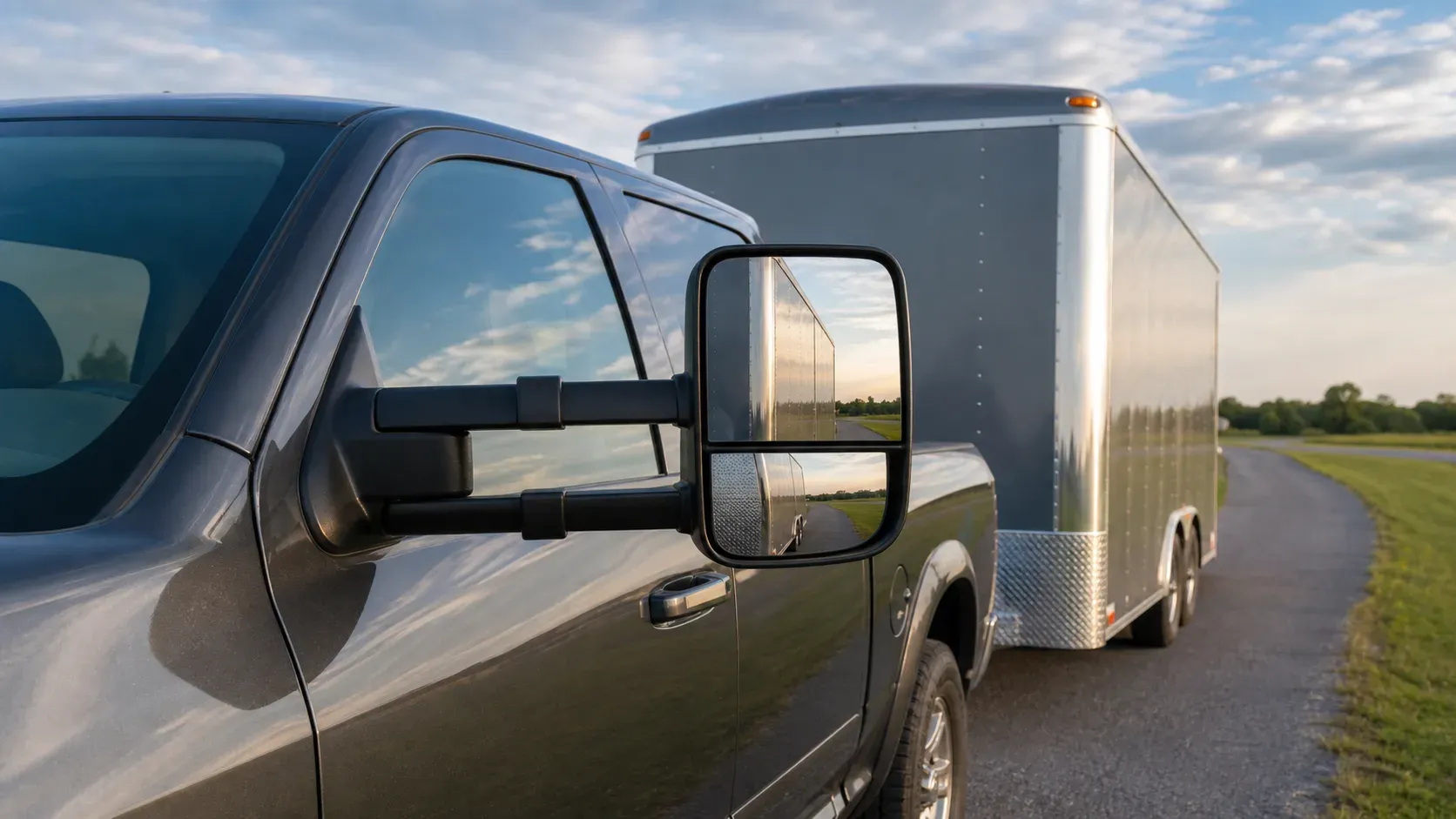
The geometry is simple and unforgiving. Stock mirrors sight down the truck's flanks, so a trailer wider than the truck fills that sightline with its own front corners. Everything beside and behind the trailer, the passing car, the merging motorcycle, the lane you're about to take, lives in a blind wedge that grows with trailer length. An 8.5-foot enclosed trailer or 102-inch deckover behind a truck with 6.5-foot mirrors is the full version of the problem, and even 7-foot utility boxes trim the view meaningfully.
The law backs the physics. Most states require towing drivers to keep a rearward view of the highway, commonly phrased as 200 feet behind, by mirror or extension when the load blocks the interior view, per the rules, and the enclosed and wide-deck worlds meet the letter of the requirement only with equipment. The citation is minor, but the merge it prevents isn't.
Extendable, clip-on, and setup
Factory extendable tow mirrors are the class's right answer where offered. The truck's own mirrors telescope outboard on demand, powered, heated, with the turn signals and blind-spot sensors intact, then retract to civilian width at the car wash. They're standard on HD trims and optional on most half-tons, and worth ordering on any truck that will tow wide, since the retrofit costs multiples of the option box.
Clip-on extensions serve everything else. These are spring-clamp or strap-mounted auxiliary mirrors that ride the stock glass, tensioned per their instructions and checked at fuel stops because vibration loosens what installation tightened. Quality tracks price honestly, and the wobbling bargain teaches its lesson at 70 mph, while strap-plus-clamp designs hold where pure spring clips walk. Suction and door-mount variants fill the gaps for SUVs whose mirror housings refuse clamps.
Setup is the same for both. The inboard glass holds the trailer's flank as reference, and the outboard extension or convex spot covers the lane beside the trailer. Adjust it hitched and loaded, because the trailer's actual width is the target, and the wide-trailer notes on the SUV and half-ton pages all land here. Convex spotters read closer-than-they-appear as always, so calibrate them mentally with a parked walk-around before the highway gives you the quiz.
Towing mirror FAQ
Are towing mirrors legally required?
When the trailer blocks the rearward view, most states require restoring it, commonly to 200 feet behind, by mirror or extension. Wide trailers meet the requirement only with equipment.
Do I need them for my trailer?
For anything wider than the truck's mirror span, every 8.5-foot enclosed and 102-inch deck absolutely, 7-foot boxes usually, narrow utility trailers rarely.
Factory tow mirrors or clip-ons?
Factory extendables where the truck offers them, integrated and retractable. Clip-ons serve everything else at a tenth the cost, bought at the quality tier that doesn't wobble.
Why do clip-on mirrors shake?
Tension and quality, spring clips loosening under vibration. Strap-reinforced designs hold, and every design gets re-checked at fuel stops.
How should towing mirrors be aimed?
Hitched and loaded, with the inboard glass referencing the trailer's flank and the outboard covering the adjacent lane, convex spotters calibrated with a parked walk-around.
Do camera systems replace mirrors?
They supplement brilliantly, since a trailer-mounted rear camera deletes the reverse blind spot, but the mirror law still reads mirrors in most states. Both is the modern answer.