Enclosed Cargo Trailers. The Complete Guide.

An enclosed cargo trailer is a fully walled and roofed trailer that protects whatever's inside from weather, road grime, and other people's curiosity. It's the right buy when the load needs security, protection, or a mobile workspace. Pick by interior dimensions, frame material, door style, and payload, in that order.
What an enclosed cargo trailer actually is
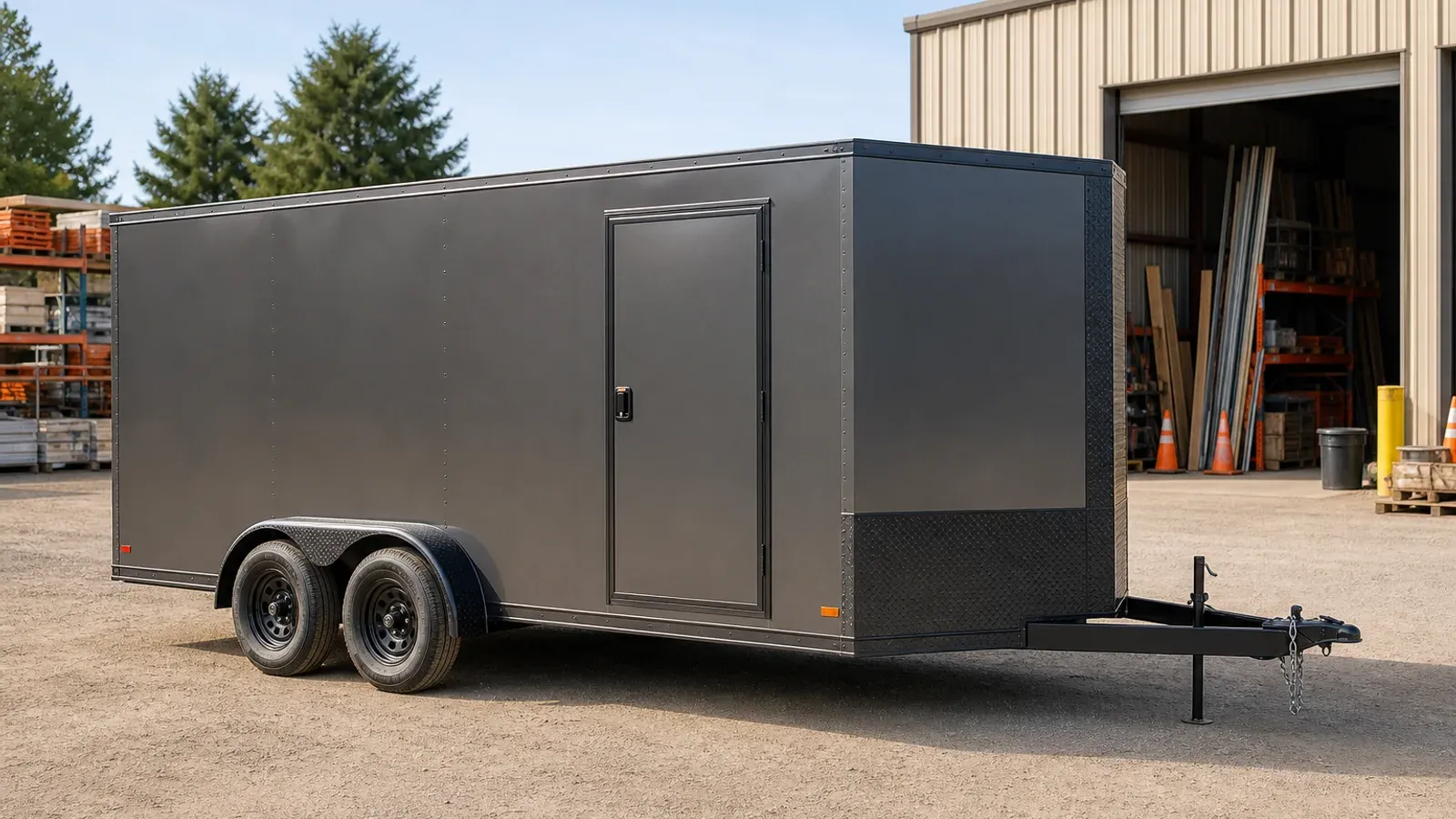
An enclosed cargo trailer is a box on axles, with walls, a roof, a rear door, usually a side door, and a floor rated for whatever rolls or stacks inside. The box is the whole point. Everything an open trailer exposes, weather, theft, road spray, prying eyes, the enclosed trailer shuts out, for a price in money, weight, and wind resistance.
That box serves three different masters. Haulers use it to move things that can't get wet or walk away, tools, furniture, freight, motorcycles, race cars. Trades use it as a rolling shop, the contractor build with shelving, lighting, and power. And mobile businesses use it as the business itself, concession trailers being the biggest category. Same box, three economies.
The vocabulary is quick. The nose is either a V-nose, angled for a little aerodynamics and storage geometry, or a flat front, simpler and boxier. The frame is steel or aluminum, the single biggest fork in the buying road. The rear door is a ramp or barn doors. And interior height is the spec people forget until the first time they stand up inside wrong.
The buying order that works goes like this. Interior dimensions first, so measure the tallest and longest thing going in. Frame material second, since that's a budget-and-lifetime call. Doors third. Then let payload and axle math confirm the pick against your truck. Buyers who start at the price sign buy a box that almost fits, which is the same as a box that doesn't.
Frames, walls, and the steel vs. aluminum decision
The frame is the skeleton, and the steel versus aluminum decision drives price, weight, and lifespan all at once. Steel frames are cheaper, stronger per dollar, easier to repair anywhere, and heavier, with rust as the lifetime enemy, especially where tubing meets floor. Aluminum frames cost more up front, weigh 15 to 25 percent less, shrug off corrosion, and hand the fuel bill and payload budget a permanent gift. The full comparison runs the numbers, and the short version is that duty and climate decide. Salt states and high-mileage haulers lean aluminum. Budget buyers in dry country do fine with steel.
Wall construction is studs and skin. Wall posts on 16-inch centers beat 24-inch, the same logic as a house. Exterior skin is aluminum sheet, either screwed with visible fasteners or bonded smooth-side. Screwless looks better and seals better, for a price. Inside, a plywood or luan liner protects the frame and gives you something to fasten shelving to. Three-quarter-inch plywood floors are the working standard, and thinner is a corner cut you'll find with a pallet jack.
Doors make or break daily use. A rear ramp door turns the trailer into a drive-in garage and adds spring-assist hardware worth inspecting closely, since it's the most-used moving part on the trailer. Barn doors open flat against the walls, need no rear clearance for a ramp arc, and suit dock loading and tight parking. The comparison is a whole section because it's a genuinely close call. Side doors are near-mandatory, because getting to the front of a packed 20-footer through the rear is a hostage situation.
Ventilation and light round out the shell. Roof vents fight condensation, the silent killer of stored cargo. Interior LED lighting wired to a wall switch beats a flashlight in your teeth. And if the trailer will hold anything with a fuel tank, powered ventilation moves from option to necessity.
Enclosed trailer sizes and real payload
Enclosed sizing is quoted width by length, 5x8 through 8.5x28 and beyond, but interior height is the third dimension that separates a cargo box from a workspace. Standard height runs about 6 feet in small trailers and 6.5 to 7 feet in larger ones, with taller options for car haulers and shops.
| Class | Typical GVWR | Typical Payload | Common Fit |
|---|---|---|---|
| 5x8 to 6x10 single axle | 2,990 lb | 1,800 to 2,200 lb | Gear, small moves, motorcycle |
| 6x12 to 7x14 tandem | 7,000 lb | 4,700 to 5,400 lb | Trades, household moves, UTVs |
| 7x16 to 8.5x20 tandem | 7,000 to 9,900 lb | 4,800 to 7,200 lb | Contractor shops, car hauling entry |
| 8.5x24 to 8.5x28 | 9,900 to 14,000 lb | 6,800 to 10,000 lb | Race rigs, freight, big mobile builds |
The box is heavy before you load it. Walls, roof, doors, and liner cost 1,000-plus pounds against an equivalent open trailer, and payload is GVWR minus that reality. An 8.5x20 steel-frame car hauler can weigh 3,200 empty against a 7,000 GVWR, which is why serious car haulers spec 9,900 or step to aluminum.
Wind is the enclosed trailer's tax. All that wall catches crosswind and eats fuel, and a tall box behind a short-wheelbase tow vehicle is the classic sway recipe. Weight distribution helps on heavier bumper-pulls, honest tongue weight at 10 to 15 percent matters more, and load placement inside the box matters most, heavy toward the axles and never behind them.
Size the truck to the loaded reality, not the empty tow home from the dealer. A loaded 7x14 tandem sits behind most half-tons comfortably. The 8.5-wide classes loaded want three-quarter-ton equipment and mirrors to match.
Enclosed cargo sub-types
The sub-types are really configurations of the same box. Nose shape and frame material apply to all of them. The trade builds, contractor, car hauler, motorcycle, concession, layer purpose-specific doors, tie-downs, power, and interior work onto the shell. Buy the shell right and the configuration follows.
The features that actually matter
The upsell tier to skip is chrome trim packages, upgraded exterior graphics, and dealer-priced E-track kits you can buy and screw in yourself for half. Put the money into the frame material or the door hardware, the two things you can't cheaply fix later.
Enclosed cargo brands
Enclosed cargo runs on a different brand roster than open trailers, and the quality spread is wide because the category ranges from big-box entry units to custom race rigs.
ATC sits at the premium all-aluminum end, and the ATC versus Wells Cargo matchup is the category's classic. Wells Cargo carries the oldest name and a deep dealer network. Haulmark and Pace American compete across the broad middle, and the Haulmark versus Pace comparison covers where each wins. LOOK and Continental Cargo fight hard on value. Spec sheets settle arguments here better than logos, so weigh wall spacing, roof build, frame material, and axle brand.
What enclosed cargo trailers cost
Enclosed pricing starts in the low four figures for small single-axle steel boxes and climbs past many pickups for big aluminum race haulers. The two price levers that dwarf everything else are size and frame material. Aluminum typically carries a 30 to 50 percent premium over the same box in steel, a premium that pays back in payload, fuel, and rust-free years for the right buyer and never pays back for the occasional one.
The dealer padding lives in familiar places, freight, prep, doc fees, and accessory markups, plus one category special, the interior package. E-track, shelving, lighting, and cabinets installed at the dealer often run double what the same parts cost installed over a weekend. Price the shell against the shell.
The comparison trap is quoting boxes by footprint alone. A 7x16 with 24-inch walls, a seamed roof, and no-name axles is not the same product as a 7x16 with 16-inch centers, a one-piece roof, and brand axles, at any price gap. Spec sheets or it didn't happen.
Concession and mobile-business builds price on a different planet, the shell plus the buildout, power, water, and code compliance. Budget the shell as a third of the project or less, and talk to your county before your dealer.
Know the fair price before you go
The free Price Guide lists current dealer and MSRP prices for hundreds of new trailer models, brand by brand, with a confidence label on every number.
Get the Price GuideEnclosed cargo trailer FAQ
What size enclosed trailer do I need?
Measure the longest and tallest thing going in, add packing room, then check payload against the real load. The 7x14 tandem is the category's do-everything answer, and 8.5-wide starts where vehicles come aboard.
Steel or aluminum frame?
Steel for budget and occasional use in dry climates. Aluminum for high mileage, salt states, and long ownership. The full comparison runs the math on both.
Ramp door or barn doors?
Ramp for anything that rolls aboard, barn doors for dock loading, tight spaces, and maximum opening. It's a genuinely close call, covered in the door section.
V-nose or flat front?
The V-nose adds a little fuel efficiency and a storage nook, the flat front packs simpler. It matters less than the frame and walls. The comparison settles it.
Can a half-ton tow an enclosed trailer?
The 6 and 7-foot-wide classes loaded, usually yes. The 8.5-wide classes loaded push into three-quarter-ton territory fast, especially with a car inside.
How much do enclosed trailers weigh?
Roughly 1,100 to 1,500 pounds for small single-axles, 2,200 to 3,400 for the common tandem classes in steel, less in aluminum. Empty weight is the payload thief, so get the real number off the label.
Do enclosed trailers need brakes?
Tandems, yes, on every axle in practice and by law in most states. Singles depend on GVWR and state rules. Every braked axle needs a controller in the truck.
Can I live or work out of one?
Work, yes, that's the contractor and mobile-business category, with ventilation and power done right. Living is a code and safety question that varies by jurisdiction and mostly answers no. Check local rules before planning around it.