Trailer Tires and Load Range Explained.

Trailer tires are ST-rated, built stiff for vertical load and sway resistance, never passenger tires, and the load range letter, C through G, sets each tire's share of the trailer's weight. They age out before they wear out, at five to six years regardless of tread, they run at sidewall max pressure, and the date code and a gauge are the whole ownership discipline. Most trailer tire failures are age and pressure, not bad luck.
ST tires and the load range alphabet
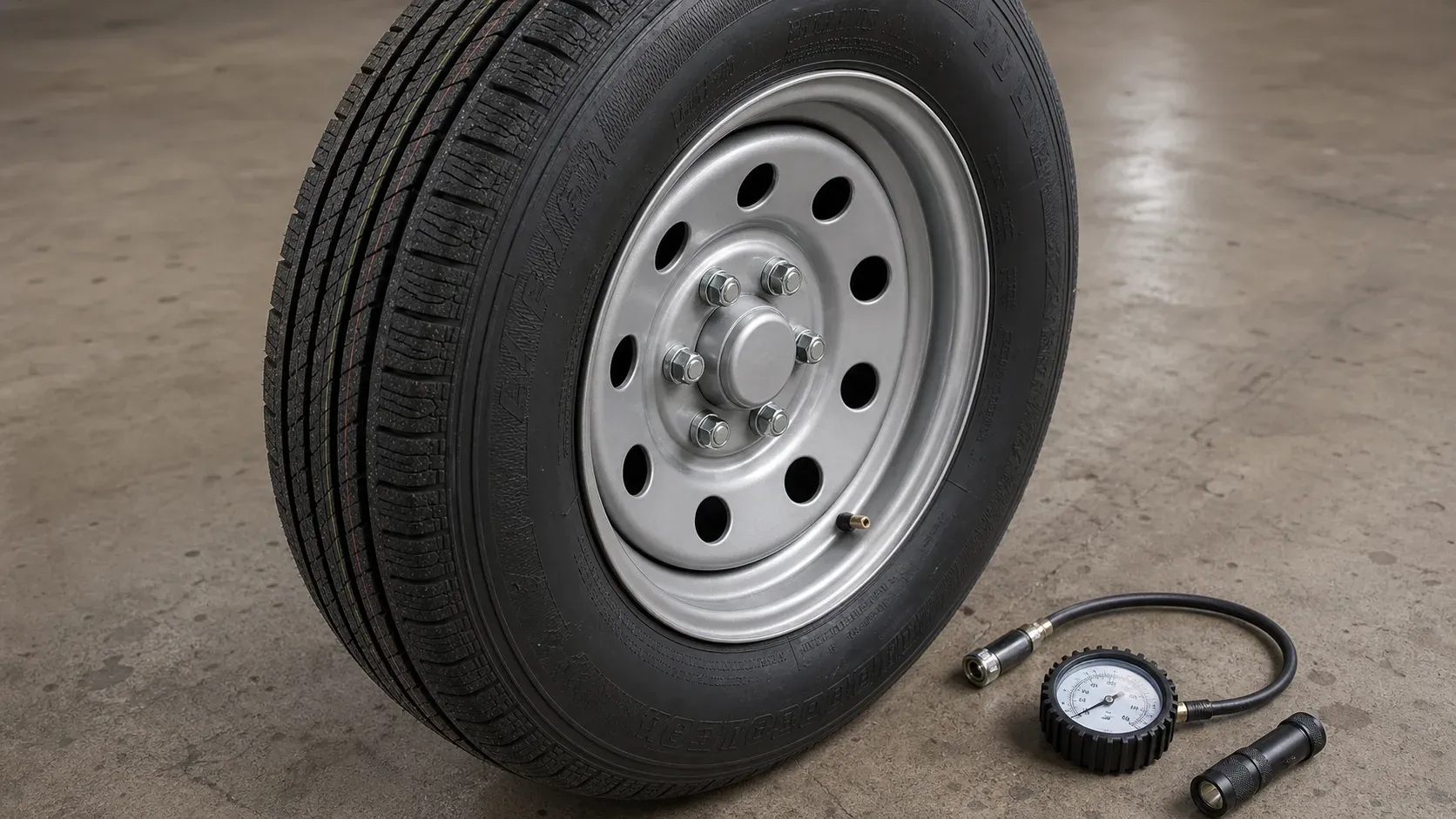
Trailer tires wear the ST prefix, for Special Trailer, and they're built with stiffer sidewalls than passenger rubber because the job is different. They carry vertical load without steering or driving, resist the sway that flexible sidewalls invite, and tolerate the scrub that tandem axles deliver in every tight turn. Passenger and LT tires flex where ST stiffness belongs, the substitution every tire shop should refuse and some don't.
The load range letter is the capacity spec. Each letter maps to a ply-equivalent and a per-tire rating at its pressure, and the tiers track the classes exactly, range C under the 3,500-pound world, C and D at the 7K tier, D and E through the 10-to-14K standards, and G rubber at the gooseneck tiers where 17.5-inch wheels appear. The math is per-position, four range-D tires at 2,540 pounds each support 10,160. The tire spec on the VIN label states what the GVWR assumed, and you match or exceed it at every replacement, never downgrade.
Age, pressure, and the failure math
Trailer tires die of age, not mileage. Sitting is their life, and UV and ozone harden the compound while tread depth lies about condition. The industry's honest window is five-to-six years from the DOT date code, the four digits on the sidewall that read week and year, and you replace on schedule regardless of appearance. The classic failure, a blowout on a tread-rich tire, is almost always a birthday problem. Read the date code at purchase too, since new trailers occasionally ship year-old rubber.
Pressure is the other half of the failure math. ST tires run at sidewall maximum cold, unlike passenger practice, because the rating exists only at that pressure. Underinflation is the silent killer, flexing sidewalls into heat until the carcass quits, usually at highway speed and usually loaded. A gauge before every loaded tow, valve caps on, and metal valve stems at the higher pressures close the discipline. The dually inner-position logic applies to tandems too, since the low tire hides while its partner carries double.
The stewardship list is short. Keep matched tires across the group, per the axle page's equalizer logic, rotate against tandem scrub wear, cover or shade the parked months, take weight off the tires for long storage, and mount a spare, same size and range, with its own date code checked. The spare is the oldest tire on most trailers and the one you'll ask to work on the worst day.
Tire FAQ
Can I use car tires on my trailer?
No, ST-rated tires only, built stiff for vertical load and sway resistance. Passenger and LT flex where trailers need stiffness, the substitution that invites sway.
What load range do I need?
The VIN label's spec or better, tracking the class, C/D at 7K, E through the 14K standards, G at the gooseneck tiers. Per-tire ratings times positions must clear the GVWR's assumptions.
How old is too old for trailer tires?
Five-to-six years from the DOT date code, regardless of tread. Trailer tires age out sitting still, and most blowouts are birthdays, not punctures.
What pressure should trailer tires run?
Sidewall maximum, cold, since the rating exists only at that pressure. Underinflation is the category's silent killer, and the gauge habit is the cure.
Why do trailer tires wear on the shoulders?
Tandem scrub in tight turns, normal in moderation, managed by rotation and wider arcs. Sudden or single-side wear says alignment or a bent spindle instead.
Does the spare really matter?
It's usually the trailer's oldest tire, so check it for date and pressure like the four working ones. The worst day is its whole job description.