Trailer Axles Explained.

Axles decide what class a trailer is. A pair of 3,500-pound units makes a 7K tandem, 7,000s make the 14K standard, and 10K and 12K pairs build the gooseneck tiers. Spring axles equalize the load and can be fixed in any town. Torsion axles ride smoother but cost more, and Dexter-pattern hubs sit under most of the market. Bearings are where the maintenance lives, greased on schedule or replaced on the shoulder. Get the rating tier right and you've picked the class.
The ratings that build the classes
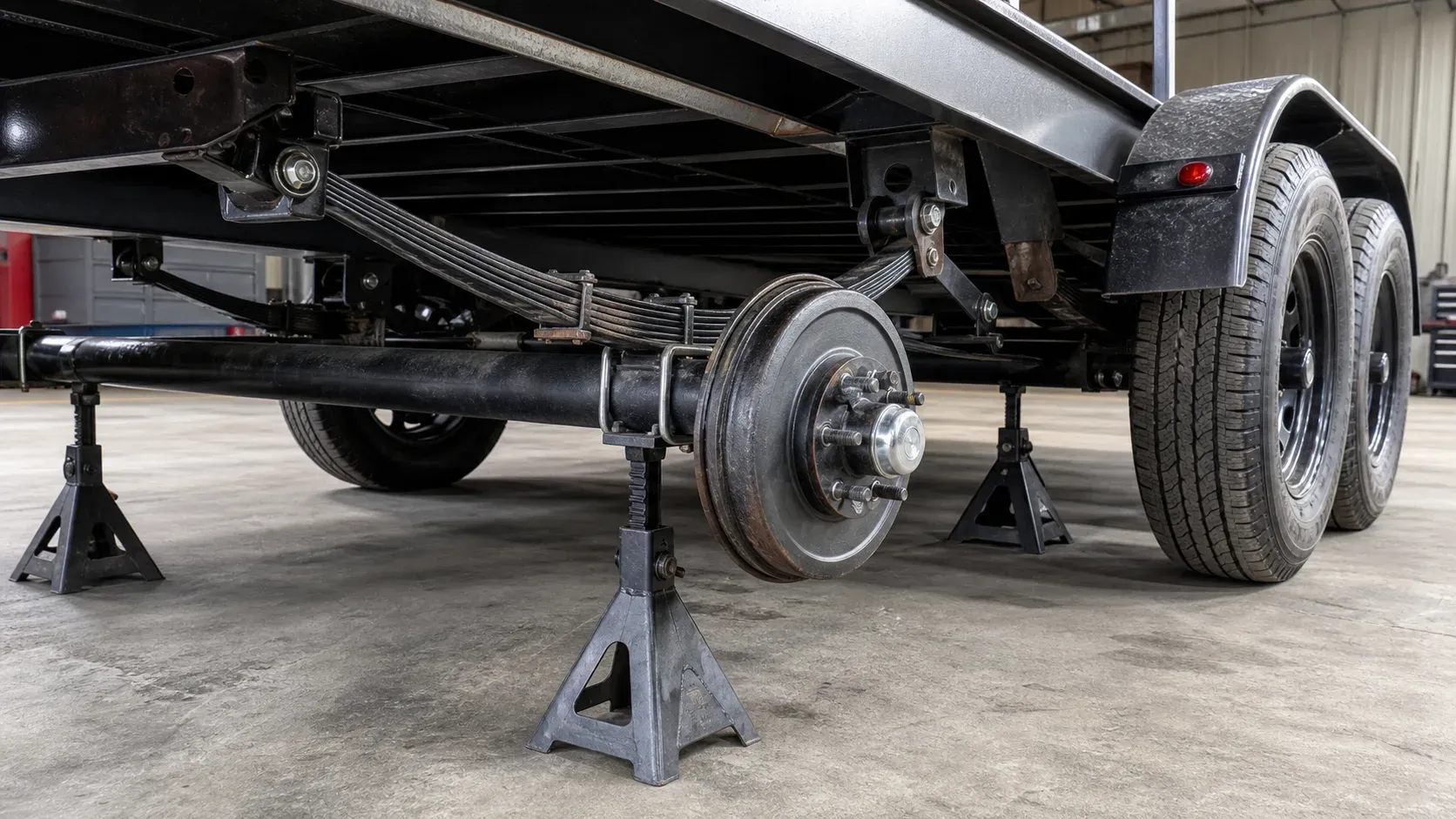
Every capacity class on this site is just axles doing arithmetic. A single 3,500 builds the entry class. Tandem 3,500s make the 7K workhorse tier, tandem 5,200s the 10K class, and tandem 6,000s and 7,000s the 12K and 14K standards. 8Ks reach the receiver ceiling, and 10K-through-12K pairs build the gooseneck tiers. Each axle's rating is stamped on its tag, and the trailer's GVWR is badged at or under the sum of the group. See the GVWR page for how that ceiling works.
The rating covers the whole assembly, the tube, spindles, bearings, and hubs engineered to work together. That's why the tiers step where they do. Spindle and bearing sizes change at 3,500, again from 5,200 to 7,000, and again at 8K-plus, and the brake and tire specs step right alongside them. A few names run the market. Dexter and its pattern-compatible peers sit under most builds, Lippert covers the volume tiers, and the tag under the trailer tells you the truth the brochure only summarizes.
Spring versus torsion
Spring axles are the default, and for good reason. Leaf packs are simple, cheap, and repairable in any town. Tandem pairs link through equalizers that rock the load between axles over bumps, and that load-sharing is what keeps all four tires planted, as the tandem pages explain. The ride is firm and the parts last, which is why the working market keeps buying them.
Torsion axles swap the leaf pack for rubber cords inside the tube, so each wheel suspends on its own. They ride smoother, mount lower, and seal the mechanism against weather, and they're what makes the low-profile builds possible. The costs are real. You pay a price premium, you get no load equalization between tandem torsions, each axle wants honest alignment and rating margin, and a damaged tube has to be replaced whole where a leaf pack rebuilds piece by piece. Comfort and a low deck buy torsion, working economics keep springs, and the suspension page runs the full comparison.
Bearings are the ownership story either way. Pack them with marine-grade grease every 12 months or 12,000 miles, replace the seals at each service, and check the hubs at fuel stops. They should be cool enough to touch, and that wrist check catches a failing bearing before it welds itself to the spindle. EZ-lube spindles make the grease job easier but never replace the teardown inspection. Keep a spare-bearing kit in the toolbox, because the failure always seems to happen on a Sunday, two hundred miles from the nearest parts counter.
Axle FAQ
How do axle ratings set trailer GVWR?
The GVWR is badged at or under the summed ratings of the axle group. Tandem 7,000s make the 14K class, and the whole class system on this site comes down to that arithmetic.
Spring or torsion axles?
Springs for working economics, equalized tandems, and repair-anywhere simplicity. Torsion for a smoother ride, a lower mounting height, and sealed weather resistance, all at a premium.
How often do trailer bearings need service?
Every 12 months or 12,000 miles. Replace the seals at the same time, and check the hubs by hand at stops. EZ-lube fittings supplement the inspection, they don't replace it.
Can I upgrade my axles to raise capacity?
You can swap in bigger axles, but it won't change anything legally. The GVWR label governs, per the GVWR page. Buy the class your loads need instead.
What's the tag under my axle?
It's the manufacturer's rating plate, with the model, capacity, and date. That's the honest spec behind the brochure, so match any replacement to it exactly.
Why do tandem tires chirp in tight turns?
That's axle scrub, the pair dragging sideways through a sharp arc. It's normal in moderation, and wider turns plus regular rotation keep it in check, per the tandem page.