GVWR Explained. What the Rating Actually Means.

GVWR is the trailer's maximum legal loaded weight, the trailer plus everything on it, set by the manufacturer from the weakest of its rated parts. It lives on the VIN label, and it's the number that registration, brakes, and CDL thresholds all read. Payload is GVWR minus the trailer's real empty weight. The rating isn't a suggestion or a safety margin to spend. It's the ceiling, and scales enforce it.
The ceiling on the label
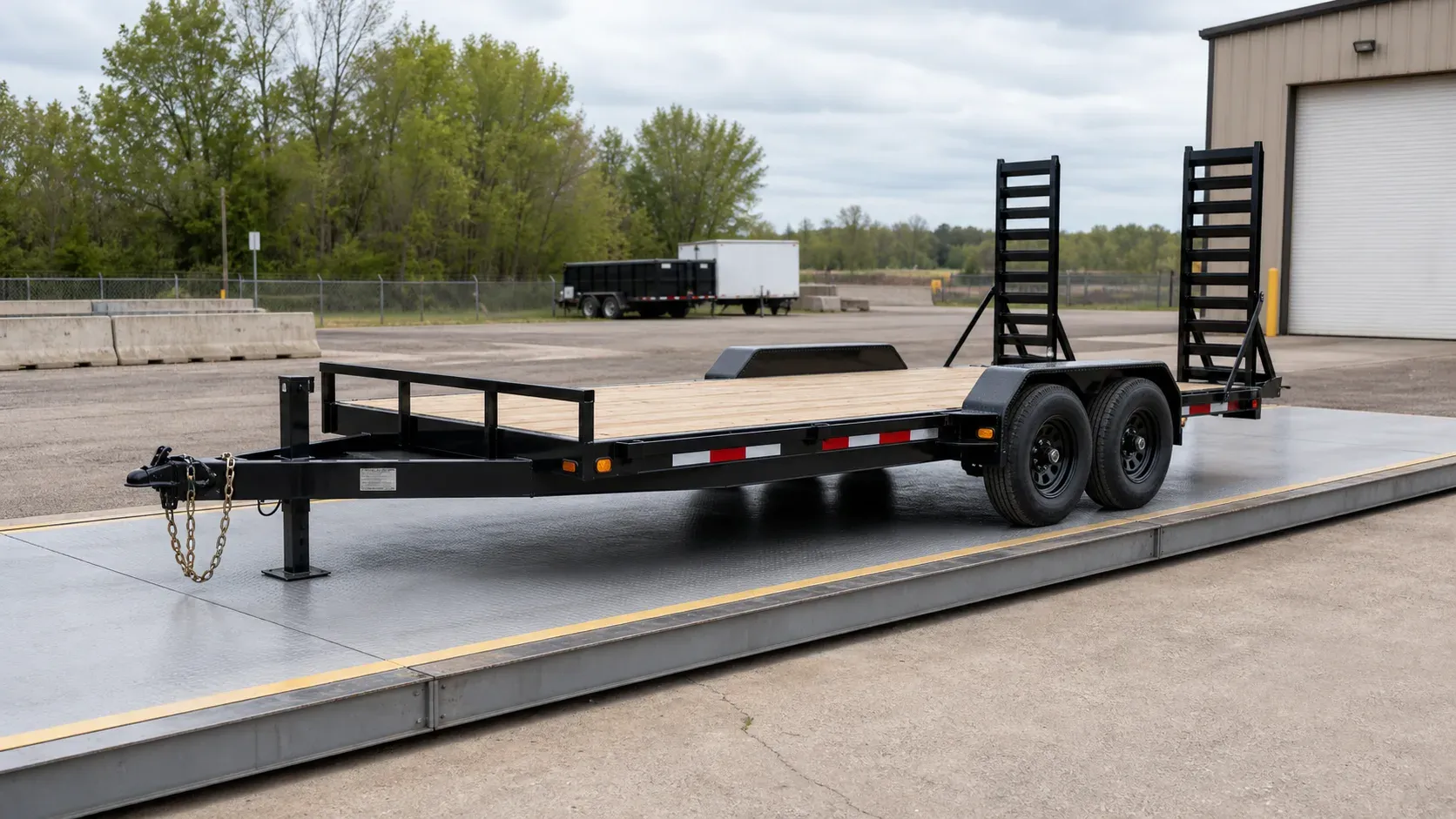
Gross Vehicle Weight Rating is the manufacturer's maximum for the trailer fully loaded, the steel, options, cargo, and the tongue's share, everything the axles and coupler carry together. It's stamped on the VIN label riveted to the frame's front left or the tongue. It's set from the build's weakest rated link, since the axles, tires, frame, coupler, and hitch hardware each carry ratings and GVWR lands at or under what the chain supports. That's why a tandem-7K-axle trailer badges at 14,000 or less, never more.
What GVWR is not deserves equal ink. It's not what the trailer weighs, that's empty or curb weight. It's not what it can carry, that's payload, the number you get by subtraction. And it's not a conservative suggestion with engineering headroom to borrow. The margin above the rating belongs to the components' fatigue life, not to your cargo, and a trailer run chronically over GVWR spends its bearings, brakes, and welds on an accelerated calendar until one of them presents the bill.
The number does a lot of legal work. State registration classes read it, brake requirements trigger from it, and the 10,001-pound commercial thresholds and the 26,001-pound combined CDL line stack it with the truck's, per the rules. Roadside enforcement weighs against it. One label, many readers.
Badges, derating, and the combined stack
The badge games exist because the thresholds do. The 2,990 badge ducks the brake mandates that start at 3,000 in some states, the 9,990 badge ducks the 10,001-pound commercial lines, and the 25,900 badge keeps combined ratings under the 26,001 CDL threshold behind a derated truck, per the heavy class pages. Same steel, chosen paperwork. Manufacturers derate honestly, and the label governs even when the components could rate higher, because the label is the legal instrument.
The combined stack is where GVWR meets the truck. GCWR is the truck's rating for the whole combination, and the trailer's GVWR plus the truck's GVWR against the 26,001 line decides the licensing math. GAWR, the per-axle ratings under the GVWR, catches the badly distributed load that a legal total can still produce. The full alphabet page maps all of it in one place.
The working rule is simple. Weigh the loaded trailer once at a CAT scale, learn where the real number sits against the label, and load by the payload subtraction after that. The label is the ceiling, the scale is the truth, and the two should never meet.
GVWR FAQ
What does GVWR mean on a trailer?
The manufacturer's maximum legal loaded weight, the trailer plus all cargo, set from the weakest rated component and stamped on the VIN label.
Where do I find my trailer's GVWR?
On the VIN label, riveted to the frame's front left side or the tongue, alongside the axle ratings and tire spec.
What happens if I exceed GVWR?
Legally, citations and liability exposure. Mechanically, accelerated wear on bearings, brakes, tires, and welds until one fails. The margin above the label isn't yours to use.
Is GVWR what the trailer weighs?
No, that's empty weight. GVWR minus empty weight is payload, the number the cargo actually gets.
Why do trailers badge at 2,990, 9,990, and 25,900?
To duck the regulatory thresholds at 3,000, 10,001, and 26,001 pounds. Same hardware, chosen paperwork, per the rules.
Can I increase my trailer's GVWR?
In practice, no. The label is the legal instrument, and re-rating requires the manufacturer. Buy the class your loads need, per the class pages.