Dump Trailers. The Complete Guide.

A dump trailer is a towable trailer with a hydraulic lift that raises the bed to unload dirt, gravel, mulch, and debris. Buy one when repeated self-unloading saves more labor and schedule time than rental costs. Pick it by loaded weight, payload, bed geometry, lift design, construction, and tow-vehicle limits, not by the biggest number on the dealer sign.
What a dump trailer actually is
A dump trailer is a steel or aluminum cargo box mounted to a trailer frame with a hinged rear pivot and a powered hydraulic hoist. Push the control, the pump sends pressurized fluid to the cylinder, and the bed rises until gravity carries the load through the rear gate. That simple cycle replaces shovels, wheelbarrows, loader time, and a fair amount of regrettable language.
The trailer still has to do every ordinary towing job before it can dump. Its frame carries the load. Its axles, tires, wheels, coupler, safety chains, jack, brakes, and breakaway system must support the rated weight. Its bed has to resist impact, abrasion, bending, and corrosion. Its electrical system must keep the brakes and lights alive while a separate battery supplies the hydraulic pump. A dump body does not excuse weak trailer fundamentals. It gives weak fundamentals more ways to become expensive.
Most buyers use dump trailers for soil, gravel, demolition debris, roofing waste, brush, mulch, firewood, scrap, and compact equipment. Those materials behave differently. Gravel is dense and reaches the trailer’s weight limit long before it fills a high-side bed. Brush is light and bulky, so side height and tarp coverage matter more than floor strength. Broken concrete combines weight with sharp impact. Mulch needs volume and a clean exit angle. One trailer can handle several jobs, but it cannot optimize all of them at once.
The common bumper-pull contractor dump has a low-profile bed between the tires, tandem axles, rear combination doors, ramps stored under the bed, a tarp, and a 12-volt hydraulic power unit. Compact models can be shorter and lighter. Deckover and gooseneck models put the bed above the wheels to create a full-width floor and additional capacity. Roll-off trailers use a hydraulic mechanism to load and unload separate bins, allowing one powered chassis to keep several containers working.
Start with the work cycle. List what you haul, the heaviest realistic load, how it gets into the bed, where it must unload, how often the trailer moves, and what truck will pull it. Then select the trailer. Starting with a glossy 16-footer and working backward is how buyers end up owning a magnificent parking problem.
How the hydraulics work
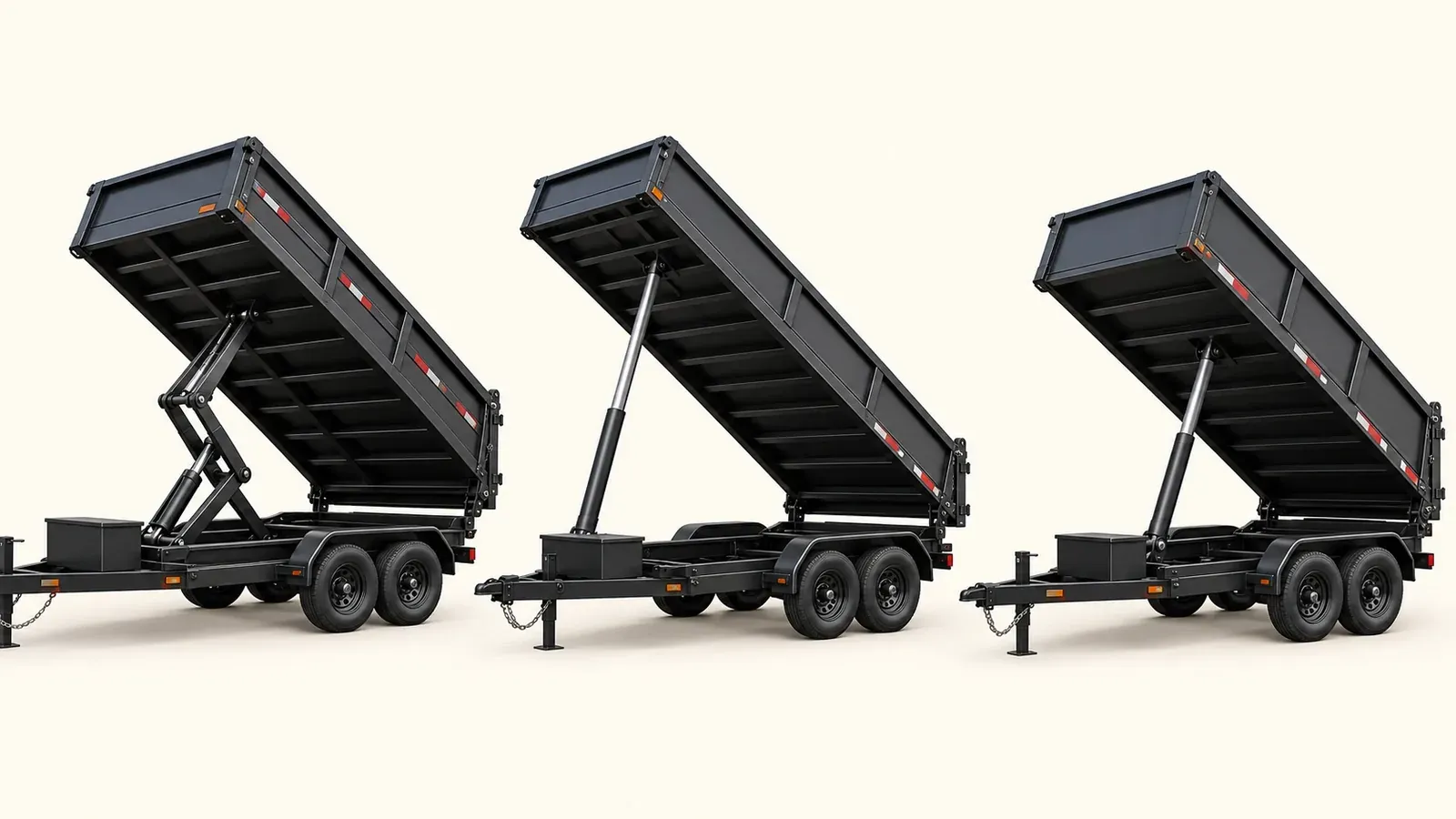
A typical electric-over-hydraulic system has a deep-cycle battery, electric motor, hydraulic pump, reservoir, control valve, hoses, cylinder, wired or wireless remote, and charging circuit. Press the up button and the motor turns the pump. Fluid moves from the reservoir into the cylinder. The extending cylinder acts through its mounting geometry or a scissor mechanism to rotate the bed around the rear hinge. Press down and the valve releases fluid so the bed returns under gravity or powered control.
The first few inches of lift are the hard part. The bed is nearly horizontal, the load is far from the hinge, and the hoist has poor mechanical advantage. Lift design matters most at that moment. A scissor hoist changes the cylinder’s force through a folding linkage and generally gives useful leverage through the lift arc. A direct-push ram attaches the cylinder more directly between frame and bed. Its performance depends heavily on cylinder bore, hydraulic pressure, pivot locations, and the angle at which the cylinder begins pushing.
A telescopic cylinder uses nested stages that extend one after another. Mounted near the front, it can produce a steep dump angle without a long cylinder hanging below the frame. Telescopic systems are common where clean discharge is important, but they are not automatically stronger than every scissor design. The label describes the mechanism. It does not certify good engineering.
The battery is the system’s fuel tank. Repeated lifts draw heavy current. A neglected, undersized, or poorly charged battery can make a healthy pump look weak. Ask for battery group size, capacity, charger type, truck charge-line arrangement, circuit protection, ground locations, and access for replacement. Inspect hose routing for rubbing and pinch points. Find the manual lowering method before a loaded trailer forces the lesson.
Load placement matters. Dense material should be distributed evenly and kept within the rated bed area. Too much weight forward increases tongue weight and makes the hoist fight a longer lever. Too much at the rear can reduce tongue weight and create instability. Frozen, sticky, or bridged loads may not slide when the bed rises. Never crawl under a raised bed without the manufacturer’s mechanical safety support correctly installed. Hydraulic pressure is not a jack stand.
Hydraulic fluid needs the same basic respect as engine oil. Use the manufacturer’s specified fluid, keep the reservoir clean, and watch for water, foam, discoloration, heat, and metal. A low reservoir can pull air into the pump. A contaminated reservoir can damage valves and cylinder seals. A leaking fitting is not fixed by continuing to tighten it until the threads surrender. Depressurize the system, identify the fitting type, replace damaged parts, and route the repaired hose away from abrasion.
Cold weather thickens fluid and reduces battery output at the same time. That combination slows lift speed and increases electrical demand. Keep terminals clean, maintain a charged battery, use the approved fluid, and allow snow, ice, or frozen material to clear before expecting normal performance. If the system suddenly changes speed, sound, heat, or current draw, stop and diagnose it. The remote button is a command, not a troubleshooting strategy.
Dump trailer sizes and real payload
Bed length is easy to compare, but weight capacity decides whether the trailer can do the job. Gross vehicle weight rating, or GVWR, is the maximum rated weight of the loaded trailer. Payload is what remains after subtracting the trailer’s actual empty weight, installed options, tools, spare tire, ramps, tarp system, and anything else riding on it. A 14,000-pound GVWR trailer that weighs 4,200 pounds has 9,800 pounds left before accounting for loose equipment or permanent additions.
Material density turns bed volume into weight quickly. A cubic yard of dry mulch may weigh a few hundred pounds. A cubic yard of wet soil can exceed 2,000 pounds. Gravel, sand, broken concrete, and wet clay vary with moisture, particle size, and source. Never use sideboard volume as permission to fill the bed with dense material. Side extensions create volume, not axle capacity.
| Class | Typical GVWR | Typical Payload | Common Fit |
|---|---|---|---|
| 10 to 12 feet | 7,000 to 10,000 pounds | About 4,500 to 7,500 pounds | Property work, compact equipment, light landscaping |
| 12 to 14 feet | 12,000 to 14,000 pounds | About 8,000 to 10,500 pounds | Contractors, roofing, landscaping, general debris |
| 14 to 16 feet | 14,000 to 16,000 pounds | About 9,000 to 11,500 pounds | Higher-volume crews and commercial work |
| Deckover or gooseneck | 16,000 to 21,000-plus pounds | About 11,000 to 15,500 pounds | Fleet work, large equipment support, heavy commercial loads |
Those ranges are orientation, not specifications. Two trailers with the same bed and GVWR can differ by more than 1,000 pounds in empty weight because of frame design, steel thickness, hoist, axles, ramps, sides, tarp hardware, toolbox, and spare. Read the certification label. Ask for the documented empty weight. Use a scale when the load matters.
Width changes loading and towing behavior. A low-profile bed between the fenders usually offers a lower floor and easier side loading. A deckover bed spans above the tires, giving a wider uninterrupted floor but raising the center of gravity and loading height. Length adds volume and equipment room, yet also adds empty weight, turning radius, parking demand, and more bed area that can tempt an overload.
Truck limits remain part of the calculation. Confirm towing capacity, receiver or gooseneck rating, truck payload, rear axle rating, tire ratings, gross combined weight rating, and expected tongue weight. The trailer may be rated for 14,000 pounds while the truck, hitch, passengers, fuel, tools, or bed cargo reduce the legal and safe combination. The smallest number wins.
Tongue weight deserves its own calculation. A bumper-pull trailer commonly needs roughly 10% to 15% of loaded weight on the hitch for stable towing, subject to manufacturer guidance. That load counts against truck payload along with people, cargo, accessories, and the hitch itself. A 12,000-pound loaded trailer can place well over 1,000 pounds on the truck before a single toolbox or passenger is counted.
Do not buy capacity that the operation cannot use. More GVWR may trigger heavier registration, different licensing, higher insurance, a larger truck, commercial rules, or restricted access. On the other hand, selecting a rating below the normal load invites overloads and eliminates margin for moisture, tools, and uneven scale estimates. Build the combination around measured work, then leave useful reserve.
Dump trailer sub-types
Sub-type names describe bed position, hitch style, hoist mechanism, or operating system. They overlap. A trailer can be low-profile, gooseneck, high-side, and scissor-lift at the same time. Use the labels to narrow the design, then compare the complete specification.
Scissor-lift and single-ram pages focus on hoist geometry. Low-profile and deckover pages focus on where the bed sits relative to the wheels. High-side and compact pages focus on body volume and overall scale. Gooseneck changes the connection point and usually opens the door to higher rated combinations. Roll-off changes the entire workflow by separating the container from the powered chassis.
Choose the operating model before the hardware. A landscaping crew carrying mulch and brush may benefit from high sides, a tarp, and a lower deck. A demolition crew needs floor strength, controlled loading, and dependable lifting under dense material. A rental operator may value simple controls, protected wiring, common components, and fast service. A dumpster business may gain more from several roll-off bins than several complete trailers.
The features that actually matter
Paint and powder coat matter because corrosion matters, but surface finish cannot compensate for poor preparation. Inspect hidden edges, weld areas, inside corners, the underside, and places where wiring or hoses pass through steel. Galvanized or aluminum construction changes corrosion behavior, price, repair methods, and empty weight. It does not eliminate inspection.
Serviceability earns money over the trailer’s life. Pumps, batteries, filters, grease points, brakes, junction boxes, lights, and wiring connections should be reachable without disassembling half the trailer. Ask whether the dealer stocks the exact pump, remote, hinges, latches, tarp parts, brake components, and lights. A premium proprietary part that arrives in six weeks is not premium on a Tuesday morning job.
Inspect the rear hinge and body support closely. The hinge transfers the weight of the raised bed into the frame while material moves toward the gate. Pins should be properly sized, retained, lubricated, aligned, and supported by sound structure. The mechanical bed prop must be strong, obvious, and usable without placing a person in the fall path. Read the procedure before maintenance, not while holding a wrench under several thousand pounds of optimism.
Brakes and tires are wear systems, not background equipment. Confirm brake type, adjustment method, controller compatibility, breakaway operation, tire load range, manufacturing date, inflation pressure, wheel rating, and lug-nut service instructions. Uneven tire wear can point to pressure, alignment, bearing, suspension, axle, or overload problems. Catching the pattern early costs less than learning about it beside an interstate.
Options should support a defined job. High sides make sense for brush and mulch. A heavy floor makes sense for demolition. A solar maintainer can help equipment that sits. A wireless remote can improve visibility during unloading, but keep a wired control available. Chrome wheels remain chrome wheels. The trailer will not haul one additional pound because it looks ready for a county fair.
Dump trailer brands
Brand matters because it affects engineering choices, component sourcing, warranty administration, dealer coverage, parts availability, and resale recognition. Model matters more. Large manufacturers sell several dump lines at different capacities and equipment levels. Never transfer a reputation from a flagship gooseneck to an entry-level bumper pull without checking the actual build.
Compare equivalent configurations. Match bed dimensions, GVWR, empty weight, payload, axle and tire ratings, floor and side material, crossmember layout, hoist design, dump angle, gate, ramps, tarp, battery, charger, jack, coupler, warranty, and included equipment. Dealers frequently quote two trailers as equals while one includes a tarp, spare, ramps, and charger and the other turns each into a profitable surprise.
Big Tex has broad recognition and a large product range. PJ and Load Trail compete across many working classes. Diamond C emphasizes distinct engineering and premium positioning. Sure-Trac and Lamar offer configurations that deserve direct spec comparison in their markets. None receives a free pass. Dealer setup and local support can change the ownership experience as much as the logo.
Before signing, record the full model, model year, VIN, option codes, component brands, written warranty, delivery condition, and promised dealer work. Confirm the title paperwork matches the certification label. Operate the bed through a complete cycle. Test every light and brake. Inspect fluid leaks, tire pressure, lug torque guidance, gate adjustment, tarp operation, ramp fit, breakaway battery, and charging system. The delivery inspection is cheaper than the first return trip.
What dump trailers cost
Dump trailer pricing moves with steel, freight, region, capacity, bed size, hoist, finish, axles, tires, dealer inventory, and included options. Compact trailers occupy the lower end. The common tandem-axle contractor class moves into five figures. Heavy gooseneck, deckover, roll-off, stainless, aluminum, and highly optioned commercial models climb from there. A useful buying process does not depend on a national number that was stale before the page finished loading.
Separate the trailer from the transaction. First compare the base model and factory equipment. Then list factory options, dealer-installed accessories, freight, preparation, documentation charges, taxes, registration, financing cost, warranties, and any trade allowance. Ask for an out-the-door quote in writing. A dealer can advertise an attractive base price and recover the difference through freight, prep, a marked-up tarp, an expensive spare, and financing terms.
Compare value per working requirement, not price per foot. A shorter trailer with the correct payload, floor, hoist, tarp, ramps, and support may outperform a larger bargain. Paying for unused side height or capacity adds weight and truck demand. Underbuying creates overloaded axles, repeated trips, slow dumping, damaged floors, and lost labor. Both mistakes cost more than a careful first purchase.
Financing can hide the real spread. Compare amount financed, term, annual percentage rate, fees, down payment, total interest, early-payoff rules, and whether optional products were inserted. A comfortable monthly payment can be attached to an uncomfortable total. If the trailer produces revenue, compare payment timing with realistic utilization, maintenance, insurance, registration, and downtime.
Warranty has monetary value only when coverage, exclusions, labor, transport, and response time are clear. Component warranties may be handled by the axle, tire, pump, battery, or tarp manufacturer rather than the trailer company. Ask who diagnoses the problem, who files the claim, who pays labor, and whether the local dealer performs the work. “We’ll take care of you” is pleasant. A written process is useful.
Get at least three comparable quotes. Use the same model or a tightly matched specification. Tell each dealer the equipment that must be included. Do not negotiate only from an advertised number. Negotiate from the complete delivered package, then decide whether local service and inventory justify a reasonable difference. The cheapest seller two states away becomes less charming when a hydraulic issue appears with nine tons in the bed.
Time the purchase around the work, not a vague sale clock. Inventory pressure, model-year turnover, factory programs, freight changes, and regional demand can influence offers, but a discount on the wrong configuration is still the wrong trailer. Ask when the unit was built, how long it has been outdoors, whether specifications changed, and whether the battery, tires, brakes, and finish were inspected after storage.
Protect the comparison on delivery day. Bring the written quote and specification list. Check the VIN, model, GVWR, options, keys, remote, manuals, warranty documents, title papers, spare, ramps, tarp, battery, charger, and dealer promises. Photograph the trailer and certification label. Document damage before leaving. Once the hitch clicks shut, spoken corrections become much harder to remember on both sides of the desk.
Know the fair price before you go
The free Price Guide lists current dealer and MSRP prices for hundreds of new trailer models, brand by brand, so you can compare complete offers with better context.
Get the Price GuideDump trailer FAQ
What size dump trailer do I need?
Choose from the weight of your heaviest regular load, not bed length alone. Many contractors land in the 14-foot, 14,000-pound GVWR class, but only when the tow vehicle, hitch, payload, and combined ratings support it.
Can a half-ton truck pull a dump trailer?
Some half-ton trucks can tow a compact dump trailer within their ratings. A loaded 14-foot contractor dump is commonly too much once trailer weight, material, tongue weight, passengers, and equipment are counted.
Is a scissor lift better than a single ram?
A scissor lift usually provides strong leverage at the start of the lift. A direct-push single ram can be simpler and less expensive. Cylinder size, mounting geometry, pressure, bed angle, and load placement all affect real performance.
How much payload does a 14,000-pound dump trailer carry?
Payload equals GVWR minus the trailer’s actual empty weight and installed equipment. Many 14,000-pound models carry roughly 9,000 to 10,500 pounds, but the certification label and scale weight are the numbers that count.
Do dump trailers need brakes?
Most tandem-axle dump trailers require brakes under state law and need a compatible brake controller. Requirements vary by weight and state, so confirm the law and verify that every required axle is equipped and working.
Do I need a CDL to tow a dump trailer?
A CDL can be required based on the truck and trailer gross vehicle weight ratings, combined rating, use, and state or federal rules. Do not decide from actual load weight alone. Verify the rated combination and the rules that apply to your operation.
How long does a dump trailer last?
A well-built frame and bed can work for decades with corrosion control and sensible loading. Batteries, tires, brakes, wiring, pumps, hoses, and hydraulic fluid are service items. Abuse, road salt, overloaded axles, and neglected pivots shorten that life quickly.
Should I buy a new or used dump trailer?
My Trailer Info covers new trailers only. A new trailer provides known specifications, current components, a clean service history, and written warranty coverage. Compare the warranty and dealer support as carefully as the steel and hydraulics.