Best Trailers for a Junk Removal Business.

The junk removal industry runs on the high-side dump trailer: a 14K box with 4-foot walls that holds 12 to 14 cubic yards, loads through barn doors, and empties with hydraulics. Solo starters do honest work in the 6x12 class, and growth-stage operators graduate to roll-off trailers with a fleet of containers. Volume per trip is the business, so buy walls accordingly, and watch the weight when the junk turns dense.
What junk actually is, by the pound
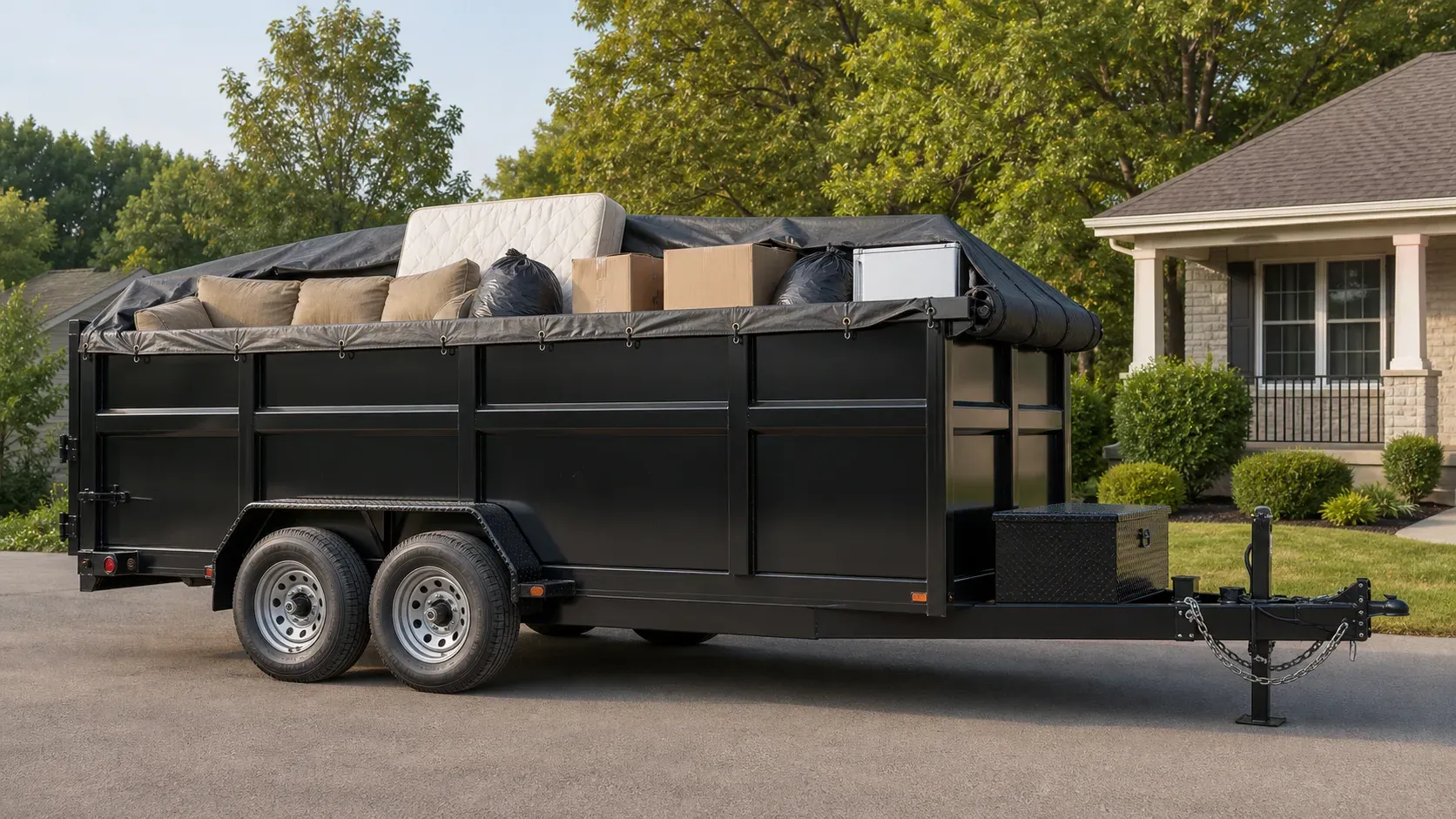
Junk is a volume business with weight surprises. A typical residential cleanout, furniture, mattresses, boxes, appliances, and bags, runs 200 to 500 pounds a cubic yard, light enough that a tall box fills long before the axles complain. That's the industry's founding math: you bill by the yard or the fraction of a trailer, and the more yards you fit per trip, the fewer dump-site runs eat your day.
The surprises are the dense calls. Construction debris, shingles, tile, concrete, wet carpet, and hot-tub demolition run 1,000 to 3,000-plus pounds a yard, and the same 4-foot walls that swallow a house cleanout will bury a trailer's GVWR at a third full of roofing. Both your pricing and your loading depend on recognizing the dense job at the estimate, not at the scale house.
Junk also fights back in ways gravel never does. It's bulky, awkward, and interlocking: mattresses bridge across boxes, couches want doors, and appliances want ramps or backs that can carry them. Loading geometry, doors, wall height, and floor strength, is as much the spec as capacity, and the trailers below rank on exactly that.
Best trailers for junk, ranked
The high-side dump is the industry standard and the headline answer here. A 7x14 at 14K with 4-foot walls holds about 14 yards struck level, loads walk-in through barn doors, and empties itself at the transfer station in half a minute. Three cleanouts a day with one crew is the whole business case. The tall box doubles as a rolling billboard, which is why half the operators in America letter their walls.
The starter tier is the mid-size dump. A 6x10 or 6x12 at 7,000 to 9,900 pounds with high-side options runs 8 to 10 yards, tows behind the half-ton a solo founder already owns, and costs thousands less at the stage where thousands matter. Plenty of one-truck operations never outgrow it.
The growth tier is the roll-off trailer and its fleet of containers. Cans dropped at job sites earn rental while the trailer shuttles, customers load on their own schedule, and one rig serves a whole route of containers. It's a better business model, at the cost of the most complex trailer in the dump family plus the can fleet. The roll-off page works the startup math.
For the record, the wrong tools: standard 2-foot-side dumps cube out on light junk at half the revenue per trip, enclosed trailers hold junk but refuse to dump it, and a utility trailer full of cleanout, hand-unloaded at the transfer station, is the founder's rite of passage that funds the high-side purchase.
Routes, weights, and the specs that pay
Spec the box for the trade. Choose barn doors over a ramp gate for walk-in loading, a reinforced top rail that survives the thousandth couch heaved over it, floor gauge that shrugs off appliance corners, and D-rings for loads that ride better strapped. A tarp kit sized to the walls isn't optional, since covered-load rules apply to exactly this cargo in most states, and loose junk on the highway is the industry's signature liability. The state rules have the specifics.
Run the weight discipline dense jobs demand. Load shingle and demo jobs shallow and price them by weight, not volume, and build a scale-house habit early, since it calibrates your eye cheaply. The truck math holds throughout: a loaded 14K high-side is three-quarter-ton work with brakes on both axles and honest tongue weight, and the tall walls add wind manners worth respecting on empty highway legs.
Mind the business the trailer sits inside. Dump fees scale per trip, which is the high-side's revenue argument in reverse, and route density decides when the roll-off's cans-earning-rent economics beat the dump-and-return cycle. Combined ratings can cross CDL lines at the gooseneck end, so check the rules before you scale up on assumptions. And keep the hydraulic system maintained like the revenue equipment it is, because a dead pump with 14 yards aboard cancels the day's route, and batteries die of neglect more often than work.
Junk removal trailer FAQ
What trailer do junk removal companies use?
The high-side dump, overwhelmingly, a 14K box with 3 to 4-foot walls, barn doors, and hydraulic dumping. It's the industry uniform because volume per trip is the business.
What size trailer to start a junk removal business?
Solo with a half-ton, the 6x12 high-side class does honest work at starter money. Once you have a first hire and a real truck, the 7x14 at 14K is the standard. The high-side page has the sizes.
How many cubic yards for junk removal?
The industry quotes jobs against 12 to 15-yard trailers, and a 7x14 with 4-foot walls holds about 14 struck level. More yards means fewer dump runs and better days.
When does a roll-off trailer make sense?
When containers earning rent at customer sites beats hauling same-day, usually at a route density a single dump trailer can't serve. Budget the can fleet as half the move, and the roll-off page has the math.
Can junk overload a dump trailer?
Dense junk absolutely can. Shingles, tile, concrete, and wet material bury a GVWR at a third of the box. Price and load dense jobs by weight, and save the walls for the light stuff.
What truck does the business need?
A loaded 14K high-side wants a three-quarter-ton minimum with a brake controller. The starter classes run behind a half-ton honestly.