Roll-Off Dump Trailers Explained.

A roll-off dump trailer carries interchangeable bins instead of a fixed box. A hydraulic hoist tilts the frame, winches a can aboard, and drops it at the next site. One trailer serves a whole fleet of cans, which turns a dump trailer into a container business. Buy it when the model is bins earning rent at customer sites. For plain hauling, a fixed-box dump does the same work with less to it.
What a roll-off dump is
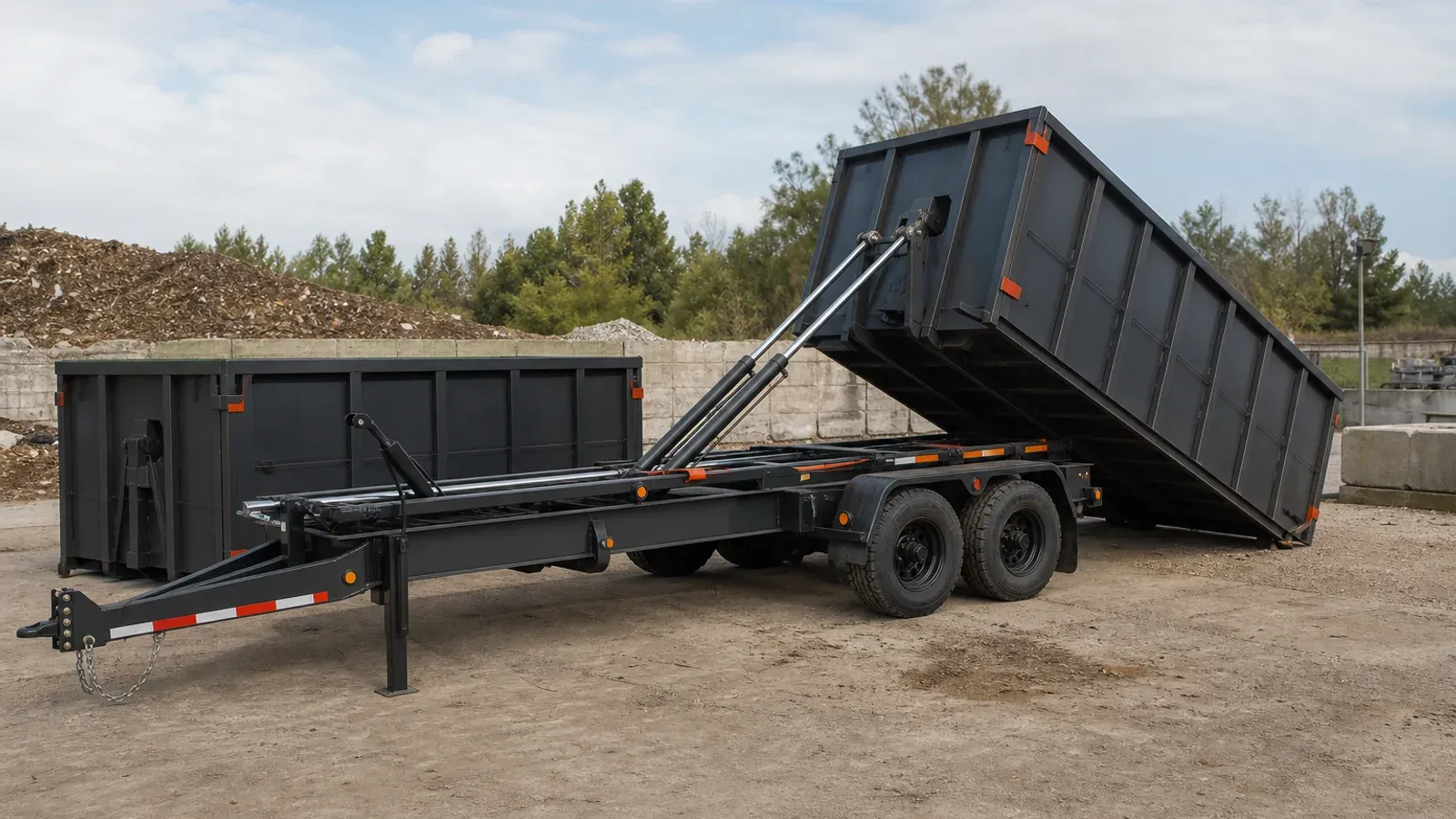
A roll-off separates the trailer from the box. The trailer is a hoist frame on axles, a tilting deck with a winch or hook system and rollers. The boxes are open-top containers, cans in the trade, that the trailer picks up, hauls, dumps, and, most important, leaves behind. Leaving them behind is the whole business model. A fixed-box dump hauls loads. A roll-off puts assets to work.
The economics explain the category. A junk removal or cleanout operation with a fixed dump trailer earns only while it's driving and loading. The same operation with a roll-off and six cans has containers earning rent at six job sites while one trailer shuttles the full ones home. Contractors rent the cans by the week, homeowners by the project, and the trailer becomes the delivery system for a container fleet. That's a different and generally better business than hauling.
The dump function comes standard. With a can locked aboard, the hoist tilts the whole container and the load slides out the swinging rear door, the same job a fixed dump box does, at similar angles. So you give up nothing on the dumping side. The roll-off just adds the swap capability on top, and it costs more in complexity, weight, and money, which only the container model justifies.
The trailer-based roll-off matters because of what it isn't, a $150,000 roll-off truck. Hook-lift trucks own the commercial waste industry, and the trailer version delivers the same can-swapping capability behind a pickup at a fraction of the entry cost. That's what makes it the small operator's way into the container business, and most people reading up on it are working out a business plan.
Hoists, cans, and the swap cycle
Two pickup systems split the market. Cable-hoist designs tilt the deck, and a winch cable hooks the front of the can and drags it up the rollers. It's simple, proven, and forgiving of ground misalignment. Hook-lift designs use a hydraulic arm that reaches out, hooks a bar on the can, and draws it aboard in one motion, faster and more precise, but at more cost and complexity. Trailer-scale units run both, with cable dominating the affordable end. Either way, can compatibility is the spec that rules everything. Rail spacing, hook height, and can length standards have to match between the trailer and every can you'll ever buy, so confirm the standard before your first container order.
The swap cycle is the daily rhythm. Tilt the deck, winch the full can aboard, latch it, haul, dump or swap, drop an empty at the site, and repeat. Good builds make every step boring, with positive can latches you can verify at a glance, rollers that survive gravel lots, a winch rated well past the heaviest loaded can, and hydraulic controls placed where the operator can watch the can track. Have the dealer run a demo swap, because one pass shows you both the cycle time and anything sketchy.
Power scales up from the standard dump package. The hoist and winch work harder than a plain box lift, so the pumps, batteries, and plumbing all run heavier. The power system rules apply here with extra force, because this is the hungriest hydraulic system in the dump family, and the charge line from the truck is not optional.
The cans are half the purchase. Trailer-scale containers commonly run 10 to 15 cubic yards, steel, with swinging rear doors and tarp bars, and each one costs a meaningful fraction of the trailer. Budget the fleet honestly. A roll-off with one can is just a fixed-box dump with extra steps, and the model starts working at three or four cans and scales from there. Used cans in compatible standards are the traditional way to build a fleet on a budget. We cover new trailers here, so it's worth saying that's a conversation about the cans, not the trailer.
Roll-off trailer sizes and can math
| Class | Typical GVWR | Typical Payload | Can Capacity |
|---|---|---|---|
| 14,000 lb roll-off | 14,000 lb | 8,800 to 9,800 lb | 10 to 12 yd cans |
| 15,900 to 17,500 lb | 15,900 to 17,500 lb | 10,500 to 12,500 lb | 12 to 14 yd cans |
| Gooseneck 21,000+ lb | 21,000 to 25,900 lb | 14,500 to 19,000 lb | 14 to 15+ yd cans |
The payload line deserves a hard look, because the hoist frame, winch, and rollers add more empty weight than any fixed box, and the can itself weighs 1,500 to 3,000 pounds before the first bag of debris. Net material payload, GVWR minus trailer minus can, is the number the business actually runs on, and it's smaller than the brochure implies. Run it before you price routes.
The density lesson carries straight over from the high-side guide. A 12-yard can of household junk rides comfortably, but the same can full of roofing shingles or concrete overloads the axles while looking half empty. Operators handle it with can rules, loading dense-material cans shallow and marking them, and the state regulations on weight and covered loads apply on every route.
Trucks live at the heavy end. The 14K classes want a serious three-quarter-ton at a minimum, working operations run one-tons, and the gooseneck classes assume a one-ton through the gooseneck hitch. Combined ratings push many working roll-off rigs into CDL territory for commercial use. The 26,000-pound line arrives fast in this category, so check it before your business plan assumes otherwise.
Where the roll-off wins and loses
The buying rule is simple. The roll-off is a business system that happens to be a trailer. If cans-on-sites is the revenue model, nothing else does the job. If the plan is just hauling debris, a high-side fixed box does it simpler, lighter, and thousands cheaper.
Roll-off dump FAQ
How does a roll-off trailer work?
The deck tilts and a winch or hook system draws an interchangeable container aboard on rollers. Latched down, it hauls and dumps like a fixed box. Left behind, the can stays at the job site earning rent while the trailer fetches another.
How many cans do I need?
The model starts making sense at three or four and scales with your routes. With one can, a roll-off is just an expensive fixed dump. Figure the cans as roughly half your startup cost.
Cable hoist or hook lift?
Cable is the trailer-scale standard, chosen for cost and its tolerance of imperfect ground. Hook lift buys speed and precision at a premium. Either way, can compatibility with your chosen standard matters more than the pickup system.
What can a roll-off trailer legally carry?
GVWR minus the trailer minus the can, which lands smaller than a fixed-box equivalent. Dense material hits the weight limit while the can still looks empty, so weight rules the route, and the state rules on covers and weights apply too.
Do I need a CDL to run one commercially?
Often, yes. The combined ratings of a one-ton and a heavy roll-off cross 26,000 pounds without much trouble. Check the regulations against your exact combination before you build a business on an assumption.
Roll-off trailer or roll-off truck?
The trailer buys the capability at a fraction of the cost and works behind a truck you may already own. The hook truck wins on cycle speed and can size, but costs several times as much. Route density decides which one pays.