Gooseneck Trailers. The Complete Guide.

A gooseneck trailer connects to a ball in the truck bed instead of the bumper, putting the hitch weight over the rear axle. That one change buys higher capacity, tighter turning, and better stability, at the cost of a bed-mounted hitch and a bigger truck. Buy one when your loads regularly pass 14,000 pounds. Below that, you're paying for capacity you can't use.
What a gooseneck trailer actually is
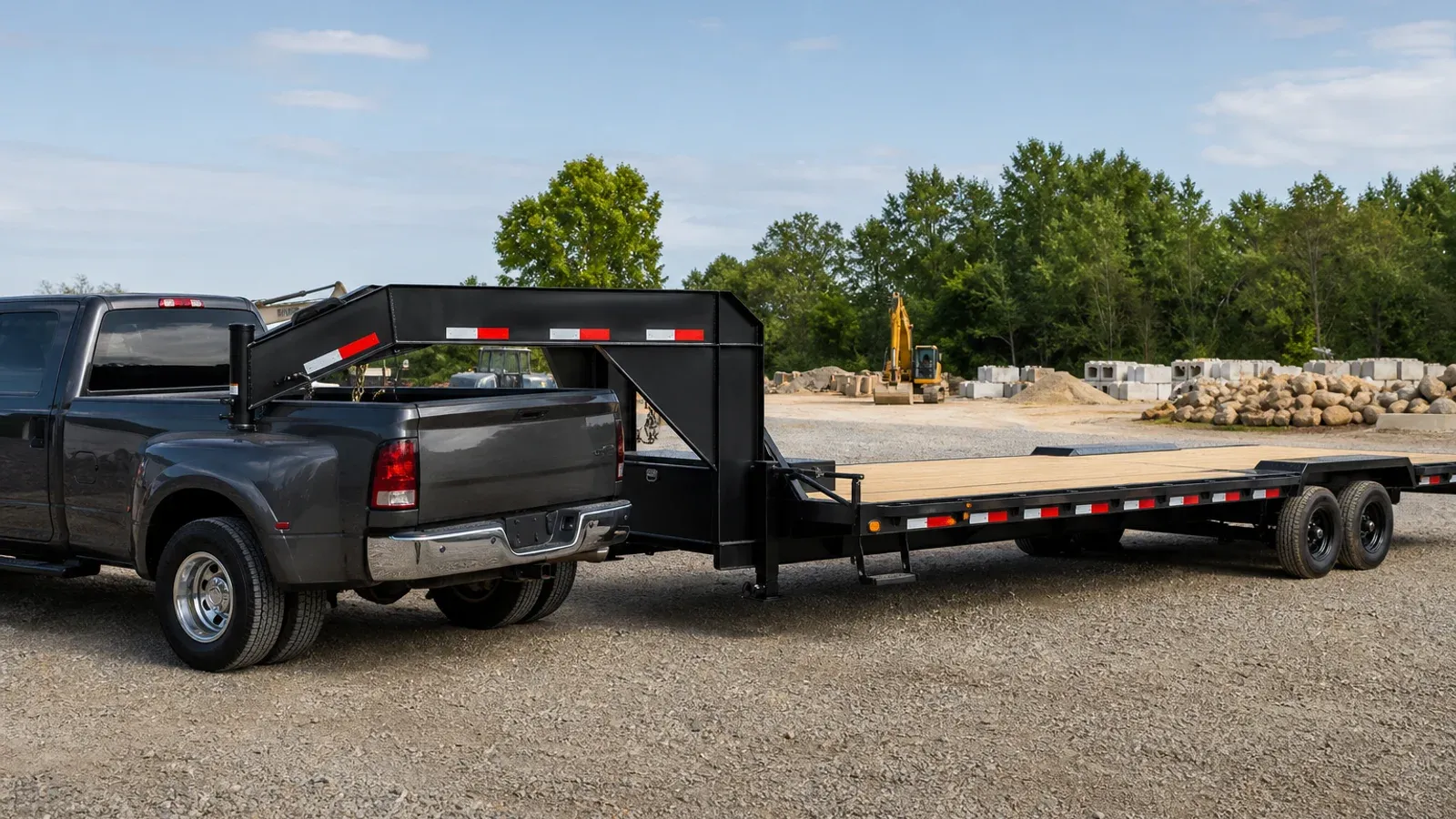
Gooseneck describes a connection, not a cargo style. The trailer's frame rises in a neck over the truck's tailgate and drops a coupler onto a ball mounted in the bed, directly over or just ahead of the rear axle. Everything behind that neck can be a flatbed, a deckover, a dump, an equipment deck, or a hydraulic dovetail. The neck is the product.
What the neck buys. First, capacity. Hitch weight moves from a lever hanging off the bumper to a point over the axle, so the truck carries 15 to 25 percent of the load where it's strongest, and rated combinations climb past 20,000 pounds where bumper-pulls stop. Second, maneuverability. The pivot over the axle lets the trailer cut inside the truck's turning arc, which is why goosenecks back into spots bumper-pulls can't. Third, stability. The geometry resists sway by design, and a heavy gust or a passing semi becomes an event instead of an emergency.
What it costs. The truck's bed hosts a ball and rails, and the first 4 feet of bed live under the neck when hitched. The trailer itself runs heavier and pricier than the equivalent bumper-pull. And the truck requirement is real, a gooseneck under load wants a three-quarter-ton at absolute minimum and usually a one-ton, often a dually.
Who actually needs one. Hotshot operators, farms and ranches, equipment movers with machines past the 14K class, and anyone whose loads live in the 15,000-to-25,000-pound world. The gooseneck versus bumper-pull decision has an honest threshold, and it sits right around 14,000 pounds of regular loaded weight.
Necks, couplers, and the physics that matter
The coupler and ball do the work. The standard is a 2-5/16-inch ball rated to 30,000 pounds, mounted through the bed on rails or a puck system bolted to the frame. The coupler drops over it and locks. Adjustable-height necks match the trailer's ride height to the truck, and getting that level matters, a nose-high gooseneck unloads the front axle of the trailer and overworks the rear.
Hitch weight is the number that surprises new gooseneck owners. Where a bumper-pull wants 10 to 15 percent of loaded weight on the tongue, a gooseneck runs 15 to 25 percent on the pin. On a 20,000-pound loaded trailer that's up to 5,000 pounds pressing into the truck bed, which counts against the truck's payload rating, not its tow rating. This is the math that quietly requires the one-ton dually, the tow rating was never the constraint, the payload was.
The gooseneck hitch install is a one-time cost worth doing right. Under-bed rail kits and puck systems bolt to the frame and leave the bed flat when the ball's out. The ball, the safety chain anchors, and the breakaway wiring all carry ratings, match them to the trailer, not the cheapest kit. And the fifth-wheel versus gooseneck question comes up constantly, short answer, fifth wheels serve RVs with articulation and cushion, goosenecks serve work trailers with a simpler, stronger, flat-bed-friendly connection.
Backing and turning is where goosenecks convert skeptics. The pivot point over the axle means the trailer responds quicker and cuts tighter than a bumper-pull of the same length. It also means jackknifing the neck into the cab corner is possible if you get greedy with the angle. The bed rails carry the scars of every driver who learned that lesson at full lock.
Gooseneck sizes and real payload
Gooseneck decks commonly run 20 to 40 feet, and the capacity classes stack by axle configuration, tandem 7K axles, tandem 10K or 12K, and triple axles at the top. GVWR minus real empty weight is the honest number, and gooseneck frames are heavy, a 25-foot deckover can weigh 6,500 pounds before the first strap goes on.
| Class | Typical GVWR | Typical Payload | Common Fit |
|---|---|---|---|
| Tandem 7K axles | 14,000 to 15,000 lb | 8,500 to 10,000 lb | Equipment, hay, general ranch work |
| Tandem 10K to 12K | 20,000 to 24,000 lb | 13,500 to 17,500 lb | Hotshot freight, heavy machines |
| Triple axle | 21,000 to 30,000+ lb | 14,000 to 22,000 lb | Multi-machine, max legal loads |
| Hydraulic dovetail | 22,000 to 25,000 lb | 14,500 to 18,000 lb | Low-clearance heavy equipment |
Deck style splits the category. Flatbed goosenecks with decks between the fenders load lower. Deckover styles run the deck above the wheels for full 102-inch width, the standard for freight and wide machines. The hydraulic dovetail folds the rear deck to the ground under power, the premium answer for low, heavy equipment that can't climb ramps.
The CDL line lives in this category. A truck and trailer with combined weight ratings over 26,000 pounds, towing a trailer rated over 10,000, generally requires a CDL for commercial use, and most working goosenecks cross that line easily. The rules turn on ratings and use, not on what the scale says today, and state regulations add their own layers. Know the line before the roadside conversation.
Length costs more than money. A 40-foot gooseneck behind a crew-cab dually is a 65-foot combination that needs planning at every fuel stop. Buy the deck the loads need, not the deck that impresses the neighbors, they aren't backing it into your yard.
Gooseneck sub-types
The sub-types are the whole open-trailer world, upgraded to the neck. Pick the deck style by the load exactly as you would on a bumper-pull, then let the neck carry the capacity. The hydraulic dovetail is the one genuinely unique product, no bumper-pull equivalent moves heavy, low machines as easily.
The features that actually matter
Skip the show tier, polished aluminum wheels and paint upgrades on a trailer that lives on job sites. Spend the difference on the axle tier or the dovetail. Nobody ever finished a job faster because the wheels matched.
Gooseneck brands
Gooseneck is the heavyweight division, and the brands that matter are the ones contractors and hotshotters trust at 3 a.m. in the middle of nowhere.
Big Tex and PJ anchor the category with deep gooseneck lines and the widest parts networks. Load Trail and Iron Bull price aggressively at strong specs. Diamond C and MAXX-D chase the premium buyer with engineering and finish. At this money, weigh the dealer's parts stock and service reputation nearly as heavily as the build, a heavy trailer down for parts costs its payment every week it sits.
What gooseneck trailers cost
Gooseneck pricing starts around the top of the bumper-pull market and climbs steeply with axle tier and deck features. Tandem 7K models open the category. The 10K-axle hotshot and equipment classes run well into five figures, and hydraulic dovetails sit at the top of the open-trailer world. Add the hitch install in the truck, several hundred to over a thousand depending on the kit, a one-time cost that serves every gooseneck after.
The gooseneck-specific padding to watch is the axle-tier shuffle. Two trailers quoted at the same length can hide a 7K-versus-10K axle difference worth thousands in real capacity. Quote by GVWR and axle brand, never by feet. Then the standard list, freight, prep, doc fees, and the finance office, all negotiable, all worth getting in writing as one out-the-door number.
The buying mistake unique to this category is the truck-trailer mismatch, in both directions. A 25K trailer behind a half-ton is illegal and dangerous. But a dually bought for a trailer that never materializes is $80,000 of parking. Buy the combination for the loads you actually run, and if the loads are growing, buy the trailer's next class and the truck to match, once.
Used-versus-new isn't our conversation, we cover new only, but at gooseneck money the new warranty earns its premium harder than anywhere else. Frames, axles, and hydraulic tails are exactly the components you want documented, current, and covered.
Know the fair price before you go
The free Price Guide lists current dealer and MSRP prices for hundreds of new trailer models, brand by brand, with a confidence label on every number.
Get the Price GuideGooseneck trailer FAQ
What's the advantage of a gooseneck over a bumper pull?
Higher capacity, tighter turning, and better stability, because the hitch weight rides over the truck's rear axle instead of behind it. The full comparison runs the numbers. The tradeoff is the bed hitch and the bigger truck.
What truck do I need for a gooseneck?
A three-quarter-ton at minimum for the lightest classes, a one-ton for most working goosenecks, and a dually when pin weight passes what single rear wheels carry. Payload rating decides, not tow rating.
How much weight goes on the truck?
Pin weight runs 15 to 25 percent of loaded trailer weight. On a 20,000-pound load that's 3,000 to 5,000 pounds in the bed, which must fit inside the truck's payload after passengers and gear.
Do I need a CDL for a gooseneck?
For commercial use, generally yes once the combined weight ratings pass 26,000 pounds with a trailer rated over 10,000. It turns on ratings and use, not the day's actual load. Check the rules before assuming either way.
Gooseneck or fifth wheel?
Gooseneck for work trailers, simpler, stronger, and the bed stays usable. Fifth wheel for RVs, where articulation and ride comfort matter. The comparison covers the crossover cases.
Can the hitch come out of the truck bed?
With rail and puck systems, yes, the ball pulls or flips and the bed goes back to flat. The under-bed frame mount stays, invisible, waiting for the next hookup.
What size gooseneck do most people buy?
The 25-foot tandem-axle classes dominate, big enough for real equipment and freight, small enough to live with daily. Buy from your loads, not from the average.
Why are hydraulic dovetails so expensive?
A powered folding deck adds hydraulics, cylinders, a pump, and serious steel at the highest-stress point on the trailer. For low, heavy machines it replaces ramps, risk, and a second person, which is what you're actually buying.