Best Trailers for Farmers and Ranchers.

Ranch work runs on the gooseneck flatbed, 25 to 30 feet of low deck behind the neck, hauling hay, fencing, machines, and the operation's whole catalog at real weights. The working fleet adds a utility trailer for errands and grows from there. Ag exemptions on licensing are real, but they're narrower than the coffee-shop version claims. Buy the flatbed first, buy it heavy, and weigh the hay honestly.
What farm and ranch hauling actually is
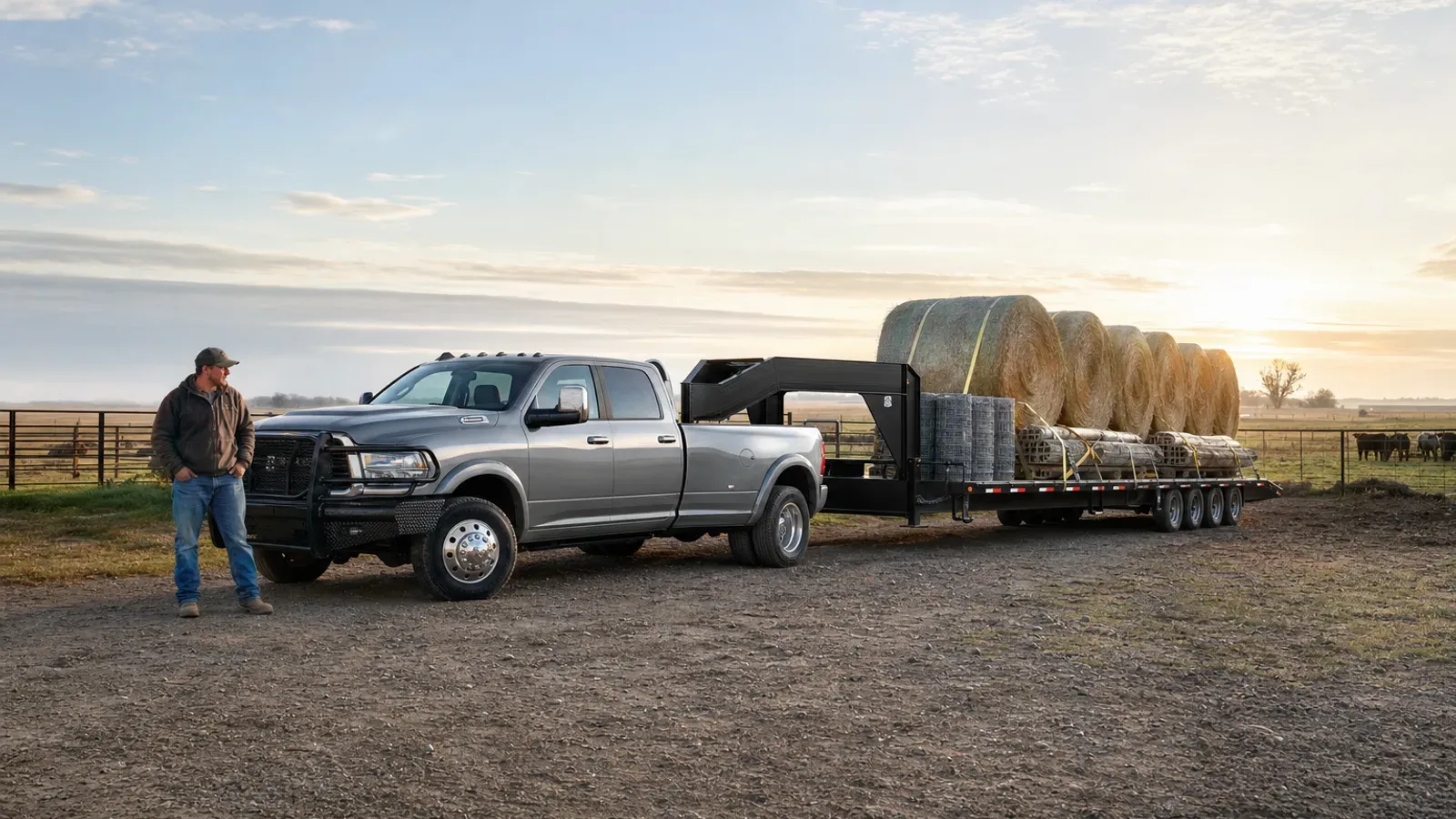
Agricultural hauling is generalist work at its hardest. One operation's trailer moves round bales Monday, a tractor Tuesday, fence posts and wire Wednesday, a pallet of feed and mineral Thursday, and somebody's stuck pickup on Saturday. The cargo list never closes and the weights run from a few hundred pounds to ten tons, so the trailer has to be long, strong, low enough to load by hand, and hitched to a capacity a bumper pull never offers.
That job description is basically the gooseneck flatbed's spec sheet, which is why rural America standardized on it decades before this site existed. The low deck suits hay hooks and hand labor, the 25-to-30-foot lengths take bales in ranks and posts by the bundle, the neck carries 10,000-to-16,000-pound payloads, and the one-ton already in the yard tows it.
Hay is the load that sizes everything. Round bales run 800 to 1,500 pounds depending on size and moisture, and a 30-foot deck racks 10 to 14 of them single-stacked, more if you pyramid. The payload usually runs out before the deck does. Twelve wet bales at 1,400 pounds is 16,800, well past the tandem-7K classes and into 10K-axle territory. Weigh a bale once a season and you load legal all year. Guess, and you'll meet the regulations eventually.
The equipment side runs the standard machine math for tractors with loaders, balers and implements, and the occasional skid steer, all covered on the equipment pages. One ranch note: implements run wide, and sprayers, disks, and duals cross the 8.5-foot line along with the permit rules that come with it.
The ag fleet, ranked
The first trailer is the gooseneck flatbed, 25 to 30 feet, with the axle tier chosen for the hay math, tandem 7Ks for lighter operations and tandem 10Ks where bales run heavy or machines ride often. Go with a wood deck, since the deck debate makes that case, a full stake-pocket rub rail for the load variety, slide-in ramps for the machine days, and dual jacks under the nose, which loaded goosenecks need.
The second trailer is the tandem utility, the errand horse for feed runs, parts trips to town, the ATV, and everything not worth hitching 30 feet for. A 7x14 or 7x16 at 7,000 GVWR behind the ranch's half-ton covers it, and the utility guide runs the class.
The specialty additions follow the operation. Livestock trailers are their own world, and this site doesn't cover them yet. A dump trailer joins operations moving feed, gravel, and manure at volume, and the gooseneck dump fits where the material math runs heavy. Equipment-specific builds come in when the machine list outgrows the flatbed's ramps, and the heavy-duty tier serves operations running real iron.
Hay, exemptions, and the ranch rhythm
Load the deck for the mixed duty it pulls. Rack hay against the neck first for pin weight, strap the bales in ranks with the winch-and-strap sets the rub rail is built for, center and chain posts and long material, and set machines at the deck marks with four-corner chains. Secure the mixed loads piece by piece instead of hoping they hold. The securing fundamentals apply at ag scale, and loose hay on a highway is both a citation and a fire waiting to happen.
Now the honest version of exemptions. Federal and state ag exemptions on CDL requirements, hours of service, and some equipment rules are real, but they're bounded, usually by distance from the farm, by whose commodity you're hauling, and by state lines. The coffee-shop version rounds all of that up to "farmers don't need CDLs," which is how ranchers end up meeting DOT officers on bad days. Your state's regulations draw the actual boundaries. Read them once against your operation so you know which trips are covered and which aren't.
Maintenance fights the ranch's own patterns, since trailers sit through whole seasons and then work daylight-to-dark for three weeks straight. Service the bearings and brakes before the season, not during it, date-check the tires because ranch trailers age standing still, test the breakaway battery in spring, and treat the pre-hay walk-around like the pre-flight check it is. A trailer that fails in hay season costs you the crop's timing, and that's the most expensive line item on any ranch.
Farm and ranch trailer FAQ
What's the standard ranch trailer?
The 25-to-30-foot gooseneck flatbed, low deck, tandem axles, behind the one-ton. It hauls hay, machines, fencing, and the whole catalog, which is exactly the job.
How many round bales fit on a 30-foot gooseneck?
Ten to 14 single-stacked depending on bale size, more if you pyramid, but weight caps you before the deck does. Heavy bales hit the tandem-7K payload around 10 to 12. Weigh a bale, then count.
Do farmers need a CDL?
Sometimes. Ag exemptions are real, but they're bounded by distance, commodity, and state. The safe move is to know your operation's actual coverage from the rules, not from the coffee shop.
What axles should the ranch gooseneck run?
Tandem 7Ks serve lighter hay and mixed work, tandem 10Ks buy margin for heavy bales and machines. The hay math, bale weight times count, picks the tier.
One big trailer or two?
Both. The gooseneck flatbed handles real loads and a tandem utility handles errands. Hitching up 30 feet for a feed run gets old by February.
What about livestock trailers?
They're their own category, not covered here yet. The flatbed-and-utility pattern above handles everything that doesn't walk on.