Best Trailers for Hauling Hay.

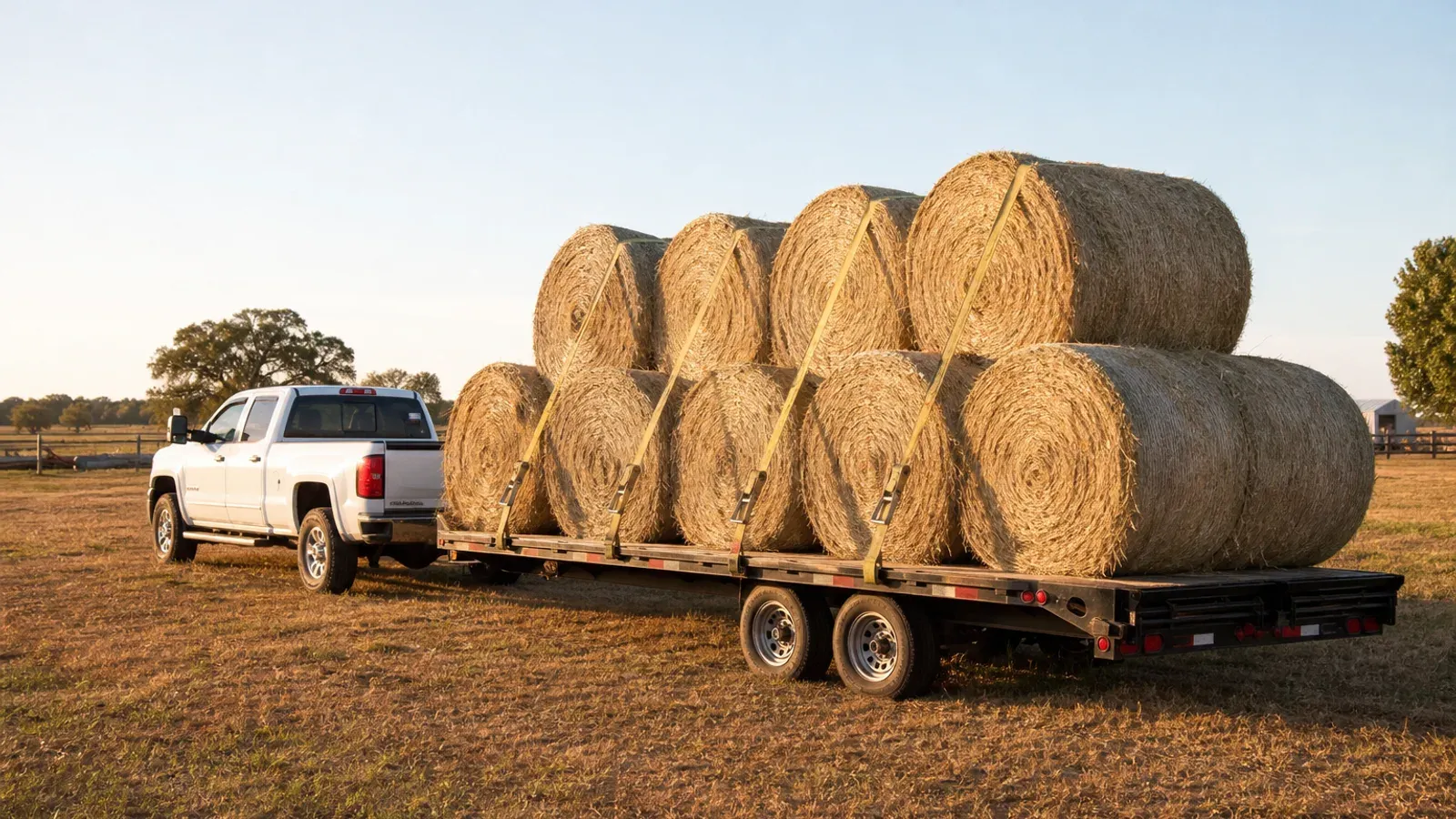
Hay hauling runs on bale math. Rounds weigh 800 to 1,500 pounds each, squares run from 50-pound two-strings to 1,400-pound big squares, and the trailer answer scales with the count. The 25-to-30-foot gooseneck flatbed is the working standard, racking 10 to 14 rounds behind a one-ton. Small counts ride the tandem flatbed honestly. Weigh a bale once a season, because the whole load plan hangs on that number.
Hay weights, the honest table
Hay is the ag world's volume-and-weight test, bulky enough to fill any deck and heavy enough to bury the axles first, with moisture the variable everyone underestimates. The same round bale runs 900 pounds cured and 1,400 wet-wrapped, so the trailer that legally hauls twelve of the first overloads at nine of the second.
| Bale Type | Typical Weight | The Load Math |
|---|---|---|
| Two-string square | 45 to 60 lb | Hand-stack economy, 100 bales is 5,000-plus lb |
| Three-string square | 90 to 110 lb | 50 bales crowds a 7K trailer |
| Round, 4x5 | 600 to 900 lb | The pickup-and-small-trailer round |
| Round, 5x6 | 1,100 to 1,500 lb | 10 bales is 11,000 to 15,000 lb |
| Big square, 3x4x8 | 1,100 to 1,400 lb | Stacks dense, weighs out fast |
The count writes the trailer spec. A 30-foot deck racks 10 to 12 5x6 rounds single-stacked, 14-plus pyramided, and the weight lands 11,000 to 18,000 pounds, which puts you in gooseneck territory by arithmetic, or tandem-10K-axle territory when the bales run heavy. The payload subtraction governs, and the moisture note bears repeating: weigh a bale from this year's cutting, not last year's memory.
Width matters too. A 5-foot round on a between-fenders deck rides the width line, and side-by-side rounds want the deckover's 102 inches or careful pyramid geometry, with the rules governing anything past legal width.
Best trailers for hay, ranked
The standard is the gooseneck flatbed, 25 to 30 feet, tandem 7Ks for moderate counts and tandem 10Ks where heavy bales run in ranks, the low deck loading by spear at tractor height and the neck carrying what the count weighs. It's the farm and ranch page's first trailer for exactly this cargo, and the rub rail's stake pockets take the strap pattern hay wants.
The small-count lane is honest. A tandem-axle flatbed hauls two to four rounds or a square-bale stack inside its 7K-to-10K math behind the half-ton, the whole answer for the acreage-and-horses tier. The volume lane runs the gooseneck deckover where rounds ride two-abreast and counts climb, treating width as capacity the way freight haulers do.
The wrong tools give themselves away. Dump boxes hold two bales and enclosed trailers hold humidity, and hay is open-deck cargo start to finish.
Stacking, strapping, and the moisture rules
Stack for the strap, not the photo. Load rounds flat-side down in contact ranks, key the pyramid tiers into the valleys below, set squares in interlocked courses, and bias the whole stack forward for tongue or pin weight with the heaviest tier low. The spear operator's placement is the load plan, ranks tight and ends square, and honor the deck mark, because loose stacking is what straps can't fix.
Strap by the rank. Run straps over the top at every rank or every second bale, sum the working-load limits per the securement math, and recheck tension at ten miles, because hay compresses under strap load and the tight morning stack rides loose by lunch. Netting or tarps handle the loose-hay rules most states carry, since chaff on the interstate is both a citation and a fire risk, and night hauls should light the overhang the last bale creates.
The season sets the maintenance rhythm. Service the bearings and brakes before cutting, date-check the tires on the trailer that sat since last season, and read the combination's ratings math once against your operation, because gooseneck counts cross into CDL territory and ag exemptions are narrower than assumed. The ranch page's honesty paragraph is worth a look on that last point.
Hay hauling FAQ
How many round bales fit on a 30-foot gooseneck?
Ten to 12 single-stacked 5x6 rounds, 14-plus pyramided, with weight capping the count before the deck does. Heavy bales at 1,400 pounds meet tandem-7K payloads around 8 to 10.
What trailer for a few bales at a time?
A tandem-axle flatbed at 7K to 10K hauls two to four rounds or a square stack honestly behind a half-ton. The small-herd standard.
How much does a round bale weigh?
Six hundred to 1,500 pounds by size and moisture, and this year's cutting is the only honest number. Weigh one, then plan the season on it.
How do I strap round bales?
Over the top per rank, tensioned into the bale's give, re-checked at ten miles as the hay compresses. Keep ranks tight and keyed so the stack rides as one body.
Can bales ride two-wide?
On a deckover's 102 inches, yes. Between fenders, the width math says no for 5-foot rounds, and past legal width the permit rules apply.
Do I need a CDL for hay hauling?
Heavy gooseneck counts cross the combined-ratings line, and ag exemptions are real, bounded, and state-specific. Read the rules against your operation once.