Flatbed vs. Deckover. Which Open Deck to Buy.

The flatbed runs its deck low between the fenders, which makes it easier to load and calmer to tow. The deckover rides above the wheels, buying the full 102-inch width and giving up 8 to 12 inches of loading height. Wide loads, pallets two-abreast, and forklift freight buy the deckover. Hand loading, narrow cargo, and a sense for center of gravity keep the flatbed. Measure the widest load you'll haul regularly, and it decides.
Flatbed vs. deckover at a glance
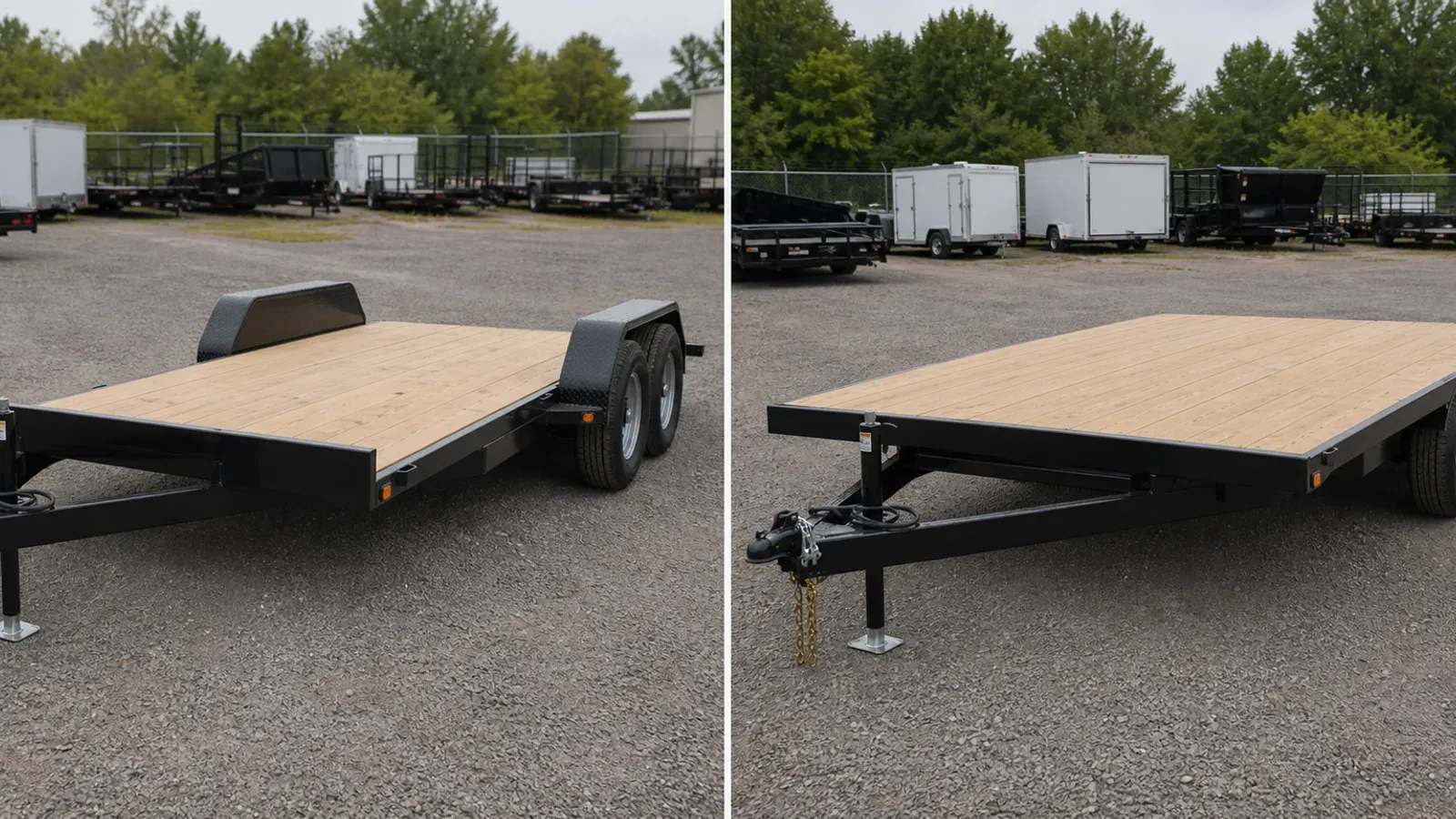
| Flatbed | Deckover | |
|---|---|---|
| Deck height | 22 to 30 in | 32 to 38 in |
| Usable width | 76 to 83 in between fenders | Full 102 in |
| Fender wells | Interrupt the deck edges | None, flat corner to corner |
| Hand loading | The friendly one | The step-stool one |
| Center of gravity | Lower | Higher, minds its loads |
| Pallets two-wide | No | The whole point |
| Drive-on angle | Gentler | Steeper, wants dovetails |
| Price and weight | The baseline | More steel, more money |
The flatbed and the deckover are the open-deck world's height-versus-width fork, one frame decision that cascades into everything above it. Both guides cover their sides in depth. This page just holds the tape measure.
Low wins the daily life
The flatbed's argument is ergonomic and physical at once. The 22-to-30-inch deck loads at hand height, lumber slides on, hay stacks at shoulder level instead of overhead, and the day's fiftieth lift ends at a deck the back can reach. Every drive-on load meets a gentler angle, which the dovetail page lays out in geometry, and every ton aboard rides 8-to-12 inches lower. You feel that center-of-gravity dividend in each crosswind and ramp the loaded trailer meets.
The fenders are the price. Wheel wells own their real estate, cargo width is capped at the between-fender measurement, and pallets load single-file. For the narrow-and-mixed cargo life, materials, machines with standard stances, and the general catalog, the cap never binds and the flatbed's lower everything wins the decade.
Weight and money run the same way. Less steel in the deck structure returns hundreds of pounds as payload, and the purchase price sits below where the deckover starts. The default is the default for good reasons.
Width wins the freight
The deckover's argument is dimensional. The deck rides above the wheels and spans the frame's full 102 inches, no wells, no interruptions, so pallets load two-abreast by forklift from any side and wide machines track aboard without fender geometry in the way. The deck sits right at the federal width limit, so flush cargo travels permit-free. The deckover guide runs the freight economics, and the gooseneck version is the hotshot industry's standard because those economics scale.
The height is the tax, and it's worth itemizing honestly. Loading rises 8-to-12 inches for every hand and every ramp, drive-on angles steepen into the dovetail-and-ramp conversation, and the load's center of gravity rides up with the deck, so crosswinds and slopes want more attention than the flatbed ever asks. The extra steel in the structure costs both payload and purchase price.
For freight-shaped work the tax pays itself, forklifts never notice deck height, and width-per-trip is revenue. For everything else it's height bought and carried for nothing, which is the whole caution of this comparison.
The tape measure decides
Measure the widest load you'll haul regularly. Past the between-fender number, roughly 76-to-83 inches depending on build, the deckover was decided before preferences got a vote, wide machines, two-abreast pallets, and oversize material have exactly one open-deck answer. Under it, the flatbed hauls the same cargo lower, lighter, cheaper, and calmer, and the width you didn't buy never gets missed.
Loading method breaks the remaining ties. Forklift-fed operations shrug at deck height and lean deckover where volume tempts, hand-and-ramp operations feel every inch and lean flatbed at any width that permits it. And the gooseneck tier reruns the same fork at heavy weights, with the gooseneck flatbed and gooseneck deckover pages carrying the identical trade at bigger numbers.
Here's the honesty in both directions. A deckover bought for width never used is the market's most common height regret, and a flatbed met by its first wide machine is a trade-in story. Run the tape measure over the actual cargo list, and you avoid both.
Flatbed vs. deckover FAQ
How much wider is a deckover really?
The full 102 inches against 76-to-83 between a flatbed's fenders, roughly 2 feet of usable width, which is exactly one more pallet.
How much higher is the deckover's deck?
Eight to 12 inches, commonly 32-to-38 total, felt in every hand load, ramp angle, and crosswind the trailer meets.
Is the deckover less stable?
Loads ride higher, the wheels sit wider, and the net is a trailer that tows well loaded sensibly and punishes tall careless loads. The flatbed simply asks less of you.
Which loads easier by forklift?
The deckover, from any side, with no fenders in the fork path. Forklift operations are the configuration's home crowd.
Does the same choice exist at gooseneck weights?
Identically, with the gooseneck flatbed and gooseneck deckover running this exact trade at heavy scale.
Which costs more?
The deckover, in purchase price and empty weight both, since the full-width deck is more steel. Width bought unused is the category's classic overspend.