Gooseneck Flatbed Trailers Explained.

A gooseneck flatbed runs its deck low between the fenders behind the neck, pairing an easy loading height with 14,000 to 22,000-plus pounds of capacity. It's the ranch and general-hauling favorite of the family, lower to load by hand than a deckover, and the wheel wells are the price you pay for that. Buy it for mixed work at gooseneck weights. Wide loads want the deckover instead.
The low deck behind the neck
The gooseneck flatbed answers a simple want: everything the gooseneck connection buys you, capacity, stability, and tight turning, on a deck that doesn't need a step ladder. It rides between the fenders at roughly 24 to 30 inches, a comfortable height for hand loading, hay handling, and whatever else a ranch throws at a trailer, while the neck carries weights no bumper-pull flatbed can touch.
The choice inside the family is deck height, and the flatbed is one side of it. The gooseneck deckover raises the deck above the wheels for a full 102-inch width, while the flatbed keeps it low and lets the fenders eat into the deck edges. The flatbed versus deckover comparison plays out the same at gooseneck weights as anywhere. Wide and palletized loads point you up to the deckover, hand loading and a low center of gravity point you down to this deck.
The cargo profile is the generalist's list at heavy weights. Hay by the stack, fencing and posts by the mile, mixed ranch and jobsite freight, machines of modest width, and all the thousand-pound miscellany a heavy operation generates. The one thing the fenders limit is width, which the deckover never has to worry about. Anything wider than the between-fender measurement loads over the wheels or not at all.
Who buys it? Ranch and ag operations first, this is practically the official trailer of the rural Texas parking lot, plus contractors whose loads run heavy but narrow, and anyone stepping up from a bumper-pull flatbed that outgrew its hitch. The flatbed guide covers the deck's fundamentals, and this page covers what the neck changes.
Neck math on a low frame
The neck's arithmetic follows the standard gooseneck rules. Pin weight lands at 15 to 25 percent of loaded weight in the truck bed, counted against the truck's payload. Figure on a one-ton past the lightest classes, and count the hitch install as part of the entry cost. The low deck adds one geometry note. The neck rises more steeply from a lower frame, so quality builds gusset the transition to match. Look it over, because it's the highest-stress joint on the trailer.
The deck follows flatbed convention at a heavier spec. Expect treated wood over 16-inch crossmembers, I-beam or heavy channel mains, a full-length rub rail with stake pockets, and weld-on D-rings where machines chain down. The fenders break up the deck edges, and the trade works around them every day, bridging loads over, stacking around, or running them down the center line. The fender tops are built heavy because everyone stands on them, whatever the sticker says.
Length and axles scale with the class. Decks run 20 to 32 feet on tandem 7K axles up through tandem 10K and 12K, with brakes on every axle, load range G at the heavy end, and dual jacks under the nose. Ramps are the working option, slide-in or stand-up for the machines that ride once in a while, and the equipment configuration takes over when machines become the main job.
Gooseneck flatbed sizes and payload
| Class | Typical GVWR | Typical Payload | Common Fit |
|---|---|---|---|
| 20 to 25 ft, tandem 7K | 14,000 to 15,900 lb | 9,800 to 11,600 lb | Ranch general, hay, fencing |
| 25 to 30 ft, tandem 7K | 15,900 lb | 10,400 to 11,400 lb | The rural standard |
| 25 to 30 ft, tandem 10K | 20,000 to 22,000 lb | 14,200 to 16,400 lb | Heavy freight, machines |
| 32 ft-plus, 12K or triple | 23,000 to 25,900 lb | 16,000 to 18,800 lb | Max loads, long material |
Payload after curb weight is still the honest number to watch, and low-deck goosenecks run a little lighter than their deckover twins, a modest payload edge that adds to the easier loading. The 25-foot tandem-7K class is the heart of the configuration, big enough for real work, light enough to live with daily, and priced at the entry to the gooseneck market.
The truck and license math is the same as the guide's, one-tons as the working floor, duallys as pin weights climb, and commercial rigs crossing the 26,000-pound CDL line routinely at the heavy end. Federal and state rules have the details, and the ranch exemptions a lot of buyers count on are narrower than the coffee-shop version. Read them before you rely on them.
Where the gooseneck flatbed wins and loses
Here's the buying rule. Measure your widest regular load. If it fits under the between-fender number, this deck hauls everything lower, lighter, and cheaper. If it doesn't, the deckover was always your answer.
Gooseneck flatbed FAQ
Gooseneck flatbed or deckover?
Width decides. Loads under the between-fender measurement ride lower and easier here, while wide and palletized freight wants the deckover's full 102 inches. The comparison walks through it.
What truck does one need?
A one-ton as the working floor, sized by payload against 15 to 25 percent pin weight. The lightest classes will tolerate a strong three-quarter-ton, but barely.
How much hay fits on one?
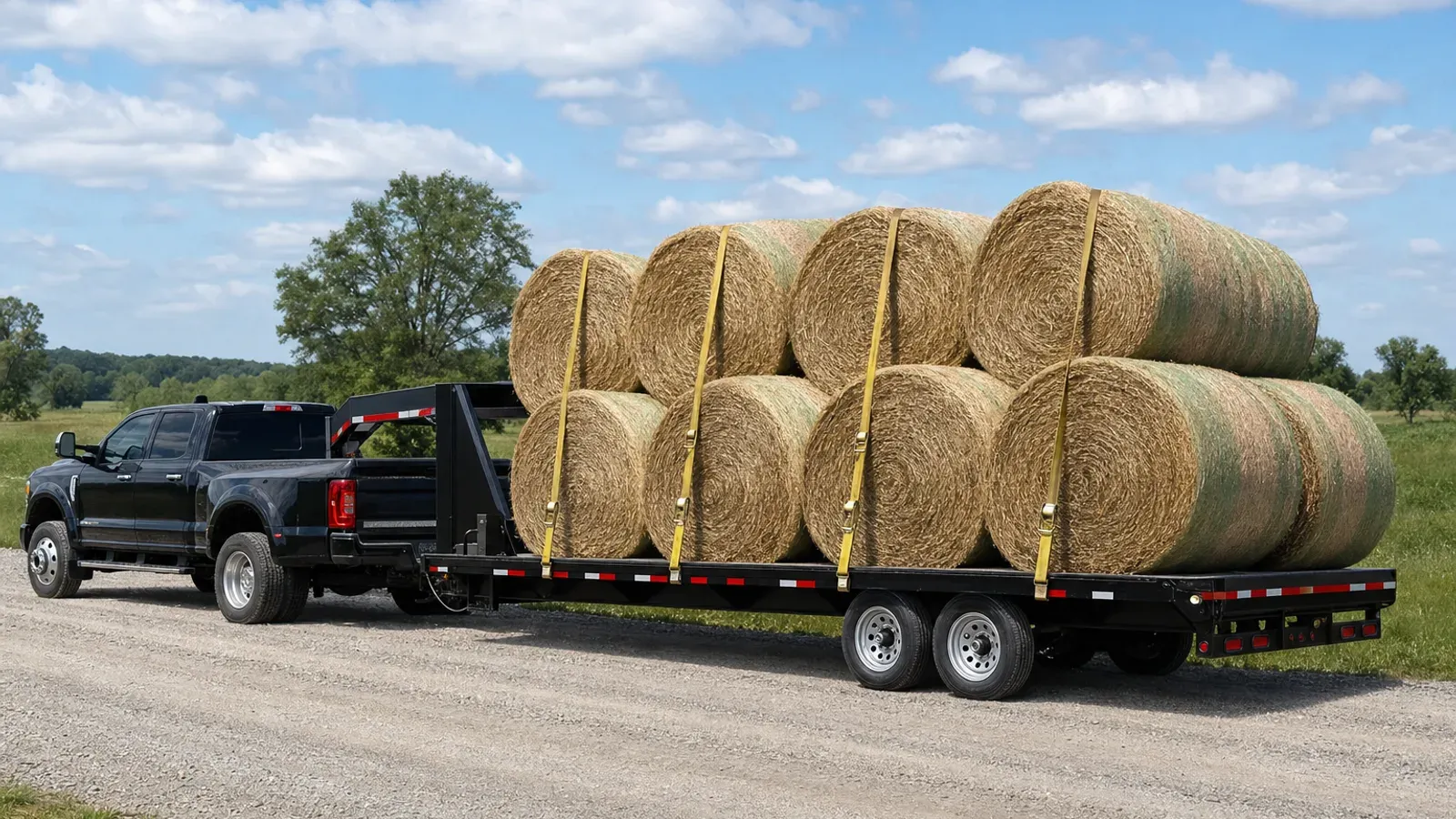
A 30-foot deck stacks 12 to 16 round bales two-high, depending on size. At 800 to 1,500 pounds a bale, you hit the payload ceiling before you run out of deck. The hay page runs the math.
Can it haul machines?
Yes, with ramps and rated tie-downs, as long as it fits the width. If machines are your first priority, read the equipment configuration, since the dedicated build loads better.
Do I need a CDL?
Commercial combinations at this tier cross 26,000 pounds routinely. Ranch and ag exemptions exist, but they're narrower than most people assume, so check the rules against your state and how you use the trailer.
Why is the deck lower than a deckover by so much?
The deck sits between the wheels instead of above them, a difference of 8 to 12 inches. That one measurement is the whole configuration, and both camps know exactly which side they're on.