Payload vs. Towing Capacity Explained.

Towing capacity is what the truck can pull, payload is what it can carry, and payload runs out first on almost every real combination. Tongue weight, passengers, fuel, tools, and the hitch itself all spend payload, so a truck rated to tow 13,000 pounds routinely runs out of payload behind a 9,000-pound trailer. Find both numbers on the door jamb, then do the subtraction this page walks through.
Pulling versus carrying
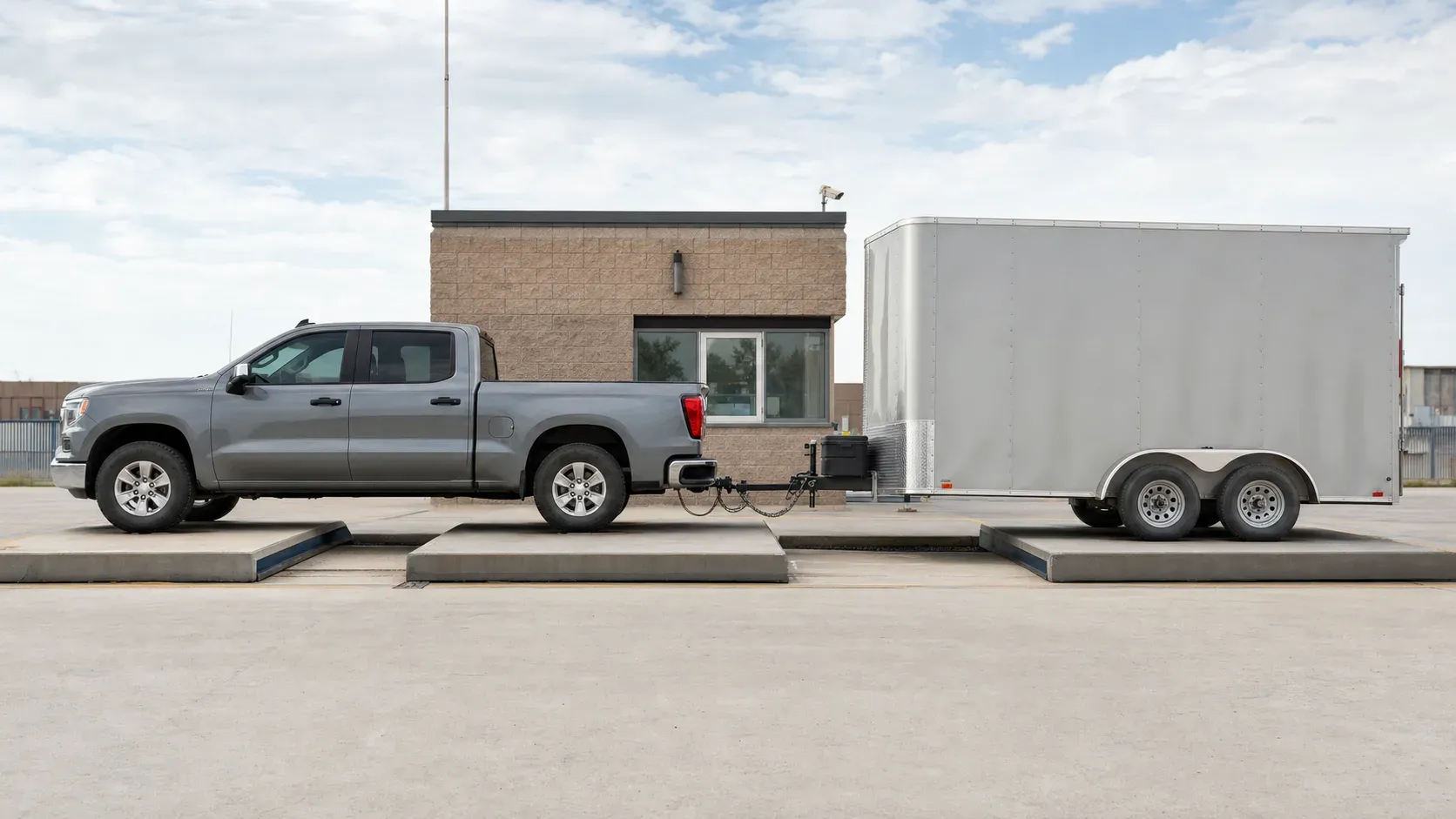
Towing capacity measures the truck's ability to pull weight rolling behind it, with the engine, transmission, cooling, frame, and brakes all voting. It's the number the commercials advertise because it's the big one. Payload measures the truck's ability to carry weight pressing down on it, with the springs, axle, tires, and frame voting, and it's the number that governs real combinations, because tongue weight is carried, not pulled.
Both numbers live on the truck itself. The door-jamb tire-and-loading placard states payload directly, "the combined weight of occupants and cargo should never exceed," and that figure is the truck's actual as-built number, options, cab, and bed included. Towing capacity lives in the owner's manual and the manufacturer's towing guide, by configuration. The brochure's headline number belongs to a specific stripped configuration nobody bought. The placard belongs to your truck.
The relationship is the trap. A bumper-pull trailer puts 10-to-15 percent of its loaded weight on the hitch, a gooseneck puts 15-to-25 percent in the bed, and every pound of it spends payload alongside the passengers, the dog, the toolbox, and the hitch hardware itself. The tow rating rarely blinks, but the payload placard runs dry, and a combination that's legal by the commercial is overloaded by the door jamb.
Run your own numbers
The worksheet is four lines. Start with the placard payload. Subtract everyone riding in the truck. Subtract cargo, tools, and the hitch hardware, since a weight-distribution setup runs 100 pounds and a gooseneck ball and rails 150-plus. What remains is the tongue or pin budget, and dividing it by the percentage, 12.5 percent bumper-pull or 20 percent gooseneck as working midpoints, gives the loaded trailer weight the truck actually carries honestly.
| Example | Half-Ton | Three-Quarter-Ton | One-Ton Dually |
|---|---|---|---|
| Placard payload | 1,750 lb | 3,200 lb | 5,600 lb |
| People and cargo | 500 lb | 500 lb | 500 lb |
| Hitch hardware | 100 lb | 100 lb | 200 lb |
| Tongue or pin budget | 1,150 lb | 2,600 lb | 4,900 lb |
| Honest trailer, loaded | ~9,200 lb bumper | ~14,000 lb bumper | ~24,500 lb gooseneck |
The table explains the whole truck market in one pass. The half-ton's 13,000-pound tow rating meets a 9,200-pound payload reality, the three-quarter-ton is the 14K trailer class's honest partner, and the dually exists because pin weight is a payload problem and nothing else solves it.
Two footnotes finish the math. GCWR, the combined rating for truck plus trailer, caps the total and occasionally binds before payload on max-tow configurations. And the rear-axle and tire ratings sit under the payload figure, respected automatically when the placard is, exceeded now and then by bed-heavy loading the placard math would have caught.
Using the numbers at the dealership
Shop the trailer and truck as one purchase, whichever comes second. Buy the trailer first and its loaded weight and hitch percentage write the payload requirement, and the truck class page that meets it, half-ton, three-quarter, or one-ton, reads from there. Buy the truck first and the placard writes the trailer ceiling, and every trailer page on this site states loaded-weight reality against it.
Verify rather than trust, twice. At the truck, read the actual placard, because payload varies 400-plus pounds across trims of the same model, and the crew cab with the panoramic roof carries less than the work truck. At the scale, weigh the loaded combination once, truck axles and trailer axles, and learn where the real numbers sit against the ratings. It's the cheapest education in towing.
And when the math comes up short, the answers rank. Load lighter or move weight forward off the tongue, within the tongue-weight band. Spec the next truck class. Or step up the trailer's connection, since the gooseneck conversation exists because bed-carried pin weight uses payload more efficiently at heavy weights than a receiver ever can. What never ranks is ignoring the placard, because that's the number the insurance adjuster reads.
Payload vs. towing FAQ
Why does payload matter more than towing capacity?
Because tongue weight is carried, not pulled, and it spends payload alongside passengers and cargo. Payload runs out first on most real combinations, usually by thousands of pounds.
Where do I find my truck's real payload?
On the driver's door-jamb placard, the as-built number for your exact truck. The brochure figure belongs to a configuration you didn't buy.
How much payload does towing use?
Ten-to-15 percent of loaded bumper-pull weight, 15-to-25 of gooseneck, plus hitch hardware. A 10,000-pound bumper-pull spends 1,000-to-1,500 pounds before anyone climbs in.
Can I exceed payload if I'm under the tow rating?
No. Every rating binds independently, and the lowest governs. Over-placard is overloaded regardless of what the tow rating still had left.
Does a weight-distribution hitch add payload?
No, it redistributes tongue weight across axles for control and level, per its page. The placard math is unchanged.
What's GCWR?
The rated maximum for truck plus trailer combined, checked alongside payload. It occasionally binds first on max-tow configurations, and the manual states it per configuration.