Weight-Distribution Hitches Explained.

A weight-distribution hitch uses spring bars as levers to push a share of the tongue weight forward onto the truck's front axle and back onto the trailer's axles, restoring the level, steering, and headlights the tongue took away. It unlocks a receiver's higher distributing rating, adds sway control on most designs, and fixes distribution, never overload. It earns its keep from roughly 6,000 loaded pounds on half-tons, earlier on SUVs.
Levers against the squat
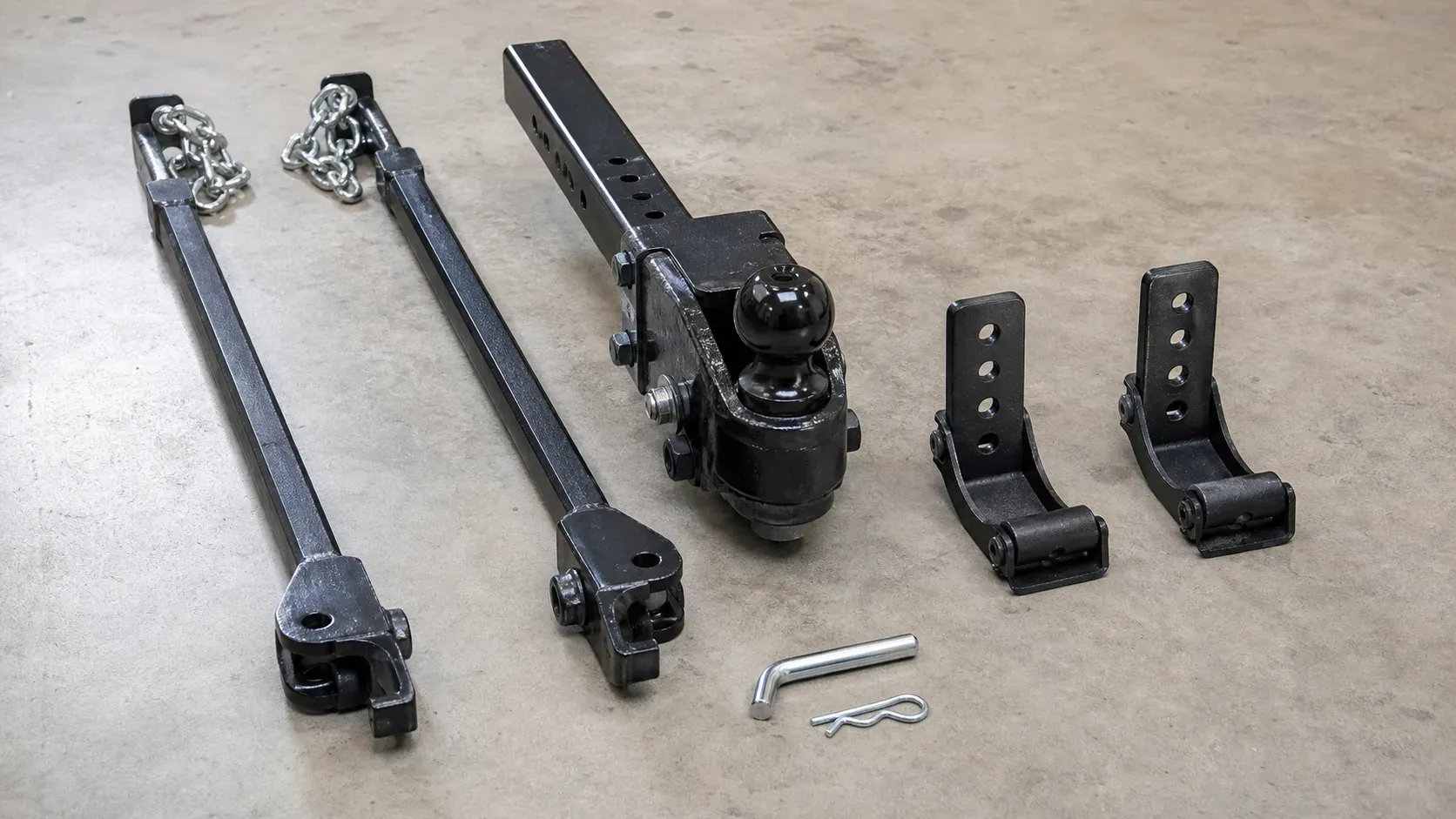
Tongue weight lands behind the truck's rear axle and acts as a lever. It squats the rear, lifts the front, lightens the steering, and aims the headlights at the sky, the geometry every loaded receiver hookup demonstrates. The weight-distribution hitch answers with counter-leverage. Spring bars run from a special ball-mount head back to chains or brackets on the trailer's frame, tensioned so the bars pry the whole joint upward and rotate load forward onto the truck's front axle and rearward onto the trailer's axles. The tongue weight doesn't shrink, the payload page's math is unmoved, it just redistributes, which is the name.
What it restores is measurable at the fenders. The front axle is loaded again, the steering and braking geometry is back, the rear squat is leveled, and the headlights point at the road. It also unlocks the receiver's higher weight-distributing rating, so the same hardware legally carries more with the bars installed. Sway control rides along on most modern designs, with friction built into the bar-and-bracket interface to resist the yaw oscillation a light tongue invites. It's a mitigation worth having, and never a license for the bad loading it mitigates.
What it never fixes closes the definition. Overloaded payload stays overloaded, an out-of-band tongue percentage stays out of band, and a WD hitch bolted onto either is just equipment spent hiding a problem the scale still sees.
Setup and the trigger weights
Setup is a fender-measurement exercise, done once per truck-trailer pair. Measure the truck's front and rear fender heights unhitched, then hitch and tension the bars until the front fender returns to within a half inch of its unhitched height, with the rear sharing the squat evenly. The head's angle and chain links memorize the answer after that. Modern designs tension by chain links, cam brackets, or head tilt, so follow the manual's sequence, and verify the result the honest way, a level trailer, restored steering feel, and headlights that stopped apologizing.
The operating notes are short. Size the bars to the tongue weight band, 800-to-1,200-pound bars for a 1,000-pound tongue, since oversized bars ride harsh and undersized ones surrender. Unload the bars for sharp low-speed maneuvers where the manual says so, and always before backing into steep transitions. And silence the friction sway units on rain-slick roads per their manuals, because physics prefers honest traction to added friction there.
The trigger weights sort out cleanly. Half-tons want one from roughly 6,000 loaded pounds, SUVs from 4,000 on their shorter wheelbases, and three-quarter-tons at the 14K class's tops. Every manual's own threshold governs where it's stated, and several manufacturers require the hitch above specific weights as a warranty and rating condition.
Weight-distribution FAQ
What does a weight-distribution hitch actually do?
It levers a share of the tongue weight onto the truck's front axle and the trailer's axles, restoring level, steering, and braking geometry. That's redistribution, not reduction.
When do I need one?
Half-tons from roughly 6,000 loaded pounds, SUVs from 4,000, and wherever the truck's manual states a threshold. The receiver's distributing rating often requires it above its carrying number.
Does it increase my payload or towing capacity?
Payload, never, since the placard math is untouched. It unlocks the receiver's higher distributing rating, which is a hitch-hardware number, not a truck one.
Does it stop sway?
Most modern designs add friction sway control, a real mitigation for the oscillation proper tongue weight prevents. It manages sway, loading prevents it.
Can I use one with a surge-brake trailer?
Many friction designs interfere with surge actuation, so the trailer and hitch manuals both rule. Electric-braked trailers pair without the question.
How do I know it's set right?
The front fender within a half inch of its unhitched height, the squat shared evenly, the trailer level, the steering restored. The tape measure is the tool, twice.