What Can a Dually Tow?

The dually is the one-ton with dual rear wheels, four tires carrying the rear axle's load, payload placards past 6,000 pounds, and tow ratings running to 40,000 with the right hitch. It exists for pin weight. Every heavy gooseneck, hotshot, and multi-car rig assumes it, and it charges for the capability in width, ride, and parking. Pin weights past 4,000 pounds buy it, and everything lighter doesn't need it.
Four tires where two ran out
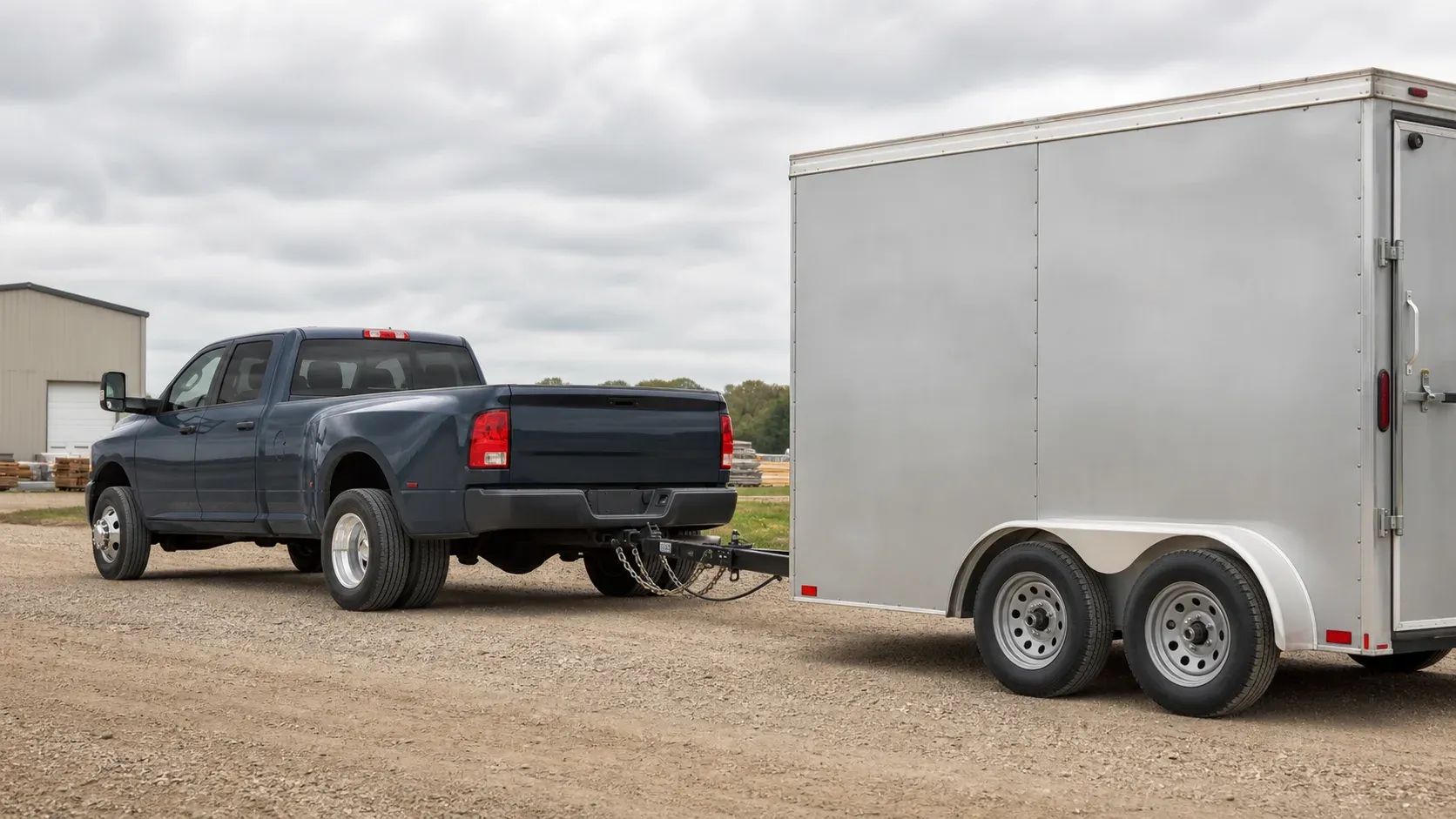
The dually is what happens when the rear axle's arithmetic exhausts single tires. Dual rear wheels double the rubber under the load, rear axle ratings climb past 9,000 pounds, payload placards run 5,200 to 6,500-plus, and the wider stance adds a stability that heavy pins reward, since the trailer's side loads meet a wider, stiffer base. The one-ton page covers the class the dually crowns, and this page covers the crown.
The purpose is pin weight, plainly. A 25,900-pound gooseneck runs 4,000 to 5,500 pounds of pin, a 40-foot hotshot deckover the same, and a loaded three-car wedge past that. The payload math admits exactly one truck configuration to those numbers. Dually buyers aren't buying towing capacity, they're buying placard, and the industries that live at these weights standardized on it generations ago.
The heavy rows, exclusively
| Rig | Loaded Reality | Pin Weight |
|---|---|---|
| Hotshot deckover, 40 ft | 24,000 to 25,900 lb | 4,000 to 5,500 lb |
| Hydraulic dovetail | 22,000 to 25,900 lb | 3,800 to 5,200 lb |
| Wedge, three-car | 20,000 to 25,900 lb | 3,500 to 5,000 lb |
| Gooseneck equipment, heavy | 22,000 to 30,000 lb | 4,000 to 6,000 lb |
| Enclosed stacker | 21,000 to 30,000 lb | 4,000 to 6,000 lb |
| Heavy hay and ag | 18,000 to 25,900 lb | 3,200 to 5,200 lb |
The table is the dually's whole market, the heavy gooseneck rows of every ecosystem on this site. The line under it is the SRW handoff: pin weights under 4,000 pounds serve honestly on single rear wheels, and the dually's costs go uncollected. The class is a specialist, the right answer to a specific number.
Living with the width
The capability charges daily. The fenders run 8 feet, so drive-throughs, parking decks, and striped spaces all vote against you. Six tires replace and rotate instead of four, the inner duals demand valve extensions and a pressure habit, and the unloaded ride is agricultural, since springs built to carry 6,000 pounds have opinions about carrying none. Operators who need the placard treat all of it as rounding error. Everyone else discovers why the SRW exists.
The working habits are the one-ton's at full scale. Verify pin against the placard on every load, run a gooseneck hitch rated past everything, check inner-dual pressures because the hidden tire fails silently, and expect to cross the CDL line by design on working combinations, per the rules. A dually pulling its intended loads is the most composed heavy rig on the road, which was the whole point of buying it.
Dually FAQ
Why buy a dually instead of a regular one-ton?
Payload, the placards past 6,000 pounds that pin weights over 4,000 require. The dual wheels are how the rear axle carries it, and the stability is the bonus.
How much can a dually tow?
Ratings run 30,000 to 40,000 with gooseneck hitches by configuration, and the placard governs as always, carrying the 25,900-GVWR trailer world with margin.
What's the downside?
Width, six-tire costs, unloaded ride, and parking. The capability taxes daily life, which is why pin weight, not preference, should buy it.
Do hotshot operators need duallys?
It's the industry standard by arithmetic, since 40-foot deckovers' pins exceed SRW placards. The hotshot page runs the rig in full.
What about inner dual tires?
They're the hidden maintenance item, checked with valve extensions and a gauge habit, because the inner dual fails quietly and takes the outer with it loaded.
Dually or SRW for a 20,000-pound gooseneck?
Run the pin math. 20K loaded at 18-percent pin is 3,600 pounds, SRW territory on strong placards. At 22K-plus the dually was always the answer.