Wedge Car Haulers Explained.

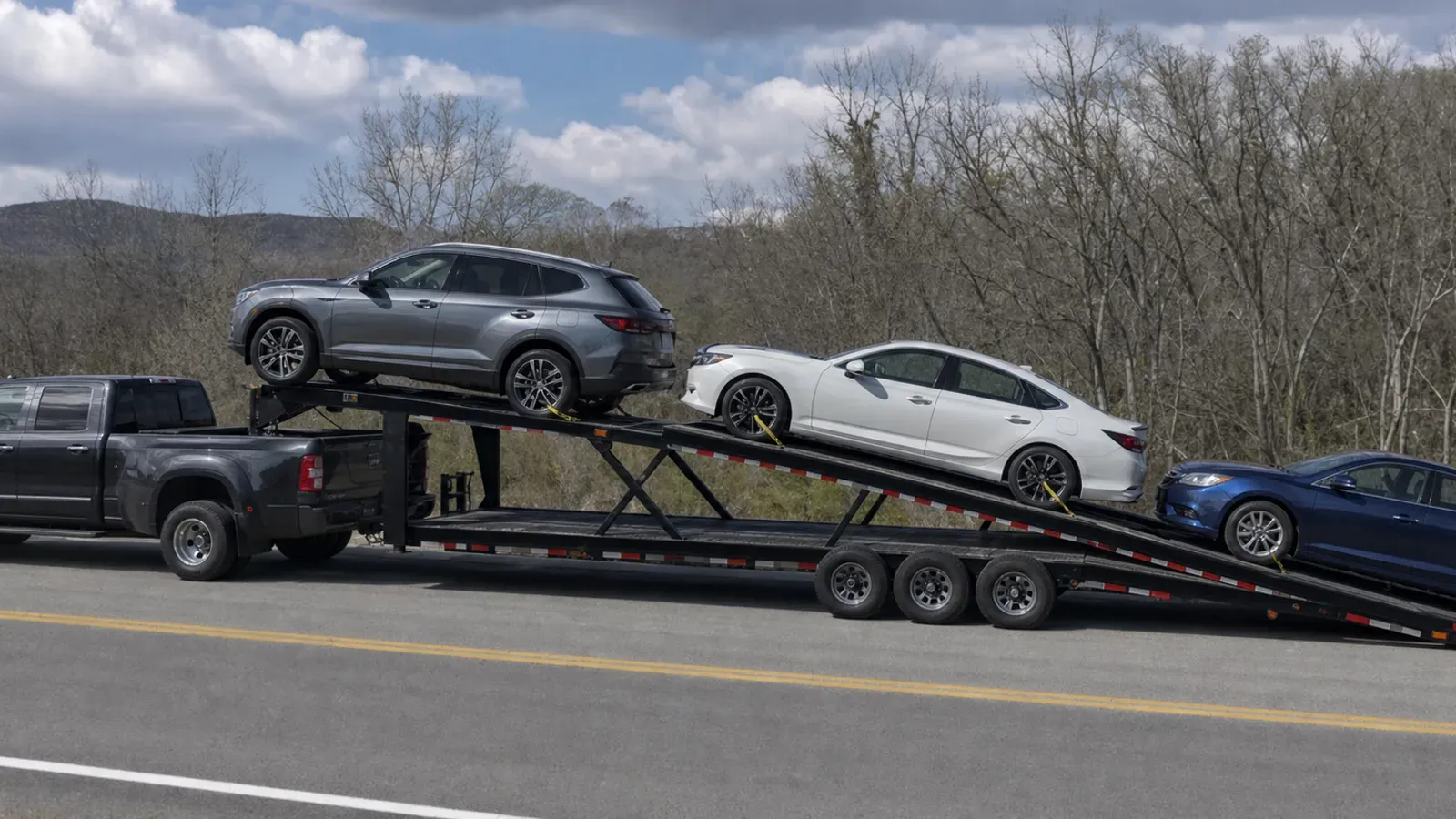
A wedge car hauler angles its deck so vehicles park nose-down in overlapping tiers, fitting two or three cars in the length a flat deck gives one and a half. It's the small transporter's workhorse, a gooseneck behind a dually that loads back-to-front in strict order. Cars per trip is the business math that buys it. Single-car owners are on the wrong page, happily.
What the wedge shape buys
The wedge is what happens when cars per trip becomes the paycheck. The deck runs as an incline, or a series of them, from low at the rear to high over the neck, and vehicles park nose-down along it, each car's nose tucking into the airspace behind the one ahead. The overlap is the product. A 40-foot wedge carries three sedans where a flat deck carries two with room left over for regret.
The configuration lives in the gooseneck world out of necessity. Two or three vehicles gross 8,000 to 15,000 pounds before the trailer's own steel, well past bumper-pull physics, and the neck's stability earns its keep under a load that tall and long. The multi-car guide covers the family's other formats, the stacked and full-deck designs. The wedge is the volume seller because it's the simplest structure that multiplies the count.
The typical buyer is the small transporter. Auto haulers running two- and three-car loads under their own authority, dealers shuttling auction buys, and the owner-operators of the broker-app economy, the tier below the nine-car stinger and above the single-car dovetail. The wedge is that tier's standard tool, and its economics, cars per trip against fuel, authority, and the note, are the real subject of this page.
Who shouldn't be here, cheerfully, is the single-car owner. The wedge's angles, order-dependent loading, and dually math all serve volume, and one car rides a standard hauler flatter, cheaper, and easier in every way.
Tiers, order, and clearance math
The geometry is overlap by inclination. Deck angles run 8 to 12 degrees along the tiers, each vehicle's nose descending into the gap behind the car ahead, its roofline clearing the deck above or the neck structure by inches you measured rather than hoped for. Layouts vary by builder, from continuous wedges to stepped two-tier designs to neck-deck combinations that carry the third car high over the pin, and each publishes a clearance envelope that your actual vehicles either fit or don't. Measure your tallest and longest before the deposit. You buy a wedge against a car list, exactly as you buy an equipment trailer against machines.
Loading order is not optional. Rear positions load first and unload last, the sequence runs back-to-front, and a mixed delivery route either gets planned around the stack or has the driver re-parking three cars at every stop, the trade's least favorite cardio. Ground clearance matters at the angles too. Low cars crossing the tier transitions want ramp extensions and patience, and the ramp guide's geometry lessons apply at every tier break.
Securement multiplies by the count. Four points per vehicle, wheel straps as the transport standard, each car strapped on its own against its tier's angle, and the nose-down parking adds a gravity bias the straps carry all day. The tie-down guide covers the hardware. The wedge just buys it in triplicate, plus the winch that dead auction cars make mandatory.
The combination is commercial from the start. A loaded three-car wedge grosses 20,000-plus pounds behind a one-ton dually, pin weight at the family's 15 to 25 percent, and it crosses the CDL line by design. The authority-and-insurance stack of commercial transport rides along, covered under the regulations.
Wedge sizes and car math
| Class | Typical GVWR | Typical Payload | Car Count |
|---|---|---|---|
| 35 ft, tandem 10K | 20,000 to 22,000 lb | 13,600 to 15,600 lb | 2 comfortably, 3 small |
| 40 ft, tandem 12K | 23,000 to 25,900 lb | 15,600 to 18,200 lb | 3 sedans, the standard |
| 44 ft-plus, tandem dual | 25,900 to 30,000 lb | 17,200 to 20,800 lb | 3 trucks and SUVs |
The car math runs weight and length together. Three modern sedans gross 10,500 to 13,500 pounds, three trucks and SUVs blow past 15,000, and the payload math against 7,000-to-8,500-pound empty weights decides which inventory the trailer can legally carry. A transporter hauling whatever the board posts sizes for the truck-and-SUV reality, because the modern fleet's weight curve moved and the wedge classes moved with it.
Length does its own gating. Forty feet of trailer behind a crew-cab dually is a 65-foot combination that has to plan its fuel stops, and the hotshot guide's operational realities transfer to car transport almost word for word, the scales, the permits at the margins, and the rhythm of maintenance as fleet overhead.
Where the wedge wins and loses
The buying rule. A wedge is bought by a spreadsheet, cars per trip times rate minus the combination's costs, and that spreadsheet either clears the note or it doesn't. Transport buyers already know this. For everyone else, the standard hauler was the answer.
Wedge car hauler FAQ
How many cars fit on a wedge?
Two on the 35-foot class, three sedans on the 40-foot standard, three trucks or SUVs on the 44-plus builds, with weight and the clearance envelope both having a say.
Why do the cars sit nose-down?
For the overlap. Each nose tucks under the tail space of the car ahead, which multiplies the count per foot. The angle is the whole design.
What truck pulls a wedge?
A one-ton dually, sized by payload against 3,000-to-5,000-pound pin weights. Loaded combinations routinely gross past 20,000 pounds.
Do I need a CDL and authority?
At these combined ratings you're in commercial transport, so yes to both, plus the insurance stack. Federal and state rules cover it, and you should budget the compliance along with the trailer.
Can low cars ride a wedge?
Usually, with ramp extensions and care at the tier transitions. Builders publish the clearance envelope and approach angles, so check them against the actual car.
Wedge or stacker?
The wedge multiplies by incline, which is cheap and simple. Stackers multiply by hydraulic second decks, which means more cars and more money. The multi-car guide runs the family.