Multi-Car Trailers Explained.

Multi-car trailers move two to four vehicles per trip in three formats, the wedge's angled overlap, the stacker's hydraulic second deck, and the long flat deck's simplicity. All of them live in the gooseneck world behind duallys and all run on commercial math. The format follows the fleet. Transporters run wedges, race teams and collectors run stackers, and anyone who just needs two cars runs the flat 30-footer.
The three ways to multiply cars
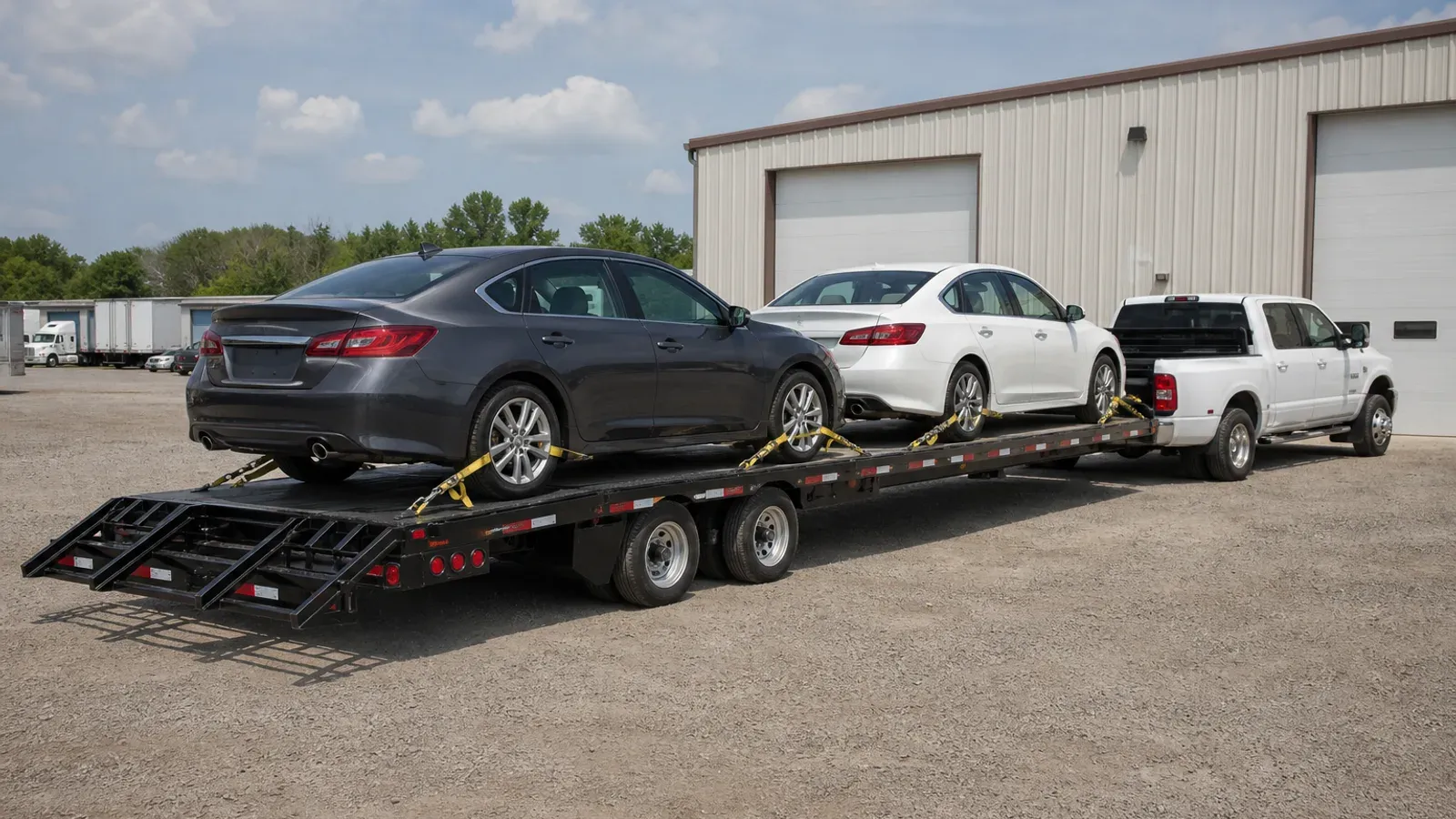
Multi-car is a set of answers to one bit of arithmetic, that the trip costs the same whether one car rides or three. The formats differ in how they multiply. The wedge angles the deck so vehicles overlap nose-to-tail, the standard for volume transporters and covered in depth on its own page. The stacker adds a hydraulic lift deck so cars ride two-high inside enclosed boxes or on open frames, the format for race teams and collectors. And the long flat deck just stretches out, two cars in line on 30-plus feet, the simplest math of the three.
The tiers map to businesses. Two-car flat decks serve dealers, shops, and the enthusiast with a pair, the easiest rung to reach. Three-car wedges serve the transport owner-operator, the small-authority tier that this site's hauling-multiple-cars page covers from the operator's side. Stackers serve paddocks and collections, where the second deck carries the spare car, the golf cart, and the pit bike over the primary, usually inside an enclosed shell that doubles as a garage on race weekend.
They all share gooseneck physics. Two or more vehicles gross 8,000 to 18,000 pounds before you add trailer steel, so every format rides behind the neck on one-ton duallys. The pin-weight math, the CDL line, and the transport compliance stack all arrive with the second car and never leave.
Wedge, stacker, and the long deck
The wedge multiplies by incline, and its own page gives it the full treatment. Its role here is the cheapest three-car structure built, with no hydraulics and no moving decks, and loading order as the only cost.
The stacker multiplies by elevation. A hydraulic lift deck rises to load, lowers onto locks for travel, and carries the second tier's 3,000 to 5,000 pounds over the primary deck. The lift's cylinders, pump, and locks join the maintenance calendar the way every hydraulic system does. Enclosed stackers dominate the format, since the shell adds the cargo world's weather and security to five figures of rolling inventory. Interior height becomes the spec that gates everything, the lower car's roof against the belly of the raised deck, measured against the actual vehicles. On the walk-around, check the lift ratings, confirm the lock engagement by eye, and ask how the manual release works for the day the pump dies.
The long flat deck multiplies by patience. It's 30 to 36 feet of standard car hauler carrying two vehicles in line, with no angles, no lifts, and no loading order beyond front car first, which gives it the gentlest learning curve of the three. Its ceiling is two cars. Its virtue is that everything the guide teaches still applies, and dealers and two-car households are happy here.
Securement scales in a straight line, four points per vehicle, wheel straps as the standard, each car tied down on its own, with the tie-down guide's hardware bought per position. Stackers add the discipline of the top deck. Strapping a car on a raised platform rewards rails, walkways, and a builder who thought about fall protection, so look for all three.
Multi-car sizes and the count math
| Format | Typical Length | Typical GVWR | Real Count |
|---|---|---|---|
| Flat two-car | 30 to 36 ft | 15,900 to 20,000 lb | 2 |
| Wedge | 35 to 44 ft | 20,000 to 25,900 lb | 2 to 3 |
| Open stacker | 26 to 34 ft | 20,000 to 24,000 lb | 2 stacked, 3 mixed |
| Enclosed stacker | 28 to 44 ft | 21,000 to 30,000+ lb | 2 to 4 |
The count math is weight first, length second, clearance third. Modern vehicles average more than 4,200 pounds, trucks and SUVs more than 5,500, and once you run the payload subtraction against empty weights that start at 7,000 pounds and reach five figures on enclosed stackers, the legal count is set before the deck plan is. The enclosed stacker's shell is the heaviest empty bill in the family, so weigh it against your inventory honestly.
These combinations run past 60 feet and 25,000 pounds gross behind duallys, CDL territory by design for commercial use, and transport authority and insurance stack up under the rules for anyone hauling for hire. The compliance is the business and the trailer is just the tool. The auto-hauler page covers that side.
The family's formats against each other
The buying rule. Count the cars your business actually moves per trip this quarter, not someday. For two, the flat deck. For three for hire, the wedge. For protected pairs and paddock weekends, the stacker. And for one, the standard hauler is still the answer it always was.
Multi-car trailer FAQ
What's the cheapest way to haul two cars?
The 30-to-36-foot flat gooseneck, with no hydraulics or angles, everything the standard hauler teaches at double the length. It's the honest entry point.
Wedge or stacker for three cars?
For-hire volume runs the wedge and its simple geometry. Race teams and collections run the stacker for its protection and second deck, and pay a real premium for it. Your business picks.
What does an enclosed stacker weigh empty?
Eight thousand to more than 12,000 pounds depending on size and shell, the heaviest empty bill in the family, and it comes off your count before the first car boards.
What truck does multi-car work need?
A one-ton dually across the board, sized by payload against pin weights that run 3,000 to 5,500 pounds loaded.
Do I need a CDL for multi-car hauling?
Commercial combinations here cross 26,000 pounds by design. For-hire work adds authority and insurance under the rules. Plan on the full stack.
How do stacker lift decks hold the top car?
Hydraulic cylinders raise it and mechanical locks carry it for travel. The locks are the spec that matters, so look for engagement you can verify and a manual release for the day the pump dies.