Best Trailers for Hauling Multiple Cars.

For two cars, start with the 30-foot flat gooseneck. Three cars steps you up to the wedge. And when protection and paddock life matter, the stacker earns its premium. Every one of these tiers rides behind a dually, and the combined weights clear the CDL line. The count is really a weight problem, not a length one. Modern vehicles run 4,200-plus pounds each, so you hit the payload ceiling before the deck fills up. Count your real fleet, then buy the format.
Multi-car math, weights first
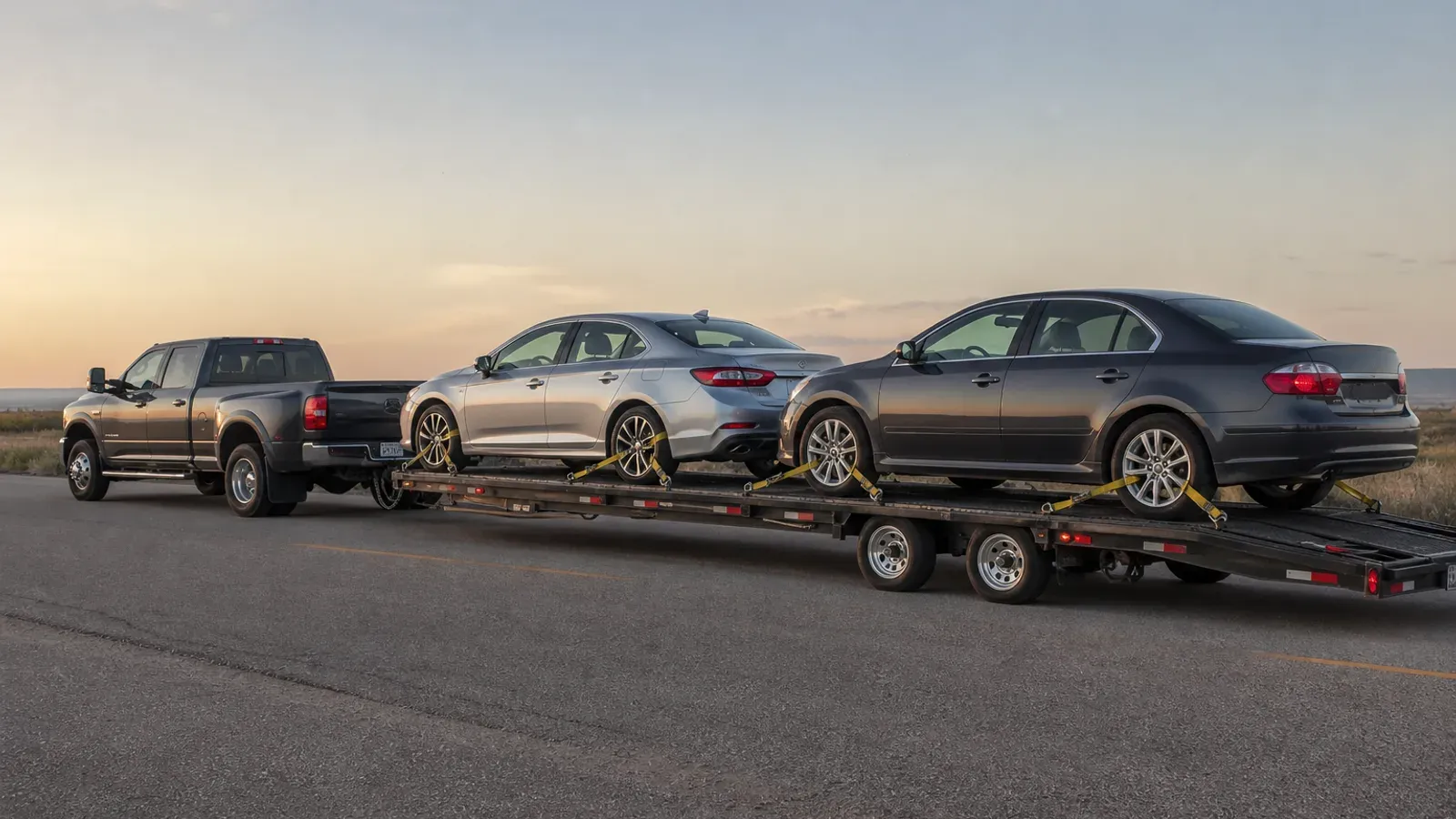
The multi-car question sounds like a length problem, but it's a weight problem. Modern vehicles broke the old math. Two cars gross 7,000 to 9,000 pounds, three sedans 11,000 to 13,500, and three trucks push past 16,000. Multi-car trailers weigh 6,000 to 12,000 pounds empty depending on format, so once you run the payload subtraction against your tow rating, you hit the ceiling before you finish measuring decks.
| Fleet | Combined Weight | Format | Combination Reality |
|---|---|---|---|
| 2 cars, standard | 7,000 to 9,000 lb | 30-to-36-ft flat gooseneck | Dually, CDL math near |
| 3 sedans | 11,000 to 13,500 lb | 40-ft wedge | Dually, CDL by design |
| 3 trucks or SUVs | 14,500 to 17,500 lb | 44-ft wedge, heavy axles | The tier's ceiling |
| 2-to-4, protected | Varies | Enclosed stacker | The premium format |
Purpose matters more than count here. For-hire operators work the business math on the auto-hauler page, where a third car spreads fixed costs over more miles. Enthusiasts, race programs, and collectors haul pairs and protected loads, which is where the stacker's shell and lift deck earn their keep. Dealers shuttle pairs on flat decks, the simplest tier of the bunch.
Formats by count and purpose
For two cars, the 30-to-36-foot flat gooseneck car hauler is the honest entry point. No angles, no hydraulics, front car loads first, and everything the single-car pages teach still applies, just at double the length behind a one-ton.
For three cars, the wedge uses the overlap geometry that made three-per-trip the owner-operator standard. Its page lays out the loading order and clearance envelopes, and the auto-hauler page covers the business context.
For protected multiples, the enclosed stacker puts a hydraulic lift deck inside a shell. It's the race-and-collection format, and its empty weight is the heaviest bill in the family. The second deck carries the paddock's entire logistics. The multi-car page walks through the lift-and-lock disciplines.
A few things hold across every format. Each car gets wheel-strap securement at all four corners, you keep a winch aboard for the load that inevitably won't start, and you size the ramp geometry to the lowest vehicle the deck will ever carry.
Order, balance, and the multi-car disciplines
Loading order is the heart of the craft. Wedges load back-to-front, flat decks load front-first, and stackers load the top deck before the lower bay closes off its clearance. Whatever the format, you plan the route's drop sequence against the stack before the first ramp comes down. Re-parking cars you loaded in the wrong order is the least billable hour in the trade.
Balance works on two axes the single-car job never dealt with. Fore-aft sets pin weight at the gooseneck's 15 to 25 percent, tuned by which car parks where. Left-right matters too, because three cars' worth of mass can lean the load and work one row of tires harder than the other by season's end. Strap each car independently at four corners, and re-tension at the ten-mile stop that multi-car loads make doubly worth taking.
The combination runs on commercial arithmetic, no exceptions. Check the dually's payload against pin weight, expect combined ratings past the CDL line at every working tier, and add transport authority and insurance once the hauling is for hire. Treat the rules as the operating documents they are. Sixty-plus feet of truck and trailer means planning your fuel stops, and honestly, that planning is most of the multi-car life.
Multi-car hauling FAQ
What's the cheapest way to haul two cars?
The 30-to-36-foot flat gooseneck. It's the simplest format, front-first loading and no hydraulics, and it rides behind the dually the weights already require.
What trailer hauls three cars?
The 40-foot wedge for sedans, or the 44-foot heavy-axle builds for trucks and SUVs. Weight caps the count before the deck does. The wedge page covers the geometry.
Do I need a CDL to haul multiple cars?
The working tiers cross 26,000 combined pounds by design, and for-hire work piles on the authority requirements. Personal use at the two-car tier can sometimes thread the ratings, so run the math honestly.
How do I balance a multi-car load?
Fore-aft, by which car parks where, aiming for the gooseneck's pin percentage. Left-right, by the lean the tires report. Your instruments are the deck marks and how the truck squats.
Wedge or stacker for three cars?
For-hire volume runs the wedge's simple geometry. Protection and paddock life justify the stacker's premium. Purpose decides, and the multi-car page lays out both.
What tow vehicle does multi-car work need?
A one-ton dually across the working tiers, sized by payload against loaded pin weights of 3,000 to 5,500 pounds.