Best Trailers for Hauling a Car.

Hauling a car starts with two measurements: the vehicle's real weight and its length. For most cars the answer is the 18-foot 7,000-pound open car hauler, and trucks and heavy builds want the 20-foot 9,900 class. Enclosed adds weather protection and security for vehicles that warrant it. Load it balanced for tongue weight, strap all four corners, re-check at ten miles, and the family truck tows most of it.
Weights, lengths, and the modern reality
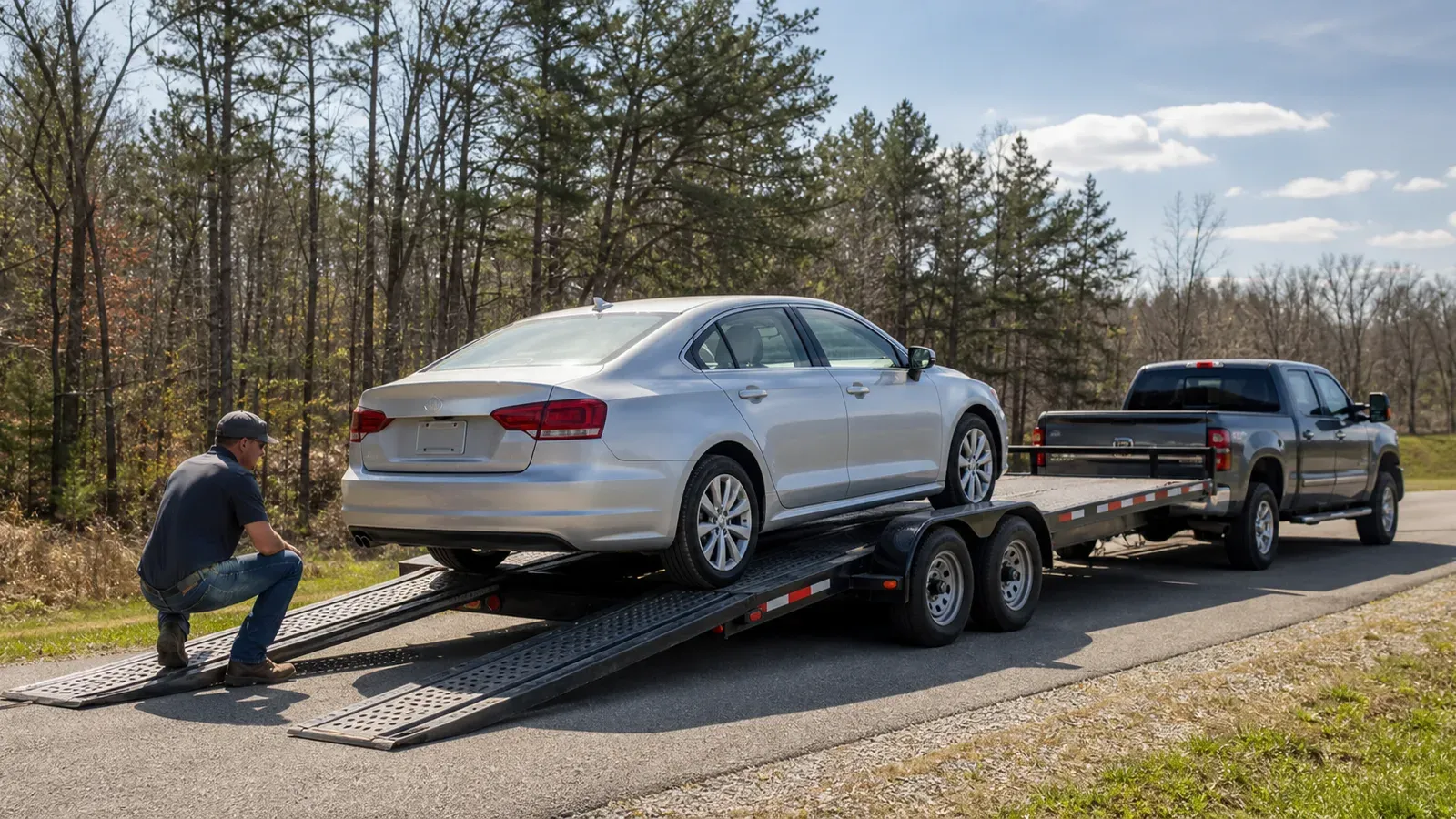
The math on hauling a car has moved, and buyer intuition hasn't caught up. The vehicles Americans actually haul now, crew-cab pickups, three-row SUVs, restomods with modern drivetrains, run heavier and longer than the sedans the old rules were written for. The classic 16-foot 7K hauler that served a generation now meets cargo it can't legally carry.
| Vehicle Class | Typical Weight | Typical Length | Trailer Answer |
|---|---|---|---|
| Compacts, classics, sports cars | 2,400 to 3,400 lb | 13 to 15 ft | 16-ft 7K |
| Sedans, muscle, modern sports | 3,400 to 4,400 lb | 15 to 16.5 ft | 18-ft 7K, the standard |
| Trucks, SUVs, heavy builds | 4,400 to 6,500 lb | 16.5 to 20 ft | 20-ft 9,900 |
| Duallys, vintage iron, big trucks | 6,500 to 8,500 lb | 20 ft-plus | 22-ft 9,900 to 14K |
Two specs buyers skip. First, real weight, scaled or documented, not remembered, because the payload math runs against the actual number plus fuel and any parts riding along. Second, approach clearance, the front overhang and ride height that drive the ramp conversation. A low car picks its trailer by approach angle before weight ever comes up.
Value rides shotgun, because the car's worth sets the protection budget. A running driver hauls open without a second thought. A six-figure classic sleeps behind enclosed walls. The enclosed-versus-open math works that whole decision one page over.
Best trailers for a car, ranked
The standard answer is the 18-foot open car hauler at 7,000 GVWR: tandem axles, a wood deck for the enthusiast, a dovetail with rated ramps, and 4,900 to 5,300 pounds of payload that covers everything through modern muscle. Swap in the steel deck for project-car fluids and winch duty. The tie-down layout and winch mount belong on the order sheet either way.
The step up is the 20-foot 9,900 class for the truck-and-SUV reality, with 7,100-plus pounds of payload and the deck length modern wheelbases need. Loaded heavy, it belongs behind a three-quarter-ton. For protection, the enclosed car hauler buys weather and security at the box's weight and price, for cargo whose value writes that check.
The occasional answer is honest too. A dovetail flatbed hauls the rare car well enough while it earns its keep on other cargo, and a one-time move just rents. The purpose-built hauler earns its small premium once you're loading monthly. The comparison draws the line.
Loading, strapping, and the ten-mile rule
Loading is geometry plus patience. Set the ramps square, drive the car up straight and committed at idle, and put a spotter on the gap the driver can't see. Choose the parking spot for tongue weight, 10 to 15 percent of the loaded total, which on a car hauler you tune by feet of deck position. Start nose-forward of center and adjust by how the truck squats. Mark the deck for a vehicle you haul often and load to the mark every time after. The winch walks aboard anything that won't drive, and eventually something won't.
Securement follows the four-corner standard. Wheel straps are the modern default, with baskets ratcheted firm at each tire and the suspension left to float beneath. Use frame chains with proper technique where weight and vintage demand it. The tie-down page gives the full treatment. Set the parking brake, leave the transmission parked or in gear, straighten the steering, and pull over at ten miles to re-tension. That habit is what separates clean hauls from stories.
The combination follows the class rules. A loaded 7K rides behind an honest half-ton, while the loaded 9,900 class pushes into three-quarter-ton math. Tune the brakes to the day's gross, and keep the state rules on securement in mind. Adjust the mirrors for the width, keep your speed honest in crosswind, and remember the cargo's value is worth some patience in the right lane.
Car hauling FAQ
What size trailer do I need to haul a car?
An 18-foot 7K open hauler covers cars through modern muscle. Trucks, SUVs, and heavy builds want the 20-foot 9,900 class. Size the length to the wheelbase and the payload to the car's real weight.
Can a half-ton truck tow a car on a trailer?
A standard car on the 7K class grosses around 6,000 to 6,500 pounds, inside honest half-ton numbers. A heavy truck aboard the 9,900 class is a different conversation.
How do I strap down a car?
Four points. Wheel straps ratcheted at each tire are the modern standard, or use frame chains with good technique for heavy and vintage iron. Re-tension at ten miles, every haul.
Open or enclosed for my car?
Value decides. Drivers ride open, six-figure and irreplaceable cars ride enclosed, and the comparison prices the middle honestly.
What about a lowered car?
Approach angle sizes the trailer before weight does. Think longer ramps and lower decks, and run the ramp geometry math. Measure the front overhang before you put down a deposit.
Do I need a winch?
Get the mount and wiring at purchase, always. Add the winch when the first dead car schedules itself, and it will.