Steel-Deck Car Haulers Explained.

A steel-deck car hauler trades wood's grip and easy repair for a surface that shrugs off fluid leaks, winch drags, and dead-car abuse. Full diamond plate serves shops and anyone hauling leakers, while open steel runners cut weight and shed water. It costs more and it's slick when wet. Buy steel if project cars, winching, and fluids are your routine. If you move running cars on weekends, wood's math still wins.
What a steel deck buys a car hauler
The steel-deck car hauler answers the question every wood deck eventually asks its owner, which is what happens after enough gear oil, brake fluid, and dragged dead weight. Wood's answer is staining, soaking, and softening. Steel's answer is a rag and some degreaser, and that's the whole configuration in one sentence.
The car hauler's job invites the abuse. Project cars leak from places their owners haven't found yet, dead cars come aboard by winch with their wheels locked and dragging, race weekends end with fluids where fluids shouldn't be, and shop and hauler duty multiplies all of it by every car. A wood deck handles the running-car life beautifully and pays for the leaker life plank by plank. The deck debate covers the general case, and this page covers the car-specific one.
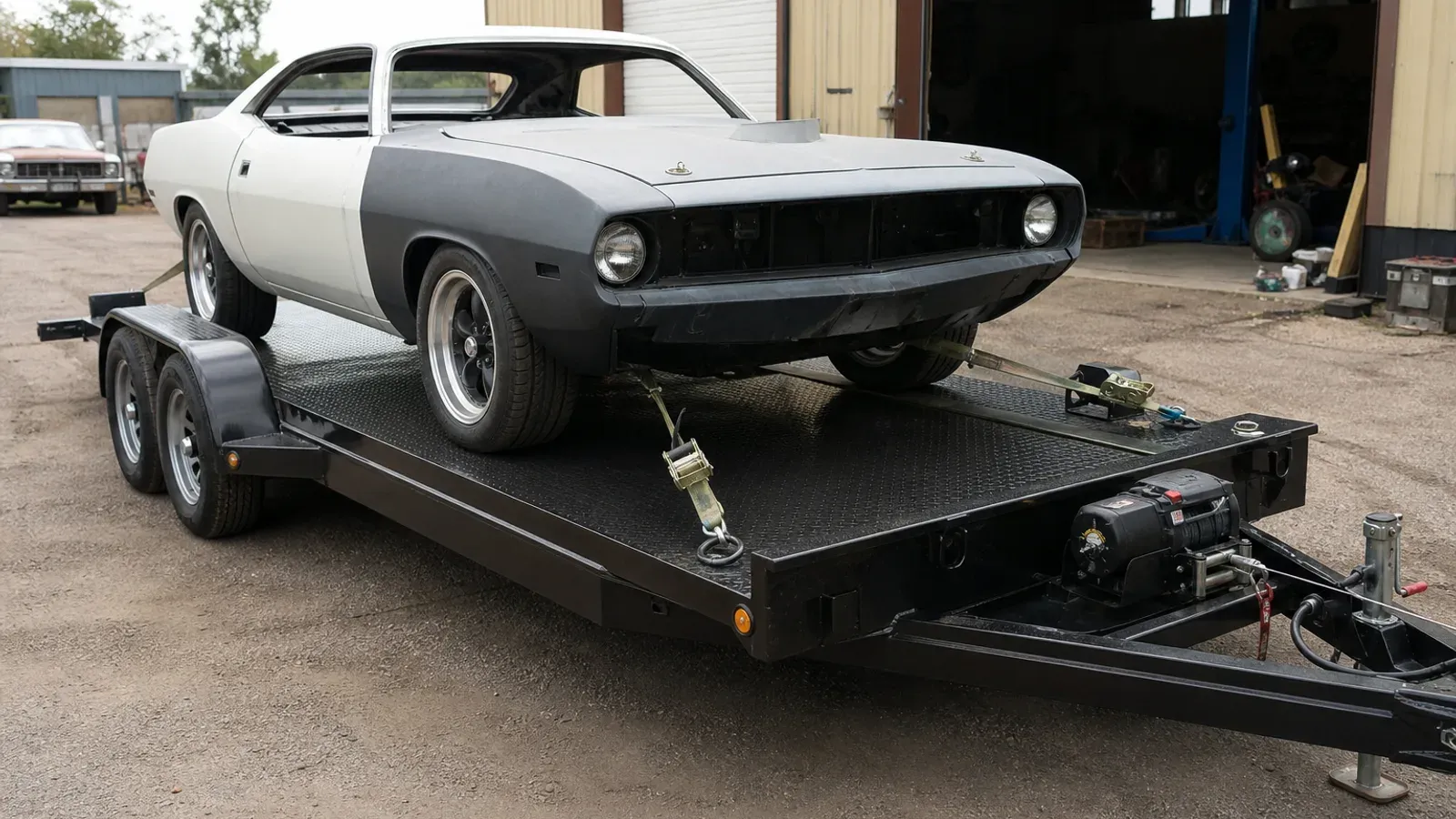
Two steel formats split the category. Full decks run smooth or diamond plate corner to corner for maximum protection and maximum weight, the shop and transport standard. Steel runners put two plate tracks where the tires ride over an open or partially open frame, so you get most of the protection where the car actually touches, hundreds of pounds lighter, self-draining, and the enthusiast market's favorite compromise.
Who's buying. Shops moving customer cars and parts cars, transport operators who never know what condition the cargo will show up in, restorers whose projects define the word leak, and racers whose paddock schedule leaves no time for deck maintenance. If you move running cars on weekends, you're honestly reading the wrong page, and the wood page says the same from its side.
Plate, runners, and traction honesty
Full-plate decks run 11-to-14-gauge steel over the standard car-hauler frame, and diamond plate adds traction texture and cost over smooth. The plate takes winch drags, jack stands, and fork abuse in stride, passes point loads to the crossmembers instead of absorbing them, and cleans to bare metal after the worst weekend. Rust is its clock, since plate rots from the underside and the seams. Undercoating and drainage separate a decade build from a five-year one, so look underneath.
Runner decks put the plate where the tires live, two tracks 18 to 24 inches wide, with open mesh, spaced channel, or nothing between them. The weight savings runs 200 to 400 pounds against full plate and goes straight into payload, water and debris fall through instead of pooling, and the open center eases the wet-traction problem simply by having less deck to slick. The cost is that missing center. There's no walking surface between the runners, a dropped tool goes to the highway, and a low-hanging exhaust wants watching over the open span.
Now the honest part about traction. Wet steel under street tires is genuinely slick, loading a car up wet plate ramps is a hands-on-the-winch job, and diamond plate texture helps without solving it. The runner format helps, traction strips and grip paint help more, and the real answer for anything questionable is the winch, which steel-deck buyers usually own anyway. Wood never had this problem, which is its best argument and the reason the comparison page exists.
Everything else follows the guide's standard, the dovetail and ramp system, the tie-down layout, tandem axles with brakes, and the truck math for the class, none of it changed by the surface you pick.
Steel-deck sizes and payload
| Class | Typical GVWR | Typical Payload | Common Fit |
|---|---|---|---|
| 18 ft full plate, 7K | 7,000 lb | 4,600 to 5,000 lb | Shop single-car standard |
| 18 to 20 ft runners, 7K | 7,000 lb | 4,900 to 5,300 lb | Enthusiast weight saver |
| 20 ft full plate, 9,900 | 9,900 lb | 6,900 to 7,400 lb | Trucks, heavy projects |
| 22 ft-plus, 9,900 to 14K | 9,900 to 14,000 lb | 7,000 to 10,300 lb | Transport duty, big iron |
The plate's weight tax shows up in the table. A full-steel 7K build gives up 300-plus pounds of payload against its runner and wood siblings, which is real margin when a 4,500-pound project rides on a 5,000-pound payload. The 9,900 class absorbs the tax comfortably and carries the modern truck-and-SUV reality besides, which is where most shop and transport builds land.
Truck math follows the guide. Loaded 7K classes ride behind an honest half-ton, the 9,900-and-up tiers move into three-quarter-ton territory, and you tune tongue weight by where the car parks on the deck.
Where the steel deck wins and loses
The buying rule. Count your leakers and winch-loads per year. Shops and transporters live on this deck, while an enthusiast hauling running cars is paying steel prices for wood's job. The comparison settles the middle honestly.
Steel-deck car hauler FAQ
Full plate or steel runners?
Full plate for shop duty, leakers, and work-surface use. Runners for enthusiasts who want steel's protection at less weight, with drainage thrown in. For some buyers the open center decides it, between dropped tools and exhaust clearance.
Is a steel deck slippery for loading?
Wet, genuinely, though diamond plate texture helps and the winch answers. Dry, street tires climb it fine at car-hauler angles.
How much heavier is steel?
Full plate runs 200 to 400 pounds over wood on common sizes, and runners split the difference. That weight comes straight out of payload, so mind the margin on heavy projects.
Does a steel deck rust out?
From the underside and the seams, on a schedule set by the coating and drainage quality. A dry-climate, undercoated build runs decades. Neglect in a salt state runs years.
Can I add plate over a wood deck later?
Overlays exist, but they add weight without the structural integration, and the classic failure is moisture trapped between the layers. Buy the deck you need the first time.
Steel deck or aluminum trailer entirely?
Those are different questions, deck surface versus frame material. The steel versus aluminum car hauler page covers the frame decision, and this deck rides on either frame.