Steel vs. Aluminum Car Haulers. Which Frame to Buy.

Steel car haulers cost less and can be fixed anywhere. Aluminum runs 20 to 30 percent lighter and never rusts. On a trailer whose cargo weighs two-plus tons, that weight savings turns straight into payload margin and breathing room for the tow vehicle. High miles, salt states, and half-ton tow vehicles buy aluminum. Dry climates, tight budgets, and three-quarter-tons keep steel honest. The frame will outlive every deck it carries, so choose it with that in mind.
Steel vs. aluminum at a glance
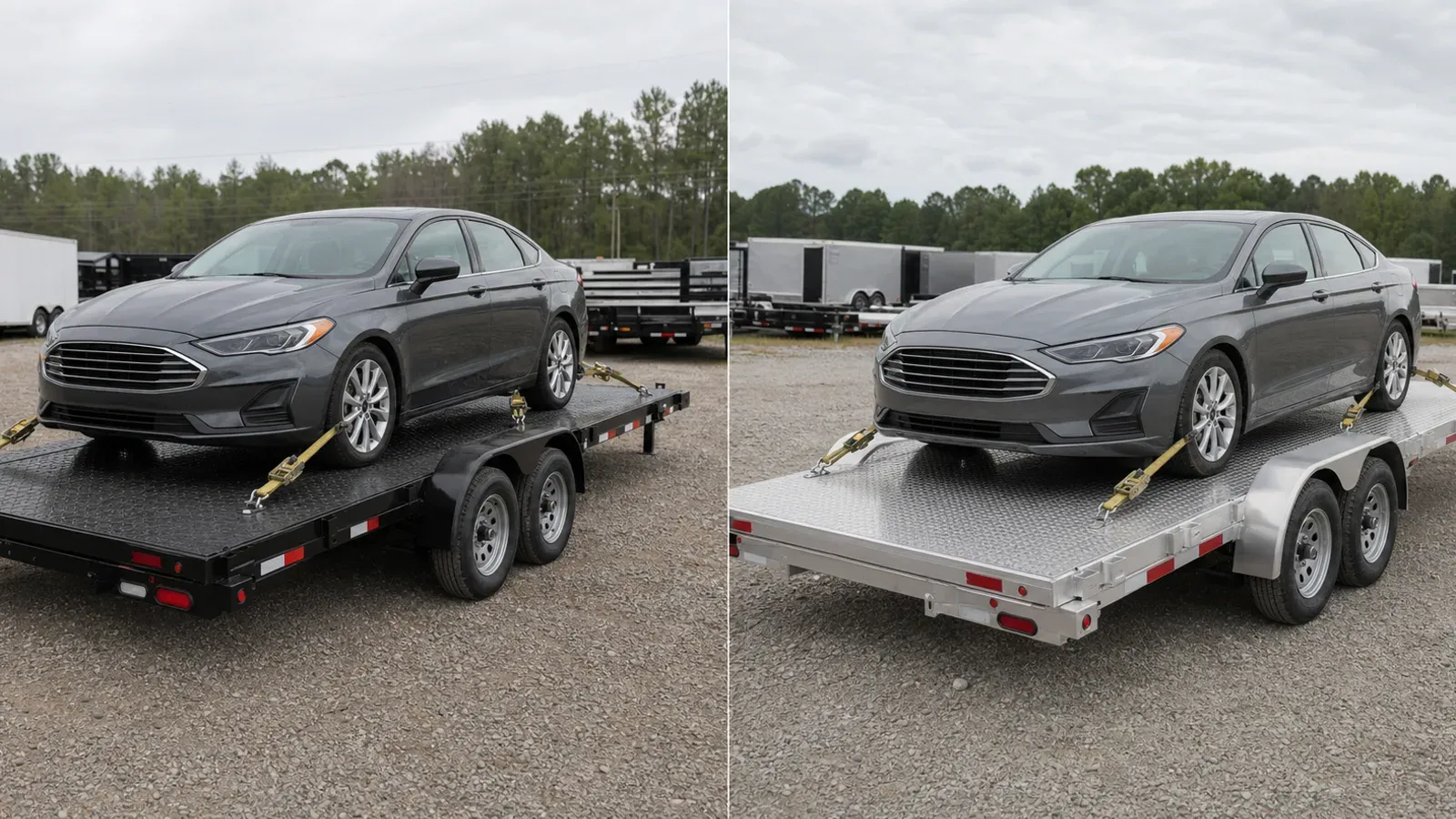
| Steel Car Hauler | Aluminum Car Hauler | |
|---|---|---|
| Purchase price | The baseline | 30 to 50 percent more |
| Empty weight | 1,900 to 2,400 lb typical | 1,400 to 1,900 lb typical |
| Payload, same GVWR | Loses the difference | Wins it back |
| Corrosion | The lifetime fight | Effectively immune |
| Repair | Any welder | TIG rigs and specialists |
| Behind a half-ton | Uses more margin | Breathes easier |
| Resale, year ten | Condition rules | Holds a premium |
The frame question runs on the same physics as the cargo-trailer version, but this page works the car-specific math. When your payload is one big heavy object, the weight argument gets sharper than it ever does with a box.
Strength per dollar, fixed anywhere
Steel's argument holds its usual shape. The purchase discount is real money at car-hauler prices, strength per dollar favors the material that welds cheap and thick, and the repair map covers every town with a shop. A bent crossmember or cracked tongue gets fixed same-day at country rates. For the wood-deck weekender hauling a running car a dozen times a year in a dry state, steel's math is comfortable, and the aluminum premium buys someone else's problem.
Steel also carries the category's proven configurations. The dovetails, ramps, and anchor layouts were refined across decades of steel production, and you'll find them at every dealer, in every class. Availability is its own argument. The steel 18-footer is the market's default partly because you can find one on any lot this weekend.
The downsides are the two everyone knows. First, weight: 400-to-600 pounds over the aluminum twin, spent from a payload modern vehicles already crowd. Second, rust, which is manageable in dry country and relentless where salt lives, with the fastener points and fender seams writing the ten-year story. The climate rule from the general comparison transfers whole: buy steel for where you park, not where the dealer does.
Payload where it counts most
Aluminum's argument gets sharper on this trailer in particular. The 400-to-600-pound savings lands on a deck whose whole job is carrying one heavy object against a fixed payload, and modern vehicles have made that margin precious. A 4,800-pound truck on a 7K trailer needs every pound the frame didn't spend. That same savings makes half-ton towing livable, since the loaded combination sits hundreds of pounds friendlier against the truck's numbers. For the enthusiast whose tow vehicle is also the family truck, that's the clincher.
Corrosion immunity matters more given how a car hauler lives: parked outdoors between weekends, washed rarely, towed through whatever the calendar hands it. At year ten the aluminum frame is structurally what it was on day one, and it holds the resale premium the general page documents. Enthusiast markets price aluminum haulers with real respect, because the buyers who own nice cars apply the same logic to what carries them.
The downsides hold their shape. The 30-to-50-percent purchase premium is front-loaded, repairs want TIG specialists, and engineering quality matters more, since aluminum punishes cheap design at the welds. The material buys best from the builder tiers that earned their name, and the brand guidance in the guide applies with those premium builders in mind.
Miles, climate, and the tow vehicle
Three questions sort the whole page. Climate first: salt states tilt hard toward aluminum, where the frame's immunity is worth the premium on corrosion alone, while dry states neutralize the argument. Miles second: high annual towing compounds the fuel and payload math into real returns, and occasional hauling never collects them. Tow vehicle third, and sharpest of all: a half-ton near its numbers buys aluminum's margin, while a three-quarter-ton shrugs off 500 pounds.
Ownership horizon breaks the ties, and the general rule transfers intact. Under five years favors steel's front-loaded savings, past ten favors aluminum's back-loaded returns and resale. The cargo's value adds a car-world wrinkle: the owner of a six-figure classic usually finds the frame premium easy math next to what rides on it.
It cuts both ways. A maintained steel hauler in Arizona outlives its owner's interest in it, and an aluminum hauler behind a dually in Georgia is margin nobody needed. Like every decision on this site, the frame belongs to the actual driveway, not the brochure.
Steel vs. aluminum car hauler FAQ
How much lighter is an aluminum car hauler?
Commonly 400 to 600 pounds on the 18-to-20-foot classes, which is 20 to 30 percent of empty weight. You get it back as payload margin and easier towing.
Does the weight difference really matter?
On this trailer, more than most. Modern vehicles crowd the 7K class's payload, and half-tons feel every loaded pound. Heavier classes and bigger trucks blunt it.
How much more does aluminum cost?
Thirty to 50 percent over the steel twin, and it's front-loaded. The returns arrive later as fuel, payload, corrosion immunity, and resale across the ownership years.
Is aluminum strong enough for a heavy truck?
Well-engineered, yes. The premium builders prove it in the 9,900 classes every day. The material punishes cheap welds, so buy the builder tier along with the metal.
Which is easier to live with long-term?
Aluminum asks less. There's no rust to manage, and the structure is unchanged at year ten. Steel asks for touch-ups and washes, and it repays you with cheap repairs anywhere when life happens.
Does deck material change with the frame?
They're independent choices. Wood or steel decks ride on both frames, and the deck comparison handles that decision separately.