Car Hauler vs. Flatbed. Which One to Buy.

A car hauler is a flatbed that specialized. It sits lower, runs a gentler dovetail, comes with ramps standard, shapes its fenders so car doors clear them, and puts anchors where cars actually need them. A flatbed hauls everything else better and cars well enough. So the decision comes down to how often you haul vehicles. Cars monthly or more, buy the purpose build. Cars now and then, keep the flatbed's versatility. The specialization costs little, which makes that call an easy one.
Car hauler vs. flatbed at a glance
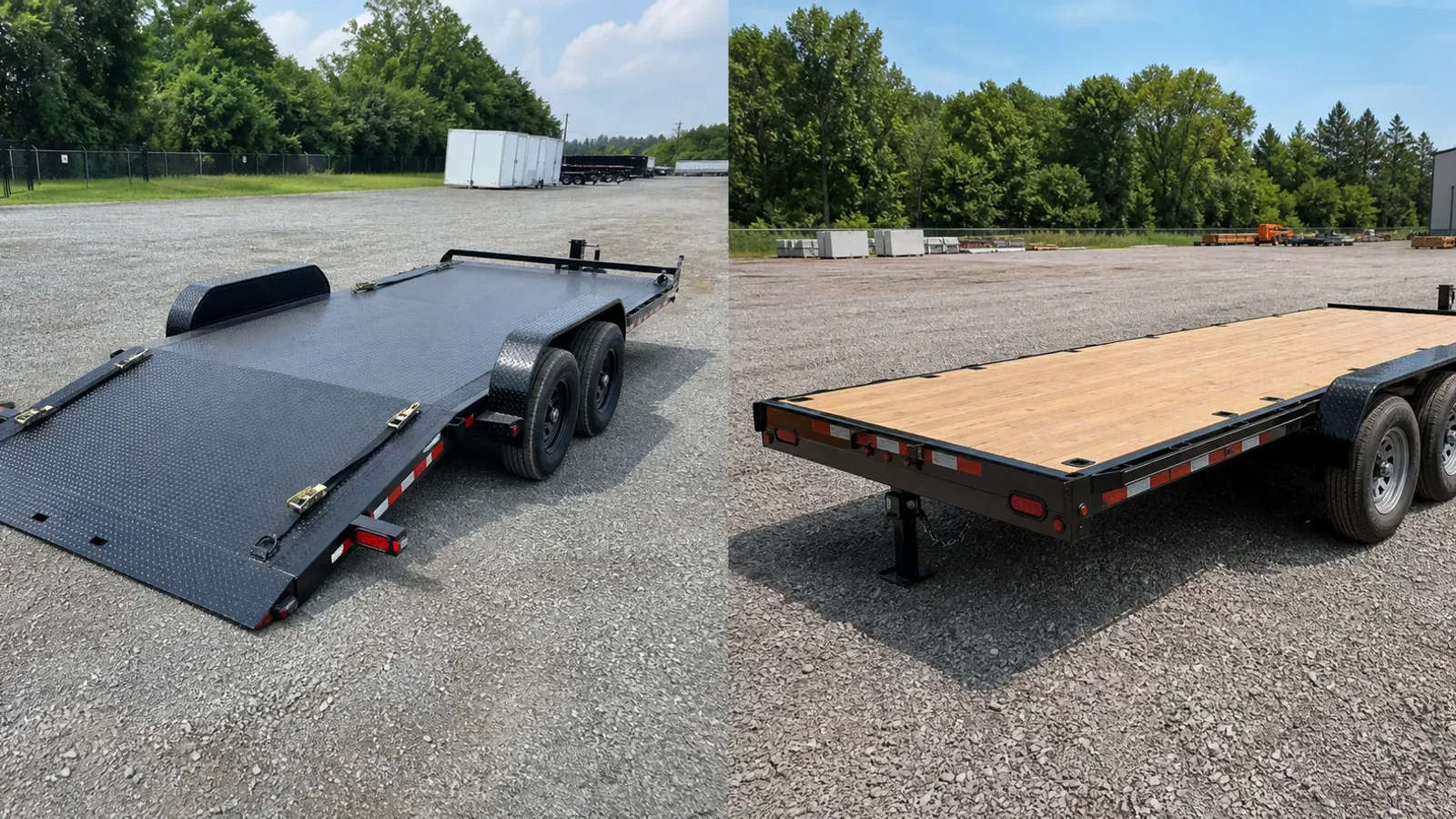
| Car Hauler | Flatbed | |
|---|---|---|
| Deck height | Lower, loading-angle friendly | Higher, general purpose |
| Ramps | Standard equipment | Optional, often lighter duty |
| Fenders | Shaped for open doors | Square, functional |
| Tie-downs | Placed for car footprints | Rub rail and pockets, general |
| Materials and freight | Adequate | The home game |
| Price, comparable size | Small premium | The baseline |
| The odd load | Fenders and dovetail in the way | Takes anything that straps |
The car hauler and the flatbed are the same species one specialization apart. They share frames, axles, and classes and split over a handful of car-specific decisions. The comparison is close because the trailers are, and the tiebreaker is honest frequency, not capability.
The specialization pays per load
The car hauler's argument is that every car-specific choice pays off again on each load. The lower deck and gentler dovetail cut the approach angle that decides whether a front bumper survives. The standard ramps are rated and sized for the job rather than added on as an afterthought. The shaped fenders let you open a door while you position the car, which any solo loader appreciates. And the anchor layout puts rated points where the wheel straps actually land instead of wherever the rub rail happens to run.
None of that matters if you load a car once. All of it matters if you load one every few weeks. For that owner the specialization shows up as friction removed, faster loads, no improvised anchor geometry, no held breath at the top of the ramp, and a winch mount ready for the day a car won't start. The premium over an equivalent flatbed is small, and that is the quiet fact of this comparison. You pay almost nothing extra up front and get it back on every cycle.
What it gives up is the flatbed's flat, take-anything deck. The dovetail's slope is not usable flat storage, the fenders get in the way where a deckover's full width would not, and hauling materials means working around choices made for cars. It is adequate at everything and optimized for one thing, which is either exactly right or slightly wrong depending on what your driveway actually sees.
Versatility with a dovetail option
The flatbed's argument is range. Lumber and materials, pallets, machines up the ramps, the household's odd loads, and yes, the occasional car, all ride on a deck built to take whatever you put on it. The flatbed guide covers that breadth, and if hauling vehicles is the exception rather than your routine, breadth is exactly the product you want.
The car job goes fine with the right options. A dovetail flatbed with rated ramps loads standard-clearance vehicles honestly, chains and straps to the rub rail hold them legally if less neatly than purpose anchors, and an occasional car ride costs nothing but a little extra care. On the days no car is aboard, which for this buyer is most days, the deck carries lumber and machines with no fenders or dovetail slope in the way.
The cost shows up as friction on car days. The deck is higher, the angles steeper, the anchor points improvised, the doors bump square fenders, and you supply the loading care a purpose build engineers away. Occasional friction is free. Monthly friction is the car hauler's whole sales pitch.
Frequency does the deciding
Count your vehicle loads per year, honestly. Twelve or more and the car hauler's near-free specialization pays off every cycle, so the purpose build is the answer. Two or three and a flatbed with a dovetail option hauls them fine and does everything else better, so keep the versatility. In between, let the rest of the work decide. A deck that hauls materials weekly and cars quarterly is a flatbed. Flip that and it is a car hauler.
The edge cases sort fast. Low vehicles point to the car hauler's deck height and ramp length no matter how often you load, because the angle math does not care about the calendar. Value points the same way, since a six-figure classic deserves purpose anchors under it. Heavy mixed use points to the flatbed, and the trades' trailer that hauls the shop truck now and then was never really part of this comparison.
Be honest about how close this is. A car hauler moves materials with minor fender gripes, a flatbed moves cars with minor angle gripes, and neither owner ends up stranded. This is the tightest matchup on the site, and the cheapest one to get slightly wrong.
Car hauler vs. flatbed FAQ
Can a flatbed haul a car?
With a dovetail and rated ramps, yes for standard-clearance vehicles, secured to the rub rail with proper technique. A purpose build just does the same job with less friction.
How much more does a car hauler cost?
A small premium over the comparable flatbed. That is the quiet fact of the category, the specialization is nearly free up front and pays you back on every loading cycle.
Can a car hauler haul lumber and materials?
Well enough, once you work around the dovetail's slope and the fenders. A flatbed's flat, open deck does it better, and that is the whole trade.
What about low or lowered cars?
The car hauler's lower deck and longer ramp options win this one at any frequency. The ramp geometry page runs the math, and the flatbed usually loses it.
Which holds resale better?
Both resell strongly, the car hauler to enthusiasts and the flatbed to everyone. Condition beats category, as always.
Is there a middle build?
The dovetail flatbed with rated ramps is exactly that, the flatbed's versatility plus the minimum a car job needs. Plenty of driveways run one happily.