Enclosed Car Hauler Trailers Explained.

An enclosed car hauler puts a vehicle inside a box, safe from weather, rocks, and prying eyes, on a reinforced floor with car-specific tie-downs and a ramp door rated for the climb. The 8.5x20 at 9,900 GVWR is the single-car standard, and interior width at the fenders is the spec that catches most buyers off guard. It costs more than double what an open hauler does, but for a car worth protecting, it's the cheapest insurance you can buy.
What an enclosed car hauler is
The enclosed car hauler is the vehicle specialist of the enclosed cargo family, a box sized, floored, and doored around a car. Compared with the open car hauler, it trades money and weight for total protection. No weather, no road rash, no curious eyes at the fuel stop, and no sign that a valuable car is passing through. The customers are racers, collectors, restorers, and anyone hauling something painted better than the trailer.
The spec that defines the category is interior clearance, and buyers tend to check its three dimensions in the wrong order. Check width at the wheel wells first. The box's 8.5-foot exterior yields roughly 93 to 96 inches between the walls, less where the wheel boxes intrude, and a modern truck's mirrors-folded width plus room to open a door decides fast whether the driver steps out or climbs through the window. Length comes second, the car plus a walkway plus the nose gear. Height is third. 6.5 feet clears most cars, while lifted trucks and roof racks want 7, measured at the door opening rather than the peak.
The ramp door is the trailer's working end, a full-width rear ramp rated past the car's axle weights, and its transition angle decides whether low cars arrive with their splitters intact. Beavertail floors, which slope gently down in the last few feet of the box, cut the breakover. There's no enclosed version of the tilt trailer, so ramp geometry is the whole low-car conversation here. Extended ramp flaps and race-ramp extensions finish the toolkit.
Weight is the honest tax you pay here. The box, door, and reinforced floor push empty weights past 3,000 pounds in steel at the standard size, which is why a 7,000 GVWR rating leaves no room. A 3,200-pound trailer and a 4,000-pound car have already blown past it. The 9,900 GVWR spec is the single-car standard for simple arithmetic reasons, and an aluminum frame earns its premium faster here than anywhere else, since every pound saved in the frame is a pound you can spend on the car.
Floors, tie-downs, doors, and getting a car in a box
The floor carries the car's whole weight on four contact patches, so it runs heavier than a cargo build, with 16-inch or tighter crossmembers under a 3/4 floor minimum and tie-down anchors landing on structure. Ask for factory recessed D-rings or pull-up anchors set at car-corner spacing. Surface-mount rings added later tend to find the plywood between crossmembers. Wheel-strap pockets or E-track at floor level handle the over-tire strapping modern suspensions want, four points with slight compression, the same approach as the open hauler.
Loading a car into a box raises questions an open deck never does. The door aperture is the gate, measured for width and height at the opening minus the ramp's side rails, and the walkway inside decides daily livability. A 96-inch car in a 96-inch box loads fine and lets nobody out. Escape hatches, a front walk door or side access ahead of the car, are the signature option here and worth every dollar the first rainy load-in. Winch mounts and wiring run forward earn their keep on dead projects, the usual advice, only more so inside walls.
Light, air, and power finish the fit-out. White walls and ceiling-length LEDs turn load-in from spelunking into parking, roof vents handle the fuel vapor a car gives off in a sealed box, and a shore-power inlet feeds the battery tender that keeps both the race car and the trailer's own breakaway battery alive between events. Cabinet-and-tire packages in the V-nose turn the front triangle into a pit box, the racer's standard buildout.
A car in a box is the heaviest, tallest thing most owners ever tow. Loaded weights run 7,000 to 10,000-plus pounds behind a wall that catches every crosswind, so three-quarter-ton equipment is the honest floor, with tongue weight at 10 to 15 percent counted against truck payload and a weight-distribution hitch earning its keep on the bumper-pull classes. Where you park the car in the box tunes the tongue weight, and a few feet matters, so mark the sweet spot on the floor after your first scale visit.
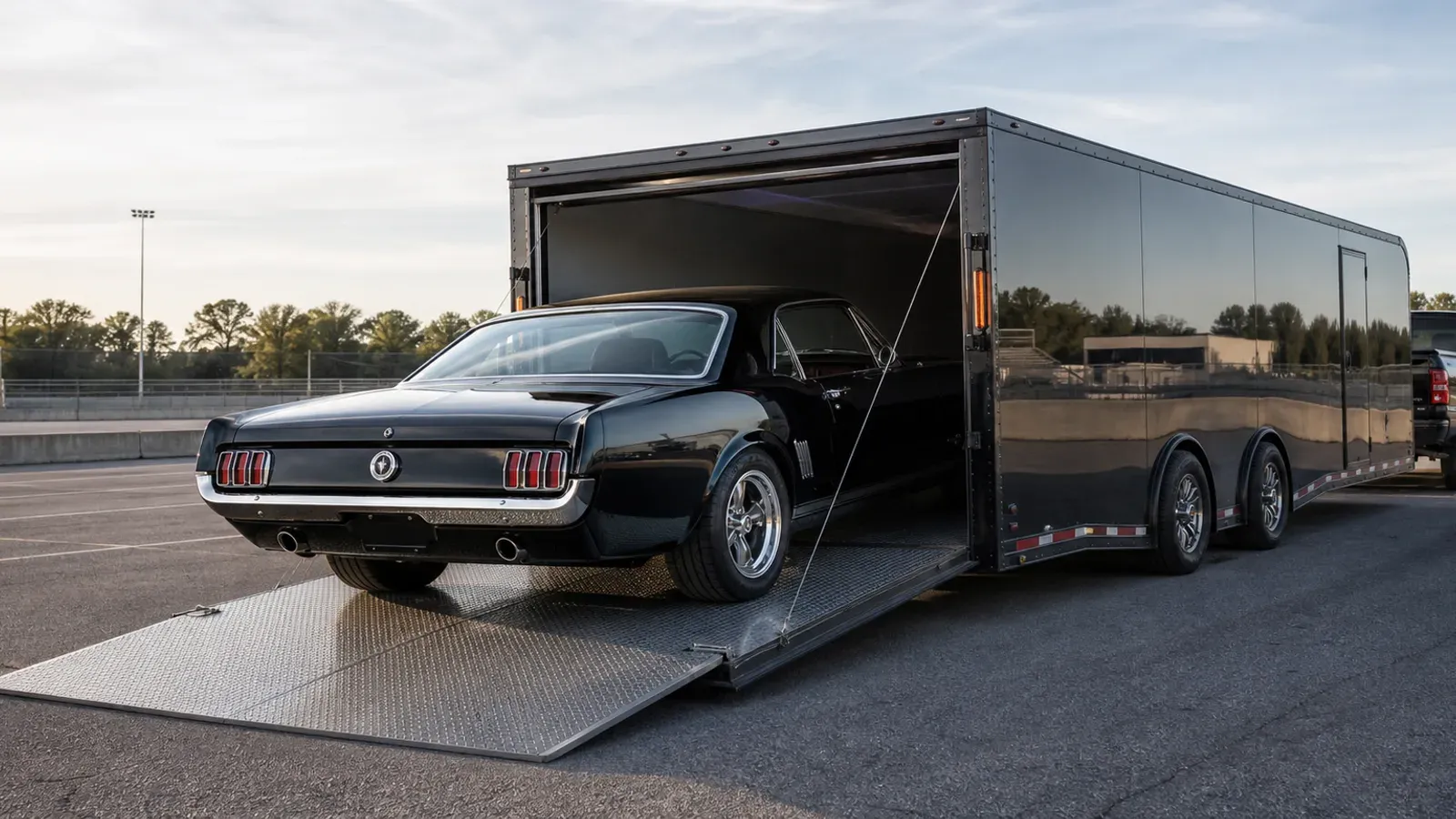
Enclosed car hauler sizes and the weight ledger
| Class | Typical GVWR | Typical Payload | Fit |
|---|---|---|---|
| 8.5x18 | 7,000 to 9,900 lb | 3,800 to 6,700 lb | Compacts, classics |
| 8.5x20 | 9,900 lb | 6,400 to 6,900 lb | The single-car standard |
| 8.5x24 | 9,900 to 14,000 lb | 6,200 to 10,300 lb | Full-size, car plus pit |
| 8.5x28 gooseneck | 14,000 to 21,000 lb | 9,800 to 15,500 lb | Two-car, race rigs |
Run the car math against the payload column, not the GVWR. A 4,200-pound muscle car plus 800 pounds of tires, tools, and fuel jugs needs 5,000 pounds of usable capacity, which is comfortable at 9,900 GVWR and impossible at 7,000 in steel. The payload math is the whole buying decision here, and the 400 to 600 pounds aluminum saves reads straight through as margin.
Length buys the walkway and the pit. Twenty feet fits most cars with room to walk, 24 adds the golf cart, tool cabinets, and tire stacks of a race weekend, and 28-plus moves into gooseneck territory with the truck and license math that comes with it. The enclosed versus open comparison works through the whole category decision. This page assumes you've decided the car deserves walls.
Where the enclosed hauler wins and loses
The buying rule. Add the car's value to the cost of one repaint, weigh that against the enclosed premium, and the decision usually writes itself. Then spec 9,900 GVWR at a minimum, measure the actual car against the actual opening, and let aluminum make its payload case before you sign.
Enclosed car hauler FAQ
What size enclosed trailer for a car?
The 8.5x20 at 9,900 GVWR is the single-car standard. Size the width for the door swing, the length for a walkway, and the payload for the car plus gear. Bigger cars and race programs step up to 24 feet.
Will my car fit through the door?
Measure the opening, not the box. Take its width and height minus the ramp rails, and compare them to the car's mirrors-folded width and roof height. The tape costs nothing.
What truck do I need?
A three-quarter-ton is the honest floor for the loaded standard class, with tongue weight counted against truck payload. Loaded, the 24-plus classes push toward one-ton and gooseneck math.
Is 7,000 GVWR enough for a car hauler?
Almost never in steel. The box weighs 3,000-plus pounds empty, and the math falls apart at a 4,000-pound car. The 9,900 rating exists for exactly this arithmetic.
How do I strap a car inside?
Four points, wheel straps over the tires to floor anchors set on structure, suspension slightly compressed, the same as an open deck. Order factory recessed anchors at car spacing.
Enclosed or open car hauler?
Open for budget and everyday hauling, enclosed for value, weather, and security. The comparison runs the numbers, and the car's paint usually casts the deciding vote.