Tilt Trailers. The Complete Guide.

A tilt trailer replaces ramps with a deck that pivots, the rear drops to the ground, the load drives up the deck itself, and the deck levels out for travel. Buy one for low-clearance machines, solo loading, or anything that hates ramp transitions. The price is a pivot mechanism to maintain and a premium over the ramp equivalent. For the right loads, it's the best money on the lot.
What a tilt trailer actually is
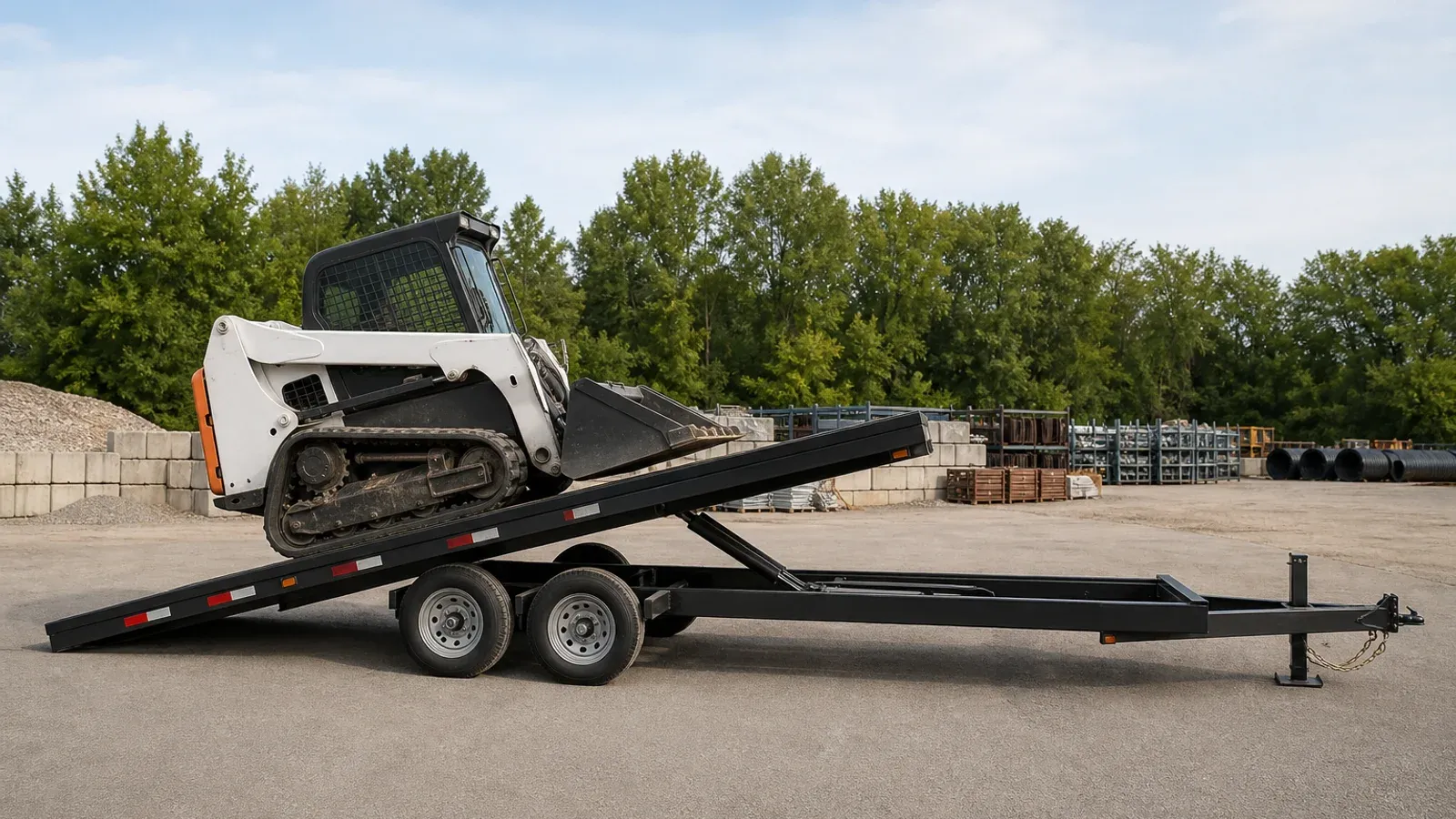
A tilt trailer is an equipment or car trailer that solved the ramp problem by deleting the ramps. The deck pivots on a fulcrum near the axles. Tip it, and the rear edge meets the ground while the deck becomes one continuous, gentle ramp. Drive aboard, roll past the balance point or lower it under power, and the deck settles level for the road. No ramps to deploy, store, lose, or fall off of.
The problem it solves is approach angle. Ramps create two breakover points, the ground-to-ramp transition and the ramp-to-deck crest, and low machines find both. Scissor lifts, lowered cars, some tractors and shop equipment scrape, high-center, or refuse entirely. The tilt deck's single continuous plane runs 7 to 11 degrees, gentler than nearly any ramp setup, which is why the category owns the low-clearance world.
The second problem it solves is the solo operator. Ramps want two hands and often two people. A tilt deck wants a latch release, or a button on the hydraulic versions. Landscapers, equipment movers, and one-person operations buy tilts for the daily minutes and the spared backs, and that arithmetic is real over a trailer's life.
What it costs. A pivot mechanism, a cushion cylinder or full hydraulic system, and more moving parts than any open trailer except a dump. Moving parts mean maintenance, and the tilt premium over a comparable ramp trailer is real money. The tilt versus stationary ramp comparison runs the honest math, and the short version is frequency and clearance decide.
Gravity, hydraulics, and the balance point
The gravity tilt is the simple machine. The deck balances slightly rear-heavy on its pivot, held level by a lockable latch and a hydraulic cushion cylinder that controls the tilt speed. Release the latch, the rear settles to the ground. Drive aboard, and as the load crosses the balance point the deck rotates down and levels, with the cushion cylinder keeping the motion civilized instead of catapult-like. Lock the latch, check it twice, and tow.
The hydraulic full tilt puts the deck under power. A pump, battery, and cylinder raise and lower the entire deck on command, no balance-point choreography, load anywhere on the deck, stop mid-tilt, and lower a machine that parked in the wrong spot. It borrows the dump trailer's power system, battery care and all, and adds the same maintenance realities in exchange for total control. Heavy machines and daily-cycle operations justify it.
Split-deck designs hedge the bet. A fixed front deck section carries a toolbox, attachments, or a second small machine, while the rear section tilts. You give up some tilting length and gain flat, always-level storage, a popular trade on landscape and multi-machine setups.
The balance point deserves respect on gravity models. Load position controls when and how fast the deck rotates, and a machine parked too far back keeps the deck tail-down, too far forward slams it level with authority. Every gravity tilt owner develops a feel for the sweet spot, usually within the first three loads and occasionally within earshot of new vocabulary. The cushion cylinder's condition, clean fluid and no weeping seals, is what keeps that learning curve gentle, treat it as a service item on the same schedule as bearings and brakes.
Tilt trailer sizes and real payload
Tilt trailers cluster in the equipment and car classes, 16 to 24-foot decks, with GVWR from 7,000 to 16,000 pounds and gooseneck versions above. The pivot structure adds steel, so empty weights run a few hundred pounds over comparable ramp trailers and payload pays the bill.
| Class | Typical GVWR | Typical Payload | Common Fit |
|---|---|---|---|
| 16 to 18 ft, 7,000 lb | 7,000 lb | 4,700 to 5,200 lb | Cars, small equipment, UTVs |
| 18 to 20 ft, 10,000 lb | 9,900 to 10,400 lb | 6,900 to 7,700 lb | Compact machines, scissor lifts |
| 20 to 22 ft, 14,000 lb | 14,000 lb | 9,300 to 10,200 lb | Skid steers, mini excavators |
| Heavy and gooseneck | 16,000 to 21,000 lb | 10,800 to 15,000 lb | Big iron, daily commercial cycles |
Deck length interacts with the tilt geometry. Longer decks tilt to gentler angles, the fulcrum math works in your favor, but add weight and cost. The 20 to 22-foot class hits the sweet spot for most equipment work, gentle angle, full-size machine capacity, manageable empty weight.
Truck requirements track the class as always. The 7K tilts tow behind equipped half-tons, the 14K class wants three-quarter-ton equipment, and tongue weight counts against payload at 10 to 15 percent of loaded weight. One tilt-specific note, the deck's pivot means load position is constrained by balance-point behavior on gravity models, so the tongue-weight tuning a fixed deck allows is partly spoken for. Hydraulic models give that freedom back.
Tilt trailer sub-types
Gravity versus hydraulic is the money decision, simplicity against control. Low-profile models drop the deck height for the gentlest angles in the category, the answer for the lowest machines. Deckover tilts pair the full-width deck with powered tilting on the heavy end. The equipment tilt and car-hauler tilt configurations tune deck surface and tie-downs to their cargo.
The features that actually matter
Skip the polish tier and put the difference into the hydraulic upgrade if your loads are heavy or daily. The powered tilt is the one premium on this trailer that pays operators back in minutes and safety every single cycle.
Tilt trailer brands
Tilt is a specialty line where engineering quality spreads wider than sticker prices suggest, the pivot and cylinder work is where builders differ most.
PJ and Big Tex field proven tilt lines across the weight classes. Sure-Trac's tilt models carry a strong field reputation. Midsota and Felling, the northern builders, treat tilts as a flagship category with heavy pivot engineering that shows up close. Load Trail competes on value. Judge the pivot, latch, and cylinder quality in person, those parts are the product, and ask every dealer what cylinder and pump parts they stock.
What tilt trailers cost
Tilt pricing runs a solid premium over comparable ramp trailers, the pivot structure and cylinder on gravity models, the full power system on hydraulics. The 7K gravity class opens in the mid four figures, equipment-class gravity tilts step up from there, and hydraulic full tilts in the 14K class push into five figures. The premium buys loading capability, price it against what ramps cost you in time, clearance, and risk.
The quote-comparison trap is gravity-versus-hydraulic ambiguity. The two systems can look similar in photos and differ by thousands in price, spec which system every quote includes, plus cylinder brand and battery details on powered models. Then the standard sweep, freight, prep, doc fees, and accessories, all in writing as one out-the-door number.
The buying mistake is paying the tilt premium for loads that climb ramps fine. A standard skid steer with decent clearance doesn't need a tilt, and the comparison page will talk you out of the upsell honestly. The reverse mistake costs more, buying ramps for a machine that scrapes, then paying the difference again in damaged plastics and improvised cribbing.
Maintenance belongs in the price math. The pivot wants grease on schedule, the cushion or hydraulic cylinder wants inspection and eventual seals, and gravity latch hardware wants adjustment. Budget a small annual line and the trailer stays civilized for decades, skip it and the tilt's best feature becomes its failure mode.
Know the fair price before you go
The free Price Guide lists current dealer and MSRP prices for hundreds of new trailer models, brand by brand, with a confidence label on every number.
Get the Price GuideTilt trailer FAQ
How does a tilt trailer work?
The deck pivots near the axles. Released, the rear settles to the ground and the deck becomes one continuous ramp. The load drives up, the deck levels, a lock secures it for travel. Gravity models use balance and a cushion cylinder, hydraulic models use a powered cylinder.
Gravity tilt or hydraulic tilt?
Gravity for simplicity, lighter loads, and lower cost. Hydraulic for heavy machines, daily cycles, and total control of the deck at any angle. Frequency and machine weight decide.
What's the loading angle on a tilt?
Commonly 7 to 11 degrees, gentler than nearly any ramp setup, which is the category's entire reason to exist. Low-profile models run gentler still.
Are tilt trailers good for cars?
Excellent for low cars that scrape on ramps, the car-hauler tilt is a lowered-vehicle specialty. Standard-clearance cars do fine on a regular car hauler for less money.
What maintenance does a tilt need?
Grease the pivot on schedule, inspect the cushion or hydraulic cylinder for leaks, keep the latch adjusted, and follow the standard bearing, brake, and tire program. The moving parts are few but they're not optional.
Can you stop a gravity tilt mid-motion?
No, the deck follows the balance point and the cylinder controls speed, not position. That mid-motion control is exactly what the hydraulic premium buys.
What truck do I need?
Standard class math. The 7K tilts suit equipped half-tons, the 14K equipment class wants a three-quarter-ton, and heavy gooseneck tilts are one-ton territory.
Do tilt decks need brakes and special ratings?
Brakes follow the same class and state rules as any trailer. The tilt-specific checks are the pivot, latch, and cylinder, inspect them like brake components, because a deck that won't stay level is exactly that serious.