Gravity Tilt Trailers Explained.

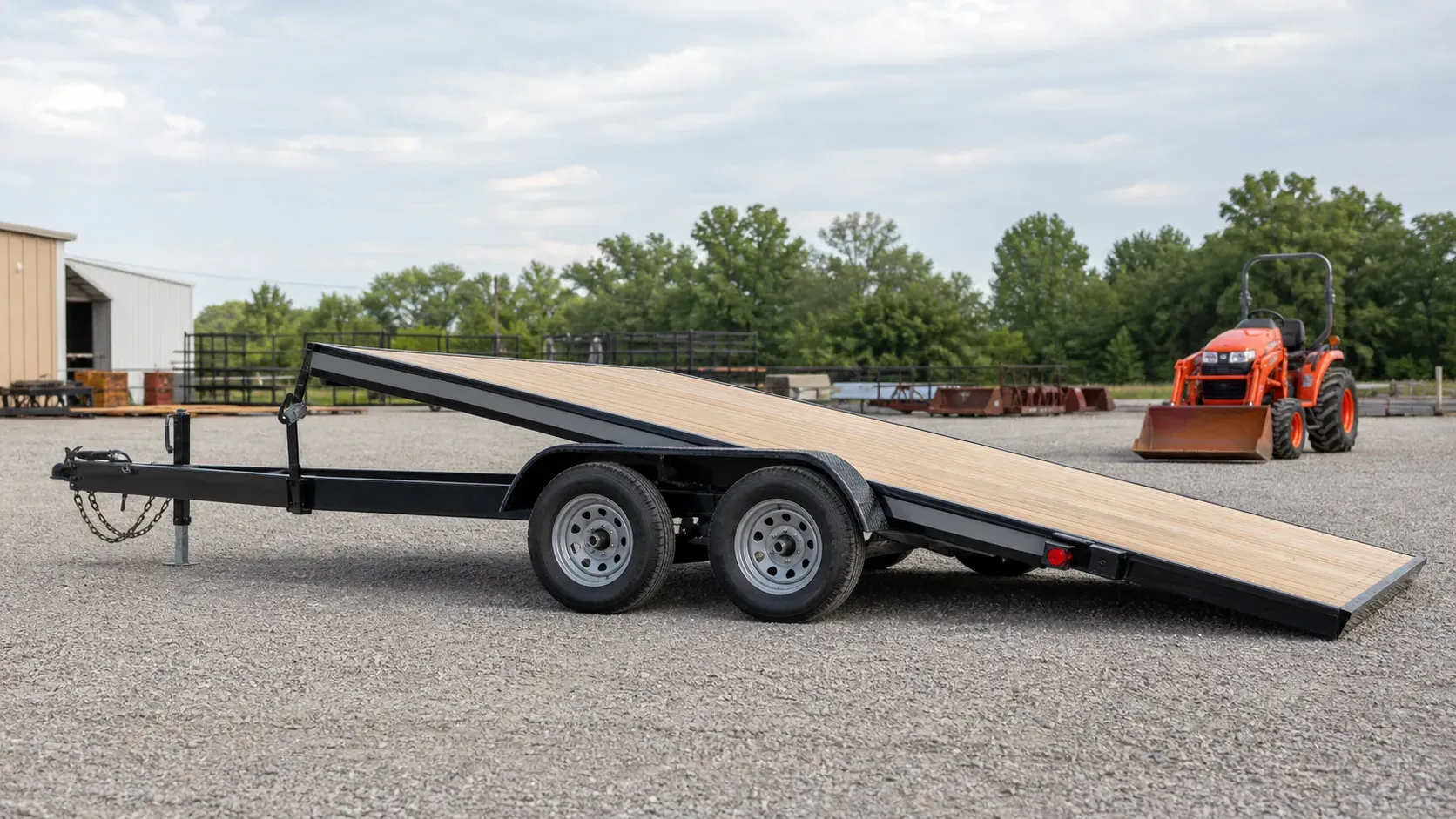
The gravity tilt is the simplest machine in the tilt family. The deck sits balanced slightly rear-heavy on its pivot, held by a latch and controlled by a cushion cylinder. The load's own weight tips and levels the deck, with no pump, no battery, and no button. It costs less than the hydraulic version and teaches every owner a balance-point lesson fast. Wherever you don't need total control over the deck, it does the job honestly.
The tilt without the pump
The gravity tilt is the tilt idea stripped to its mechanical minimum. The deck pivots near the axles, balanced a few degrees rear-heavy, held level by a mechanical latch and governed by a hydraulic cushion cylinder that meters the motion. Pull the latch and the rear settles to the ground under its own weight. Drive aboard, cross the balance point, and the deck rotates level under the load while the cylinder keeps the landing gentle. Then you latch it, check it, and tow.
Its case against the hydraulic full tilt is everything that isn't there. No pump, battery, wiring, or remote. No charge line to run and no dead-battery mornings. And a price that undercuts the powered version by real money. The cylinder is a damper, not an actuator, sealed and simple, and you could hold the whole parts list in one hand.
What you give up is control. The deck follows the balance point, not a button. It can't stop mid-motion, can't lower a machine parked in the wrong spot, and can't tilt empty without a push. You learn the load positions that make it graceful, and that learning is most of the ownership. It's why daily-cycle and heavy-machine operations often pay for the hydraulic version's buttons, while the weekly loaders happily pocket the difference.
Who buys one? Equipment owners in the 7K-to-14K classes who load weekly, car and low-vehicle haulers whose cargo hates ramps, and the budget-conscious buyers across every profile the main tilt guide lists.
Balance, cushion, and the latch
The balance point is the whole machine. Empty, the deck's pivot sits slightly behind its center of mass, so a released deck settles tail-down. As the loading vehicle moves, it shifts the combined center of mass across the pivot, and the deck rotates level as it crosses. Position matters. Park too far back and the deck stays tail-down, roll forward briskly and it levels with authority. Every gravity owner finds the sweet spot inside three loads, sometimes with a few choice words.
The cushion cylinder is what keeps it civil. It's a sealed hydraulic damper plumbed between the frame and deck, metering rotation speed in both directions so the deck settles instead of slams. Its condition is basically the whole health check on this trailer. Look for a clean rod, no weeping seals, and steady resistance through the stroke, and inspect it whenever you service the bearings and axles. A failed cushion turns a graceful tilt into an abrupt one, and abrupt is the one thing this design can't afford.
The latch is non-negotiable. It's a positive mechanical lock that holds the deck level for travel, and you engage and verify it before every tow. The cylinder damps motion, the latch prevents it, and those are two different jobs, which is why the tilt guide's safety notes won't let one part cover both. If the latch starts needing persuasion, that's adjustment drift and worth acting on early. The walk-around habit, latch seated, pin in, cylinder dry, takes ten seconds a hookup for the life of the trailer.
The deck surface matters too. Grip on a moving incline is a safety spec, and wood beats wet steel every time.
Gravity tilt sizes and payload
| Class | Typical GVWR | Typical Payload | Common Fit |
|---|---|---|---|
| 16 to 18 ft, 7K | 7,000 lb | 4,700 to 5,200 lb | Cars, UTVs, small machines |
| 18 to 20 ft, 10K | 9,900 to 10,400 lb | 6,900 to 7,700 lb | Compact equipment, lifts |
| 20 to 22 ft, 14K | 14,000 lb | 9,300 to 10,100 lb | Skid steers, the class ceiling |
The gravity mechanism covers the tilt family's light and middle classes. Think of the main guide's lineup minus the heavy tiers, where machine weights and daily cycles justify the hydraulic version's control. When you subtract for payload, the pivot structure adds only modest steel, and the truck math follows the family standard, with 7K behind half-tons and the 14K class into three-quarter-ton territory.
The balance-point behavior adds one more note. Gravity decks reward loads whose weight is concentrated and mobile, like vehicles and machines, and frustrate loads that are diffuse or hand-placed, like pallets and loose material, which never give the clean center-of-mass crossing the mechanism needs. Mixed-cargo buyers should hear this plainly. The gravity tilt is a vehicle-and-machine specialist.
The gravity tilt's ledger
Here's the buying rule. If you load vehicles and machines weekly in the light and middle classes, the gravity tilt earns its keep and banks the hydraulic premium. If you're running daily cycles, heavy iron, or mixed cargo, read the hydraulic page before you decide.
Gravity tilt FAQ
How does a gravity tilt work without a pump?
The deck balances slightly rear-heavy on its pivot. A latch holds it level and a cushion cylinder meters its motion, and the load's own position tips and then levels it as it crosses the balance point.
Can I stop the deck mid-tilt?
No. The deck follows the balance point, and the cylinder controls speed, not position. Mid-motion control is exactly what the hydraulic version is selling.
What happens if the cushion cylinder fails?
The deck's motion turns abrupt, which is the one behavior this design can't have. Weeping seals and changed resistance are your warnings, so inspect it like the safety component it effectively is.
Where do I park the machine on the deck?
At the spot that levels the deck smoothly and sets an honest tongue weight. You'll find it inside three loads, then mark it on the deck for good.
Is the latch really necessary if the deck balances?
Absolutely. The balance holds the deck near level, the latch holds it locked. Hydraulic damping and balance bias aren't travel restraints. The latch is.
Gravity or hydraulic tilt?
For weekly loading of vehicles and machines, go gravity and keep the premium. For daily cycles, heavy machines, or any need to reposition mid-lift, go hydraulic.