Car-Hauler Tilt Trailers Explained.

The car-hauler tilt loads vehicles up one continuous plane at 7 to 11 degrees. No ramps, no crest, no negotiating a bumper over the lip, which is exactly why the low-car world favors it. It loads better than any hinged setup short of the low-profile builds below it, pairs naturally with a winch for the dead and the slammed, and asks the tilt family's usual premium and pivot upkeep in return. Low cars buy it happily.
The low-car answer on a pivot
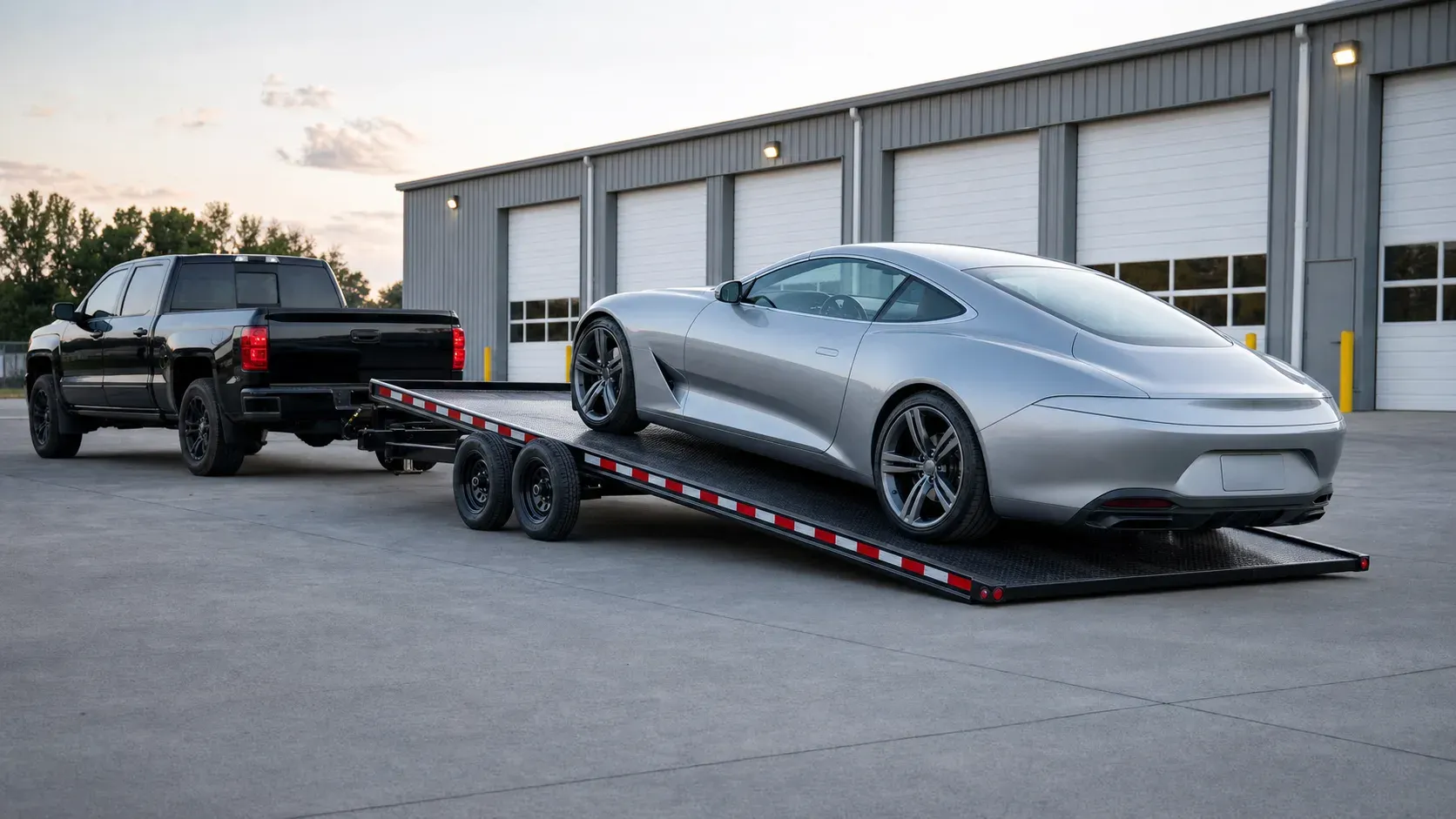
The car-hauler tilt solves the problem the ramp geometry guide works toward the whole way down. It deletes the loading angle at the source. The deck pivots into one continuous plane from ground to deck with no ramp-to-deck crest, and the approach runs 7 to 11 degrees against the standard car hauler's stacked transitions. Front overhangs that scrape every hinged setup roll up the tilt without trouble, which is why lowered, vintage, and race-prepped cars end up here.
Losing the crest matters as much as the angle. Hinged setups catch overhangs at the ramp-to-deck knuckle even when the approach math works out, the oldest warning on the ramp guide, and the tilt has no knuckle. The plane runs unbroken from pavement to parking spot. That leaves only the deck-edge-to-ground transition, feathered or rolled on the good builds, and the low-profile tilt waits below for cars that need even fewer degrees.
Both mechanisms serve the market, though gravity dominates it, since a car's concentrated rolling mass is exactly the cargo the balance point was made for. Hydraulic builds serve the shops and transporters whose cycle counts justify the buttons. The buyers sit at the low-and-nice end of the car hauler world, enthusiasts, racers, restorers, and the transport operators whose inventory arrives slammed.
Cars on the plane, winches on the dead
Loading is the balance point at its most natural. With the deck tilted, the car climbs at idle, straight and committed, its front wheels crossing the pivot as the deck levels under the rolling mass, and parks at the deck mark that sets tongue weight. It's the whole procedure from the hauling-a-car guide minus the ramp chapter. Gravity builds reward a smooth, continuous roll, hydraulic builds forgive everything, and both want the driver's window down and a spotter watching the first dozen loads.
Pairing a winch is the configuration's quiet strength. A deck-mounted winch pulls the dead, the wrecked, and the too-low-to-drive up the tilted plane with no ramp alignment to manage. The sizing math from the tie-down guide applies, 1.5 times the heaviest dead vehicle, and the tilt-plus-winch combination is the project-car community's standard answer for cargo that hasn't run since the last owner.
Securement follows the car world's standard, with one caveat from the tilt family. Wheel straps at four corners are the modern default, chains where weight and vintage demand them, tensioned with the deck level and latched, never mid-tilt, and the travel latch checked every tow. The deck surface question matters most here, because street tires on a moving incline want wood's grip or the traction treatment a steel build owes them.
Car-hauler tilt sizes and payload
| Class | Typical GVWR | Typical Payload | Common Fit |
|---|---|---|---|
| 16 to 18 ft, 7K | 7,000 lb | 4,600 to 5,100 lb | Cars, classics, the standard |
| 20 ft, 10K | 9,900 to 10,400 lb | 6,800 to 7,600 lb | Trucks, heavy builds |
| 20 to 22 ft, 14K | 14,000 lb | 9,000 to 9,900 lb | Shop duty, dead-iron work |
The classes track the car hauler's table, with the pivot's cost showing up in the payload math. The 18-foot 7K tilt is the enthusiast standard, and the modern truck-and-SUV reality pushes buyers into the 10K class just as it does on fixed decks. Truck math holds the family ladder, 7K behind honest half-tons and the heavy classes into three-quarter-ton territory.
Deck length follows the fixed-deck rules, the longest car plus room to walk, with one tilt-specific note. The pivot position fixes the balance geometry, so the deck mark for each regular vehicle is worth finding once and painting for good.
The car-hauler tilt's ledger
The buying rule. Clearance decides. Cars with under 5 inches of chin or a regular diet of dead iron buy the tilt, standard-clearance cars loaded occasionally keep the fixed deck's savings, and the ramp guide's math settles the middle.
Car-hauler tilt FAQ
Will my lowered car clear a tilt trailer?
The 7-to-11-degree single plane clears what every hinged setup scrapes, and the low-profile tilt runs gentler still. Measure the chin against the published angle, then check the finish at the deck edge.
Gravity or hydraulic for hauling cars?
Gravity dominates, since a rolling car is the balance point's ideal cargo. Shops and transporters running daily cycles buy the hydraulic's buttons.
Can I winch a dead car up a tilt?
This is the configuration's home game. The plane needs no ramp alignment, and you size the winch at 1.5 times the heaviest dead vehicle, per the winch math.
How do I strap a car on a tilt deck?
Wheel straps at four corners with the deck level and latched, the standard procedure plus the family's never-mid-tilt rule and the ten-mile re-tension.
Tilt or long ramps for a low car?
Ramps plus a dovetail handle moderate clearance for less money, and the tilt deletes the problem entirely below that. The chin measurement decides it, honestly.
What wears on a car-hauler tilt?
The pivot pins, the cushion or drive cylinder, and the latch adjustment, all greased and checked on the family calendar. The deck itself lives the same life a fixed deck does.