Low-Profile Tilt Trailers Explained.

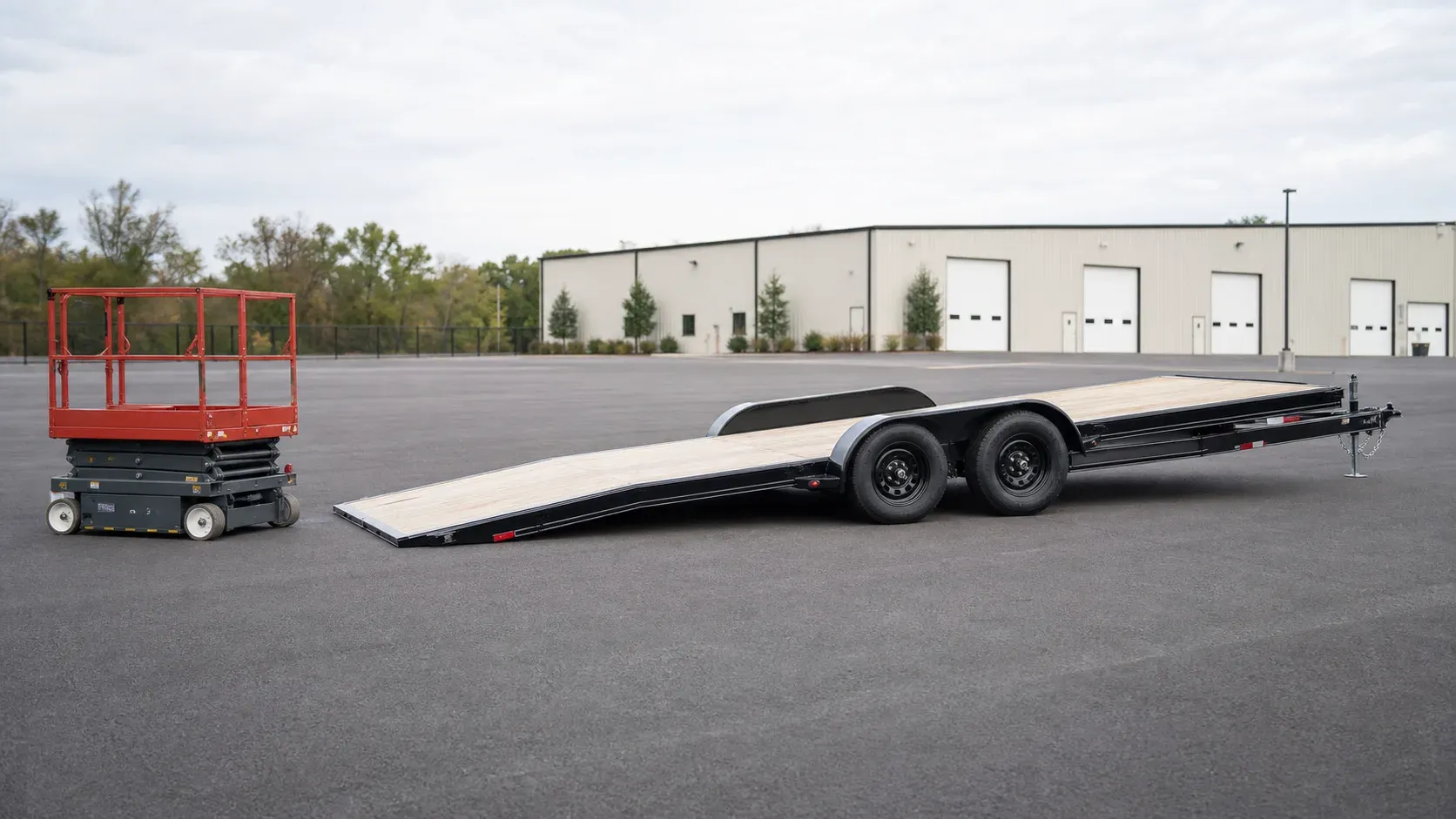
The low-profile tilt combines the two gentlest loading tricks in towing. It drops the deck toward the ground, then a tilt mechanism lays that deck into a single plane, and the result is an approach angle of 5 to 8 degrees. That is about as gentle as loading gets short of a gooseneck hydrotail. It's built for the lowest machines and vehicles, scissor lifts, slammed cars, and shop equipment, and you pay for it with less clearance underneath.
The gentlest angle in the family
The low-profile tilt is what you get when the tilt family pushes its angle math as far as it will go. A standard tilt already runs 7 to 11 degrees, gentler than any stack of ramps, and the low-pro build goes after the last few degrees at the source, deck height. It tucks the frame and runs lower-rise or torsion suspension, the same approach the low-profile dump uses, so the tilted plane starts lower and lies flatter, 5 to 8 degrees on the gentle builds.
The buyers are, by definition, the clearance-limited. Scissor lifts with 3 inches of ground under them, lowered and race vehicles too low for even the car-hauler tilt, floor equipment, shop machines, anything that measures its ground clearance in fingers. For that crowd, every degree is access, and the low-pro sells those degrees cheaper than anything short of a gooseneck hydrotail.
The trade is the one every low-profile build makes, clearance underneath. The tucked frame and low deck drag where a standard build clears. Driveway aprons, grade breaks, and rutted ground all find the belly, and the pivot hardware rides closer to the road, so it wants the same underside armor inspection the dump version's guide prescribes. Route awareness comes with the trailer.
Both tilt mechanisms work here. Gravity builds handle the light end, hydraulic builds take the heavy, daily-use end. It's the family's usual split, just lower to the ground.
Where the degrees come from
The math is simple. Approach angle comes down to deck height divided by effective length. The tilt mechanism stretches the length term by turning the whole deck into the ramp, and the low-pro build shrinks the height term. Frame rails are formed around the running gear, torsion axles cut out the spring stack's inches, and deck heights land at 15 to 19 inches instead of the standard tilt's 20 to 24. Divide the smaller height by the same deck length and you get the gentler angle.
Torsion suspension does most of the height work. Its low mounting geometry buys back the inches a leaf stack eats up, and it rides better too, though the axle page covers the cost and pairing caveats. The pivot geometry adapts to the lower deck, with pins and either a cushion or drive cylinders packaged into the shallower space. How well that packaging is done, protected plumbing and greaseable pins you can reach at ground level, is what separates a trailer engineered low from one that was merely lowered.
Traction on the tilted plane matters even more for these buyers. Low vehicles arrive on street tires and low machines on small casters, and both need grip from the deck surface. Inspect the transition where the deck edge meets the ground too. A rolled or feathered rear edge lets a three-inch clearance cross where a square edge would catch. Walk your actual machine's geometry through the trailer's actual numbers, because this market shops by the eighth of an inch.
Finish by checking under the trailer. The pivot hardware, the plumbing on hydraulic builds, and the frame's lowest points all ride closer to the road than on a standard build, and whether they're armored or left exposed tells you how much the builder cared.
Low-profile tilt sizes and payload
| Class | Typical GVWR | Typical Payload | Common Fit |
|---|---|---|---|
| 16 to 18 ft, 7K | 7,000 lb | 4,600 to 5,100 lb | Low cars, small equipment |
| 18 to 20 ft, 10K | 9,900 to 10,400 lb | 6,700 to 7,500 lb | Scissor lifts, shop machines |
| 20 to 22 ft, 14K | 14,000 lb | 9,000 to 9,900 lb | The configuration's ceiling |
These classes cover the family's light and middle weights. The payload math has to account for both the tucked frame's engineering and the pivot's steel, and the truck side follows the usual ladder, 7K behind a half-ton, 14K into three-quarter-ton territory. Heavier low-and-heavy iron above the table belongs to the gooseneck hydrotail world, the same buyer with ten times the machine weight.
The low deck also steadies the tow. Cargo rides inches lower on a build that's already calm, the same center-of-gravity benefit the low-profile dump gets.
The low-pro tilt's ledger
The buying rule. Measure your lowest regular load's clearance against the trailer's published angle and the real shape of its rear edge. If your machine has under 6 inches of clearance, the low-pro's degrees are worth buying. If it has standard clearance, a regular tilt does the job for less.
Low-profile tilt FAQ
How low is the loading angle really?
Five to 8 degrees on the gentle builds, with deck heights of 15 to 19 inches laid flat into a single plane. That's the gentlest loading you'll get short of a gooseneck hydrotail.
What clears a low-profile tilt that won't clear a standard one?
Anything in the 3-to-6-inch clearance range, scissor lifts, slammed vehicles, floor equipment. At those numbers, every degree the low-pro saves is real access.
What's the ground clearance trade?
The tucked frame drags on aprons and grade breaks a standard build would clear, and the pivot hardware rides closer to the road. You manage it with route awareness and armored plumbing.
Gravity or hydraulic at low profile?
The usual split. Gravity for weekly vehicle loading, hydraulic for daily cycles and the heavy classes. Sitting lower doesn't change which mechanism you want.
Torsion axles required?
Nearly always, yes. Their low mounting buys the inches the geometry needs, though the axle page covers the cost and pairing notes.
Low-pro tilt or hydraulic dovetail?
Weight decides. The low-pro serves through 14K, and the hydrotail owns the low-and-heavy gooseneck world above that. Same buyer, different scale.