Low-Profile Dump Trailers Explained.

A low-profile dump trailer drops its bed height several inches by tucking the frame and running lower-rise suspension. That makes skid steer loading easier, lowers the center of gravity, and lets equipment climb aboard at a saner ramp angle. You pay for it with less under-bed clearance and usually shorter sides. If a loader fills your dump, or machines ride in it between loads, low-pro is the working answer.
What a low-profile dump is
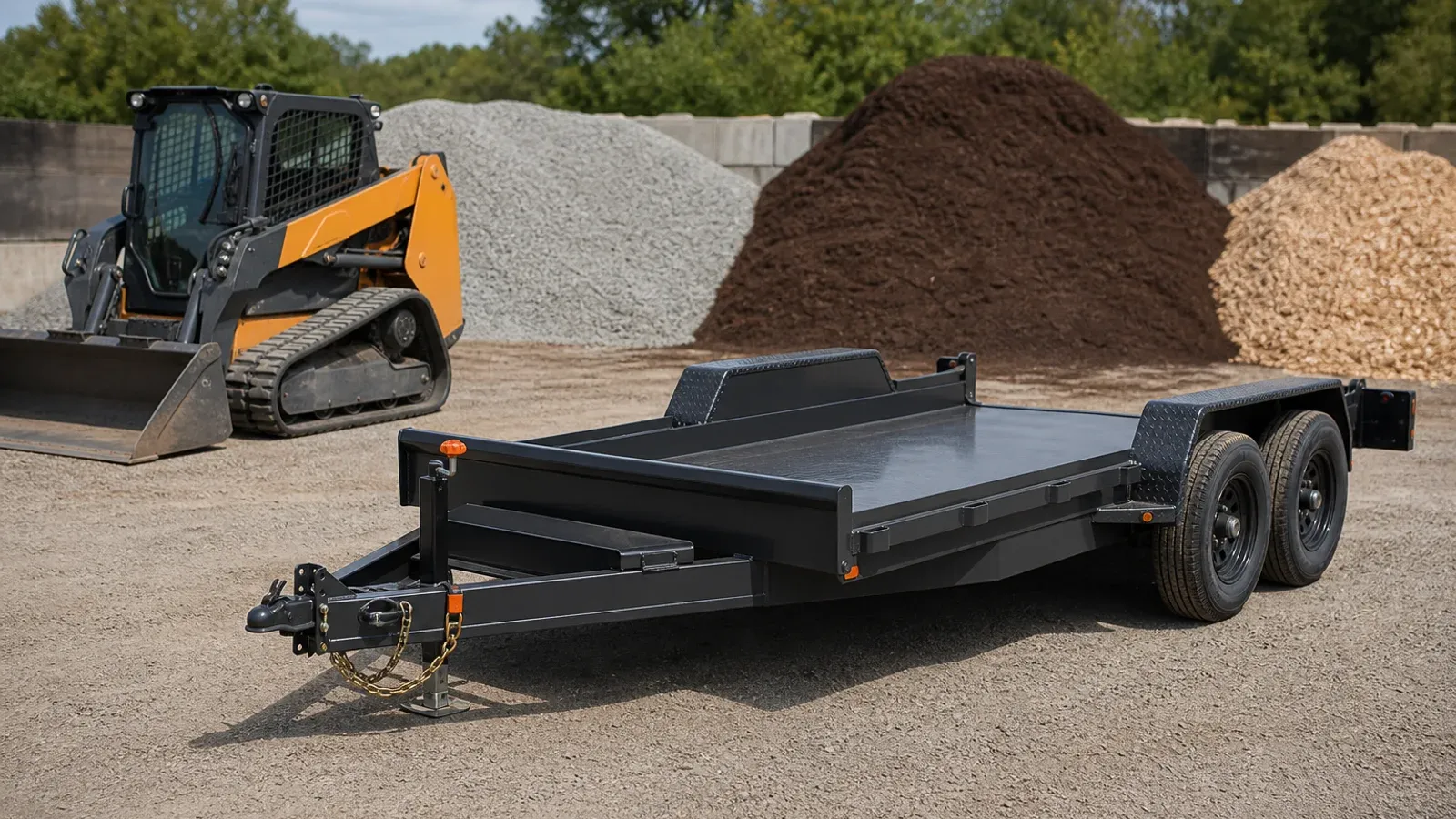
Low-profile is a height decision, and it changes everything downstream. A standard dump carries its bed above the frame rails, which ride above the axles, stacking the bed floor 30-plus inches off the ground. A low-pro build tucks the bed between or partway around the frame structure and runs lower suspension geometry, dropping the floor 4 to 8 inches. A few inches doesn't sound like a category. Load one for a week and it does.
So who cares about those inches? First, anyone loading with a skid steer or compact loader, because bucket clearance over the side rail decides how fast and how cleanly a trailer fills. A lower rail means less spillage, less reach, and smaller machines that can still do the job. Second, anyone running equipment up the rear ramps, since the lower deck cuts the approach angle, and low-pro dumps with ramp gates moonlight as equipment haulers far more credibly than standard-height boxes. Third, everyone towing, because a lower center of gravity with a heavy wet load aboard is the difference you feel in every crosswind and on every ramp.
The tradeoffs are structural. Tucking the bed costs under-bed clearance, so low-pros drag their bellies where standard dumps clear, which is a real problem on rough sites. Side height usually gives some ground too. A low floor with standard-height sides would tip a loader's bucket, so builders commonly pair low-pro floors with moderate sides and trade a little volume. The tucked frame is also harder to build, which shows up in the price and separates good engineering from marketing.
The buyer profile is easy to picture. Contractors and landscapers loading by machine daily, crews whose dump doubles as the equipment trailer, and anyone hauling dense material where volume was never the limit anyway. The high-side build is this trailer's mirror image, volume over density, and between them they frame the dump market's real question. What does your material weigh?
Frames, suspension, and the geometry of low
The height savings come from two places. Frame design first: low-pro builds nest the bed into the frame structure instead of stacking above it, some using formed main rails, some a dropped cradle between the rails. Suspension second: lower-rise spring setups or torsion axles, which mount to the frame with no spring stack at all and buy inches while smoothing the ride. Torsion suspension shows up on low-pros more than any other dump configuration for exactly that reason, and the axle fundamentals page runs the torsion-versus-spring debate in full.
The lift is standard dump equipment adapted to tighter quarters. Scissor mechanisms dominate because they fold flat into the shallow space between frame and bed, one more argument for the scissor in this configuration. Power is the usual battery, pump, and remote, and the guide's power rules apply unchanged.
Dump geometry shifts a little with the lower height. The lower pivot means the bed's rear edge starts closer to the ground and meets it sooner in the lift, which shortens the slide distance for the load. It's a minor unloading advantage nobody advertises but everyone notices. Ramp-gate versions use the same math, so the deck-to-ground transition a machine climbs is genuinely gentler.
The clearance ledger runs both directions. Less air under the bed means the pump box, wiring, and plumbing live closer to the road and the rocks, and good low-pro builds armor them accordingly, so look for shielded lines and a protected pump enclosure. Approach and departure angles at site entrances deserve a thought too. The same low belly that steadies the highway ride will find the high spot in a rutted entrance.
Low-profile sizes and payload
| Class | Typical GVWR | Typical Payload | Common Fit |
|---|---|---|---|
| 6x10 to 6x12 low-pro | 7,000 to 9,900 lb | 4,800 to 7,200 lb | Landscape crews, machine loading |
| 7x12 low-pro | 12,000 to 14,000 lb | 8,500 to 10,200 lb | Contractor daily work |
| 7x14 to 7x16 low-pro | 14,000 to 16,000 lb | 9,700 to 11,600 lb | The working standard |
| Gooseneck low-pro | 15,900 to 21,000 lb | 11,000 to 15,500 lb | Heavy equipment crossover |
The class math is ordinary dump math. GVWR minus real empty weight equals payload, the 14K class is the working center, and dense material fills the weight rating long before shorter sides fill up by volume. That's exactly the low-pro's design bet. Ten cubic feet of wet clay doesn't care how tall your sides are.
Truck requirements track the class as always, 7K classes behind an equipped half-ton, the 14K working classes into three-quarter-ton territory, tongue weight honest at 10 to 15 percent. One low-pro bonus rides along: the lower center of gravity makes the loaded tow noticeably calmer at every class. It's the kind of spec that never shows on the sheet and always shows in the seat.
Where low-profile wins and loses
The buying rule. If a machine loads your trailer or rides in it, the low-pro premium pays for itself daily. If you load by volume and by hand, a standard or high-side build serves the material better.
Low-profile dump FAQ
What makes a dump trailer low-profile?
The bed nests into the frame structure instead of stacking above it, usually with lower-rise or torsion suspension, dropping the floor 4 to 8 inches against a standard build.
Why does bed height matter?
Loading, mostly. Lower side rails make skid steer and loader work faster and cleaner, and a lower deck gives equipment a gentler ramp angle. You also get a calmer tow from the lower center of gravity.
Can equipment ride in a low-profile dump?
With a ramp gate and rated tie-downs, yes, and it's the configuration's second job. Mind the bed's payload and secure to rated points, because a dump bed floor is not an equipment deck unless it was built as one.
What's the downside of low-profile?
Ground clearance, since the tucked belly drags where standard dumps clear, and usually some side height, which trades away volume. Rough sites and light fluffy material argue for other builds.
Do low-profile dumps cost more?
Typically a modest premium, because the tucked frame and torsion suspension cost more to build. Machine-loading operations earn it back in weeks.
Torsion or spring axles on a low-pro?
Torsion suits the configuration, with lower mounting height and a smoother ride, at a higher part cost and different repair economics. The axle page runs the full debate.