Scissor-Lift Dump Trailers Explained.

A scissor-lift dump trailer raises its bed with a folding scissor mechanism driven by a hydraulic cylinder, which spreads the lift force across the frame instead of one point. It powers through the heavy, wet, and off-center loads that stall single rams, and that's why it's standard on serious 14K dumps. You pay for it in money, moving parts, and a little empty weight. For loads that actually work the trailer, it earns that price.
What a scissor-lift dump is
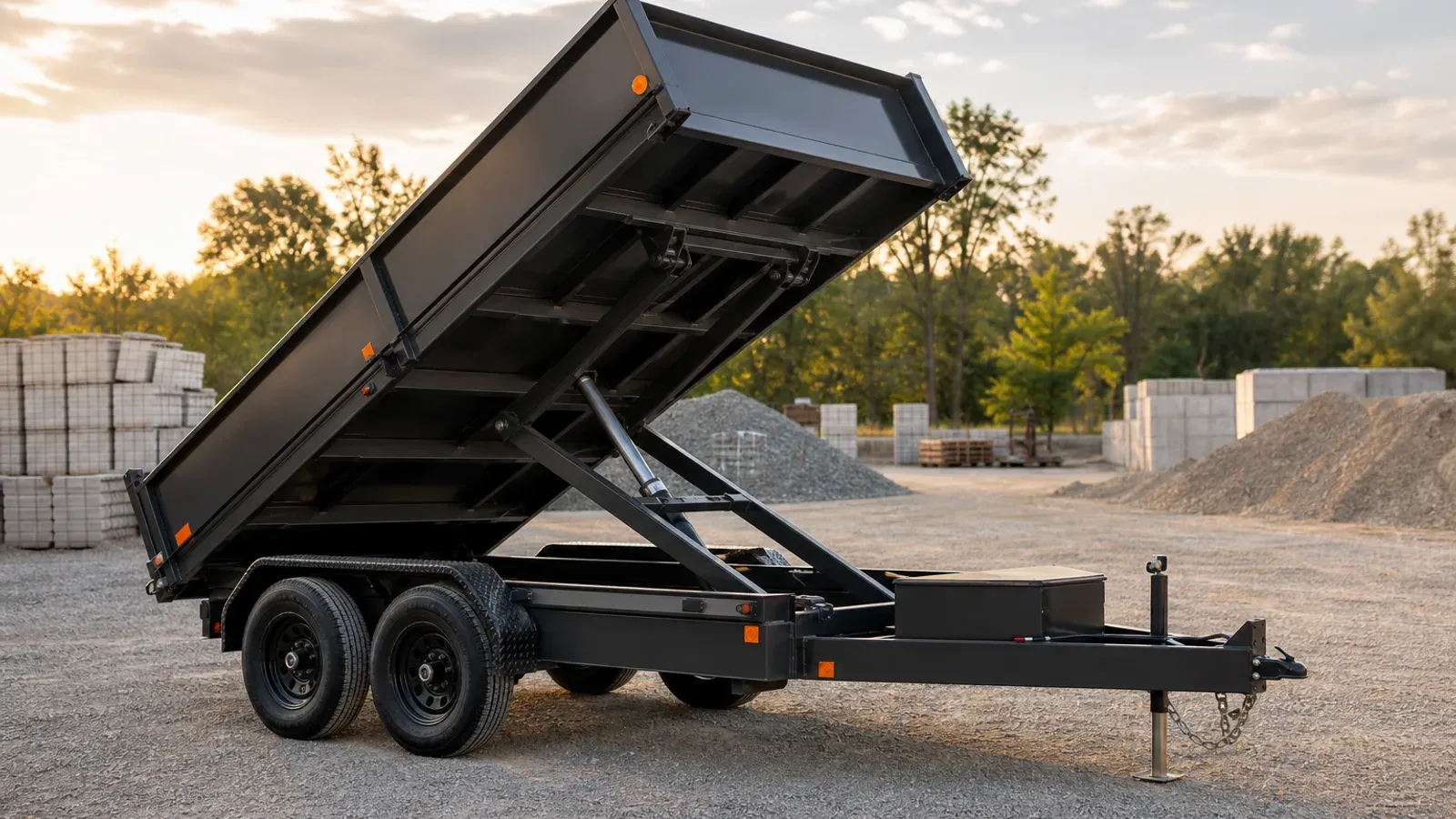
The name describes the mechanism under the bed. A hinged X of steel arms sits between the frame and the box. A hydraulic cylinder drives the X open, the arms straighten, and the bed rises on its rear hinge. Instead of one cylinder pushing on one point, the load rides a spreading cradle of steel, and that geometry explains everything the trailer does well.
That shape pays off three ways. Lifting force stays strong and steady through the stroke, including the mid-lift zone where a single ram works its weakest angles against a still-full bed. The centered mechanism resists the twist of an off-center load, so the operator who heaps one side of the box doesn't pay for it. And the arms handle side loads that a ram's chrome stages were never built to take.
It costs you something too. The scissor package runs real money over a ram on the same box, adds pins and pivots to grease, and adds a couple hundred pounds of steel that comes straight out of payload. It also tops out at a slightly shallower dump angle than a tall telescopic ram, which matters with the stickiest loads and rarely anywhere else.
The market has sorted this out by class. Light dumps ship with rams because their loads don't need the cradle. The 14,000-pound working class ships mostly scissor, because contractors learned the mid-lift stall lesson decades ago and stopped paying to relearn it. For the middle ground, our single-ram versus scissor-lift comparison sorts it out.
Arms, cylinders, and steady force
The scissor is a force multiplier. At rest the arms fold nearly flat and the cylinder pushes at a shallow, hard-working angle, which is why a scissor lift breaks loads free with real authority. The mechanism is strongest exactly when the bed is heaviest. As the arms rise their leverage improves, and the force stays flatter across the stroke than any single ram's curve. Engineers call that a favorable force profile. Operators just call it a lift that doesn't groan at half-mast.
The hydraulics are standard dump equipment. A 12-volt pump and a deep-cycle battery drive a straight cylinder, shorter and simpler than a telescopic ram. The power-system rules from the main dump trailer guide all apply here, so run the charge line from the truck, keep the battery on a tender between jobs, and keep the fluid clean and topped off. The cylinder itself has an easier job than a ram, tucked inside the mechanism and working through fewer seal surfaces.
Almost all the wear lives in the pins. A scissor carries pivot pins at the arm crossings, the cylinder mounts, the frame mounts, and the bed mounts, and every one is a grease point on a schedule. Demand greaseable pins with zerks, because sealed pins on a working dump are a slow-motion problem. Walk the mechanism on any trailer you're comparing. Generous pin diameters, grease zerks you can actually reach, and gussets at the frame mounts are what separate a working build from a brochure build.
One honest note on sticky loads. The scissor's slightly shallower maximum angle means the wettest clay sometimes needs a bump of the brakes to finish sliding, a trick every dump owner learns the first spring. A steep-angle ram sheds it a little sooner. Nobody trades away mid-lift power to gain five degrees, but the tradeoff is real and worth knowing.
Where scissor lifts rule
| Class | Typical GVWR | Typical Payload | Scissor Fit |
|---|---|---|---|
| 6x10 to 6x12 | 7,000 to 9,900 lb | 4,700 to 7,100 lb | Available, often the upgrade |
| 7x12 to 7x14 | 12,000 to 14,000 lb | 8,400 to 10,100 lb | The class standard |
| 7x16 heavy tandem | 14,000 to 16,000 lb | 9,800 to 11,500 lb | Standard, no real alternative |
| Gooseneck dump | 15,900 to 22,000+ lb | 11,000 to 16,000 lb | Universal |
The heart of the class is the 14K tier. The 7x14 scissor dump is arguably the single most common serious dump configuration in America, and everything about it is spec'd around the mechanism: tandem 7K axles, brakes on both axles, and a box built to be filled with material that weighs more than most buyers expect.
Payload is the number that matters, GVWR minus real empty weight, and the scissor's extra steel counts against that empty weight. The truck follows the class. A loaded 14K scissor dump is three-quarter-ton work, with 10 to 15 percent tongue weight riding the truck's payload, and the gooseneck versions climb from there.
Where the scissor wins and loses
Here's the rule. If the trailer will regularly carry heavy, wet, or carelessly loaded material, the scissor premium is the cheapest insurance on the option sheet. If your loads are light and even, keep the money, because the ram does that work just fine.
Scissor-lift dump FAQ
What does scissor lift mean on a dump trailer?
It's a folding X of steel arms between the frame and the bed, driven by a hydraulic cylinder. The mechanism spreads the lift force across the frame and delivers it steadily through the stroke, rather than one cylinder pushing on one point.
Scissor lift or single ram?
Go scissor for heavy, wet, and off-center loads, and for the 14K class by default. Go ram for lighter, evenly loaded work at a better price. Our comparison runs it in full.
Do scissor lifts dump at a steeper angle?
Usually a bit shallower than a tall telescopic ram. Most loads never notice. The stickiest clay occasionally wants a brake-bump to finish the slide.
What maintenance does a scissor need?
Grease every pivot pin on schedule, keep the fluid clean, mind the battery, and check the frame and bed mounts for cracking gussets once a year. The pins are the whole wear story.
How much more does a scissor lift cost?
A meaningful premium over the ram on the same box, and it varies by builder and class. In the 14K class it's usually standard equipment, priced in because buyers there demand it.
Is the scissor safer to work under?
No raised dump bed is safe to work under without the safety prop set, scissor or ram. The mechanism holds hydraulic pressure, but the prop holds the bed. Use the prop.