Single-Ram Dump Trailers Explained.

A single-ram dump trailer lifts its bed with one hydraulic cylinder, usually a telescopic ram mounted at the front of the box. It's simpler and cheaper than a scissor lift, reaches a steeper dump angle, and does honest work in the light and middle classes. It gives ground to the scissor on heavy, sticky, and off-center loads. For gravel runs and general hauling under 10K, it's all the lift most buyers need.
What a single-ram dump is
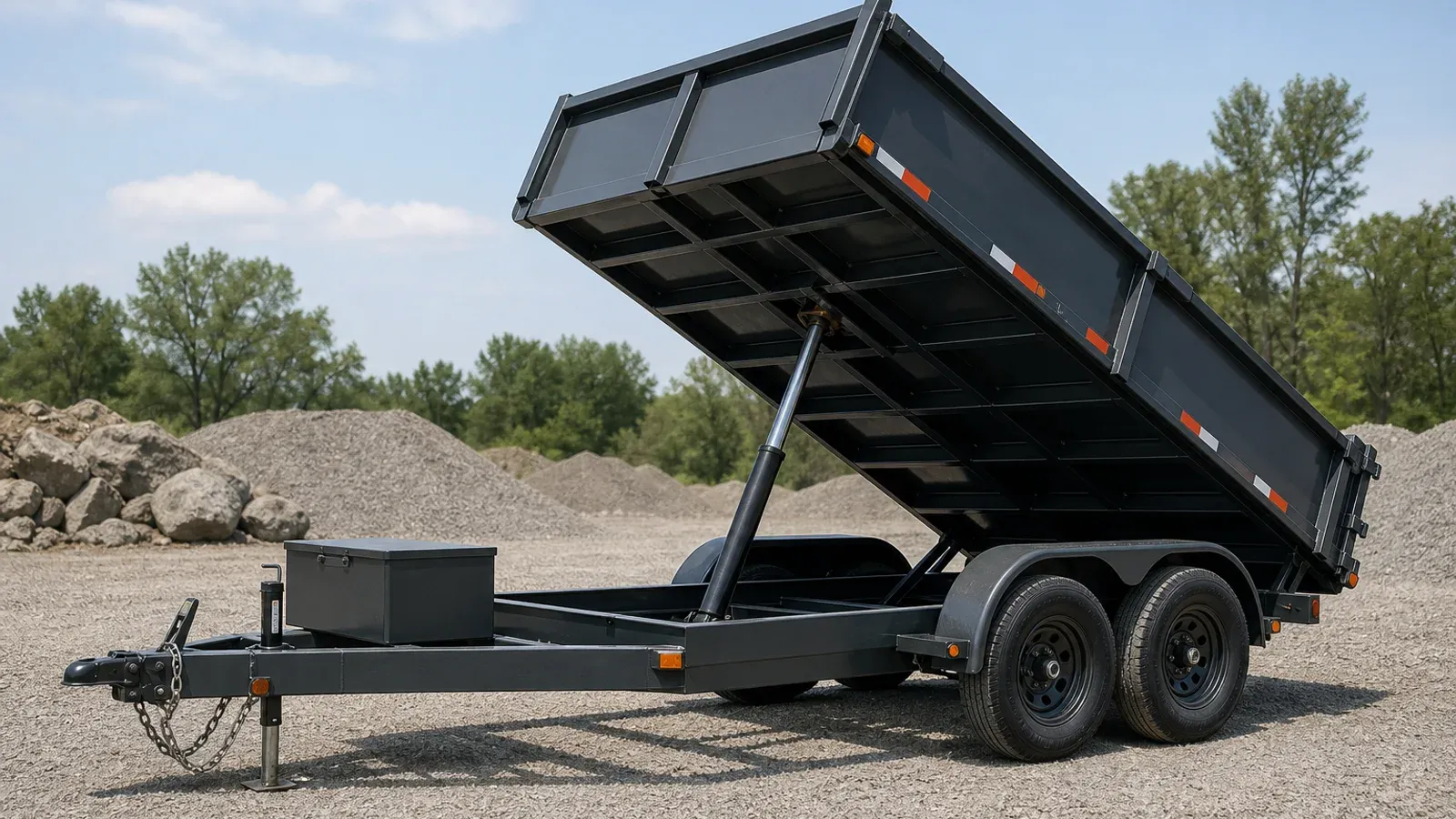
Single-ram describes the lift, not the whole trailer. One hydraulic cylinder does the raising, most often a telescopic ram, a cylinder inside a cylinder inside a cylinder, mounted upright at the front of the bed. Power it up and the stages extend in sequence, and the bed pivots on its rear hinge until the load slides out.
The pitch is simplicity. One cylinder means fewer seals, fewer pins, and fewer places for something to go wrong, plus a lighter, cheaper lift package than the scissor mechanism it competes with. The telescopic design also buys geometry. Because the ram keeps extending stage by stage, single-ram beds commonly reach steeper dump angles than scissors, and a steep angle empties sticky loads that a shallow one holds onto.
The catch is leverage. A front-mounted ram lifts hardest at the start of the stroke and works through its weakest geometry mid-lift, right where a heavy load still sits in the bed. And because the force enters the bed at one point, off-center and rear-loaded weight twists the box in ways a scissor's centered cradle resists. That's the single-ram versus scissor argument in a nutshell, and it's why the market splits by class. Rams rule the light end, and scissors take over as loads grow.
You'll find single-ram lifts standard on compact and mid-size dumps, and as the base configuration on many 7x14s, with the scissor offered as the upgrade. Neither is wrong. The load decides.
Telescopic stages, pivots, and power
The telescopic ram is the signature part. Three to five nested stages extend in order, largest first, and the bed rises through an arc set by the rear hinge. Full extension commonly puts the bed past 45 degrees, and the steepest single-ram setups approach the angle where almost nothing sticks. Lowering reverses the sequence under gravity, controlled by the valve.
The power package is the same battery-and-pump system every hydraulic dump carries. A 12-volt pump draws from a deep-cycle battery, a charge line from the truck keeps it fed on the road, and the remote runs the show. The dump trailer guide covers the power system's care and feeding, and all of it applies here without a discount. A dead battery grounds a single-ram exactly as fast as it grounds a scissor.
Mounting style varies, and it matters. Front-of-box telescopic mounts are the standard, and they produce the geometry described above. A few builders run an under-body single cylinder pushing on a lift arm, which trades the telescopic's steep angle for a lower, more protected cylinder. Ask which you're looking at, because the spec sheet often just says "single cylinder."
The wear points are few and easy to find. The ram's chrome stages collect grit that scores seals, so a wipe-down habit is cheap insurance. The base and bed pins want grease on schedule. And the rear hinge carries every dump cycle, so look for greaseable, generously sized hinge pins when comparing builds. A worn hinge turns a clean lift into a shimmy.
Where single-ram lifts show up
| Class | Typical GVWR | Typical Payload | Single-Ram Fit |
|---|---|---|---|
| Compact 4x6 to 5x10 | 5,200 to 7,000 lb | 3,600 to 5,200 lb | The standard lift |
| 6x10 to 6x12 | 7,000 to 9,900 lb | 4,900 to 7,300 lb | Common, competitive |
| 7x12 to 7x14 | 12,000 to 14,000 lb | 8,600 to 10,300 lb | Base option, scissor upgrade offered |
| Heavy and gooseneck | 15,000 lb and up | 10,500 lb and up | Rare, scissor territory |
The pattern is clean. Below 10,000 pounds GVWR, the single ram is the market's default and there's little reason to pay past it. In the 14K class it holds the base-model slot, and the scissor upgrade earns its price once loads get heavy, wet, and slow to leave the bed. Above 14K the ram mostly drops out of the conversation.
Payload works the usual way, GVWR minus real empty weight, and the single-ram package saves a little empty weight against the scissor, a small payload bonus in the light classes. Truck requirements follow the class, not the lift type. The 7K dumps tow behind an equipped half-ton, and the 14K class moves into three-quarter-ton territory with tongue weight counted honestly.
Where the single ram wins and loses
Here's the rule. Match the lift to your honest load, not the brochure load. For gravel spread evenly in a 7x12, the ram does the job for less money forever. For wet fill dirt heaped by a tired loader operator at 4 p.m., that's scissor work, and the comparison page makes the case both ways.
Single-ram dump FAQ
What does single-ram mean on a dump trailer?
One hydraulic cylinder lifts the bed, usually a telescopic ram at the front of the box, instead of the two-arm scissor mechanism. It's simpler and cheaper, reaches a steeper dump angle, and has less muscle mid-lift.
Single ram or scissor lift?
Go ram for light and evenly loaded work at a better price. Go scissor for heavy, wet, and off-center loads. The full comparison runs it class by class.
Will a single ram lift a full load?
A properly matched ram lifts its rated box, because builders spec the cylinder to the class. Trouble shows up with overloads, stuck wet material, and weight piled at the rear or one side, which is scissor territory.
What maintenance does the ram need?
Clean chrome, fresh fluid, greased pins at the base, bed, and rear hinge, and a healthy battery. The stages multiply seal surfaces, so grit is the enemy to keep out.
Do single-ram dumps cost less?
Yes. The lift package is the cheapest hydraulic option, and it usually shows as a real gap against the scissor version of the same trailer.
What happens if the ram fails mid-lift?
The control valve holds the bed where it stopped, and the manual release lowers it under control. Never work under a raised bed without the safety prop set, ram or scissor, no exceptions.