Compact Dump Trailers Explained.

A compact dump trailer fits the hydraulic dump function into a 4x6 to 6x10 box at 5,200 to 7,000 pounds GVWR, and it tows behind half-tons and many SUVs. It's the answer for homeowners, small properties, and light trades who want real dumping without a bigger truck or the 14K price. Its honest limit is dense material. A small box overloads on dirt faster than it looks.
What a compact dump is
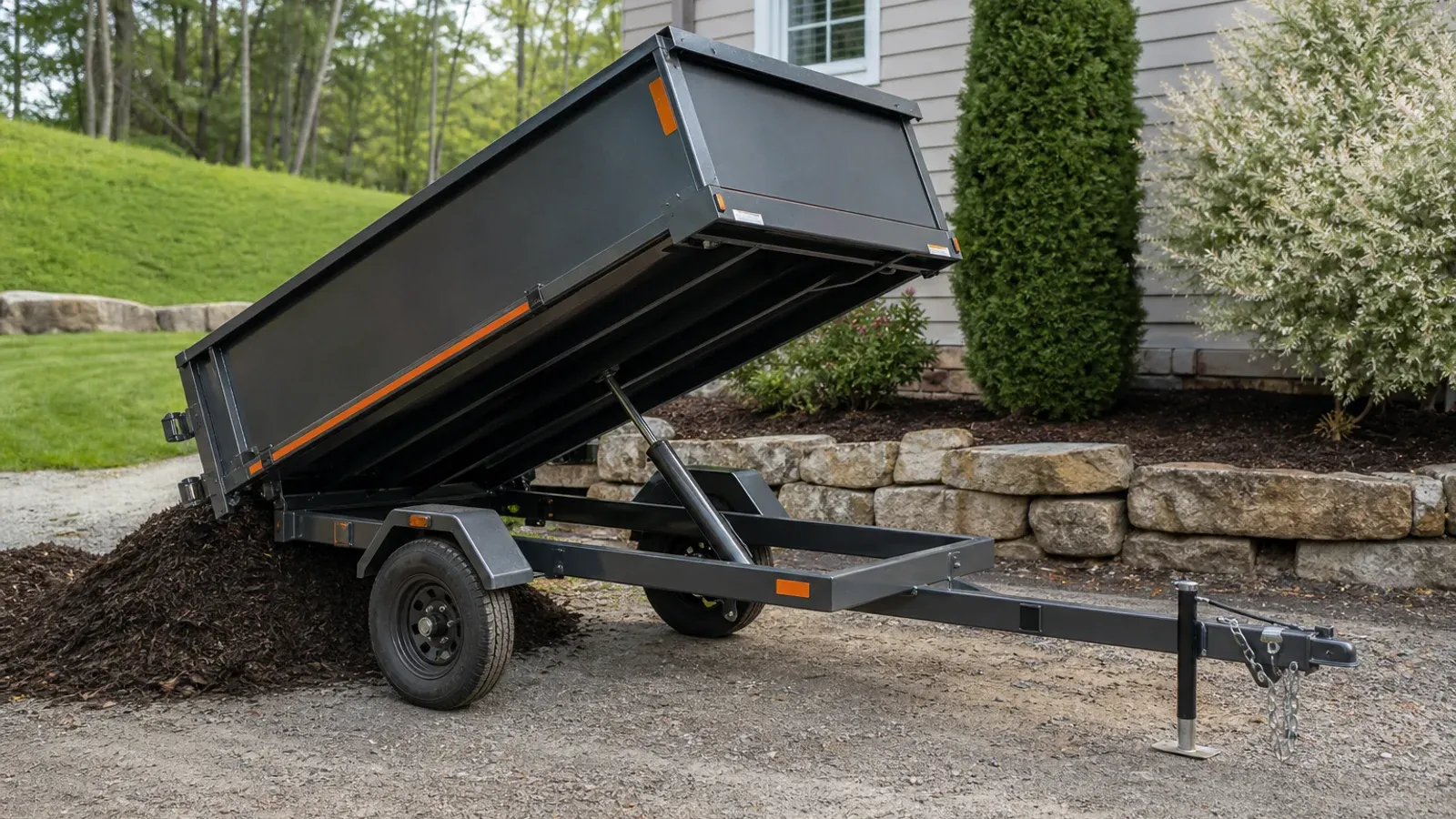
A compact dump is the smallest working member of the family, a hydraulic dump box scaled to 4x6 through 6x10 footprints. Single axles are common at the small end, and light tandems show up at the top. Everything the dump guide describes appears here in miniature. You get the battery-and-pump power pack, the remote, the rear gate, and the tipping bed, all sized for loads and budgets an order of magnitude below the contractor classes.
The pitch is access. Hydraulic dumping used to start at trades money and three-quarter-ton trucks. The compact class brings it behind a half-ton, many SUVs, and even well-rated crossovers at the smallest sizes, at prices that make sense for a property instead of a payroll. If you've ever spent a weekend shoveling mulch back out of a utility trailer, the pitch lands.
Who's buying? Homeowners with acreage, firewood, and the eternal mulch cycle. Hobby farms moving feed, manure, and fence dirt. Rental yards keep them on the lot because everyone needs one occasionally. And light trades, from handymen to small landscape crews whose debris runs light enough to fit the class. The common thread is real dump work at residential scale.
The category's honest boundary is density. A 5x8 compact at 7,000 GVWR carries maybe 5,200 pounds, which works out to 2.5 yards of wet soil, a pile that looks insultingly small in the box. Mulch, leaves, firewood, and debris fill the class happily. Dirt and gravel hit the weight rating first, every time, and the smaller box makes that mistake easier to load and harder to see.
Scaled hydraulics and single-axle realities
The lift is almost always a single ram. The telescopic cylinder's simplicity and cost fit the class perfectly, and the light loads never expose its mid-lift limits. A handful of premium compacts offer scissors, though it's rarely worth the money at these weights. Power comes from the standard 12-volt pump and battery, scaled down, with one warning specific to this class. Small trailers sit for months, and keeping the battery on a tender between uses is the difference between a dump trailer and a very heavy wheelbarrow come spring. Follow the charge-line habit from the guide whenever the trailer's hitched.
Axle configuration splits the class. The 4x6 and 5x8 sizes run single axles that are light, cheap, and easy to hand-maneuver in a garage, and they carry the usual single-axle tradeoffs, no blowout redundancy and brakes only if you spec them. The 6x10 and heavier compacts run light tandems with brakes. Anyone towing behind an SUV should treat trailer brakes as mandatory no matter what the state minimum says, because the tow vehicles in this class have the least margin for an unbraked push.
The box and gate follow big-dump convention scaled down. Sides run 12 to 24 inches, gates split between simple barn doors and combination gates, and the floor gauge is where budget builds cut corners. Check the steel schedule, because a compact hauling firewood takes point loads that dent thin-floored competitors by the second cord. Frame quality is easy to read from six feet away, a wrapped tongue and real crossmembers on the good builds against angle-iron economy on the cheap ones.
Towing behavior deserves a note of its own here. A loaded compact behind a mid-size SUV is about the highest trailer-to-vehicle weight ratio you'll tow, so the tongue weight discipline of 10 to 15 percent matters more, not less. The tow vehicle has the least authority to correct a misloaded trailer. Load the heavy half forward, strap down anything that can shift, and read the SUV towing page before you assume the crossover's brochure rating means what it implies.
Compact dump sizes and honest payload
| Class | Typical GVWR | Typical Payload | Common Fit |
|---|---|---|---|
| 4x6 single axle | 5,200 lb | 3,900 to 4,200 lb | Property chores, firewood |
| 5x8 single axle | 5,200 to 7,000 lb | 3,800 to 5,300 lb | The homeowner standard |
| 6x10 light tandem | 7,000 lb | 4,900 to 5,300 lb | Small trades, hobby farm |
| 6x12 tandem | 9,900 lb | 6,900 to 7,400 lb | The bridge to the mid classes |
Payload runs the same equation as the rest of the family, GVWR minus real empty weight. Compact hydraulics cost proportionally more empty weight than big-trailer hydraulics because the pump and cylinder don't scale down as fast as the box does. Compare scale weights between builds, since the payload math spread at this size eats a bigger percentage of what you bought.
Here's the material math in the units owners actually use. A 5x8 with 5,000 usable pounds carries 6-plus yards of dry leaves, 8 to 10 of mulch by weight though never by volume, roughly 2 cords of seasoned firewood, or 2.5 yards of wet soil. The box holds about 2.2 yards at 18-inch sides, so mulch and leaves cube out before they weigh out, and soil weighs out before the box looks half loaded. There are two limits, and you need to know which one your material hits.
Matching the tow vehicle is this class's defining homework. The 4x6 and light 5x8s suit properly rated SUVs, the 7,000-pound classes want a half-ton, and a loaded 6x12 bridge class is genuinely half-ton work with brakes and honest math. The smallest rating in the chain wins, whether that's the hitch, the vehicle, or the trailer, exactly as it does at 22,000 pounds.
Where the compact wins and loses
Here's the buying rule. Match the class to your material's density and your vehicle's honest rating, and buy the hydraulics for the labor they replace, not the capacity they imply. The compact that hauls mulch every weekend is a great purchase. The one bought to move a driveway's worth of gravel is a lesson.
Compact dump FAQ
What's the smallest dump trailer made?
The 4x6 single-axle class at around 5,200 pounds GVWR opens the hydraulic dump market, and the 5x8 is the volume standard. Below that, dumping comes from tilt-bed lawn carts, which are a different product.
Can an SUV tow a compact dump?
Properly rated SUVs handle the 4x6 and light 5x8 classes, and trailer brakes are strongly advised no matter the state minimum. Check the vehicle's rating, the hitch class, and the SUV towing math honestly.
How much dirt fits in a small dump trailer?
Less than it looks. A 5x8 with 5,000 usable pounds carries about 2.5 yards of wet soil, a pile that won't impress anyone. Mulch, leaves, and firewood are the class's honest cargo.
Single ram or scissor at this size?
Single ram, almost always. The light loads at this size never expose its limits, and the price fits. A scissor upgrade buys you little here.
Do compact dumps need brakes?
The 7,000-pound classes carry them by law in most states, and behind an SUV they're wise at any rating. The brake rules and your state's threshold have the specifics.
Why does the battery keep dying?
Parking. Compacts sit for months between jobs, and the pump battery self-discharges. A cheap maintenance tender solves it for good, and the truck's charge line helps whenever you're hitched.