Single Axle vs. Tandem Axle. The Complete Comparison.

One axle is cheaper, lighter, and simpler. Two axles carry more, tow steadier, brake better, and survive a blowout. The honest thresholds point tandem: loads regularly past 2,500 pounds, regular highway miles, or anything you can't afford to have stranded. Light, local, and occasional points single. This is the most consequential spec on any trailer under 10,000 pounds, so choose it by the work.
Single vs. tandem at a glance
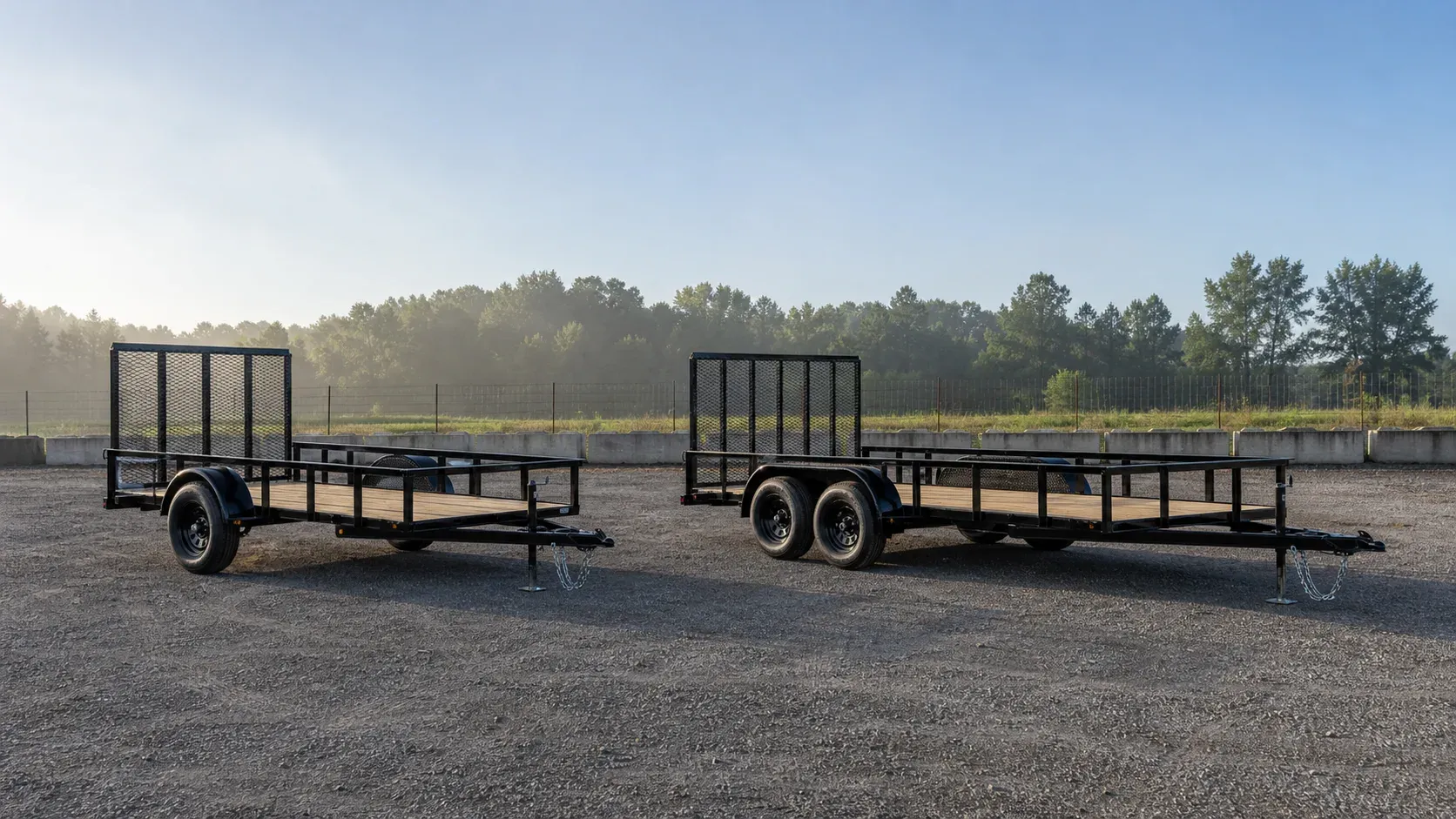
| Single Axle | Tandem Axle | |
|---|---|---|
| GVWR ceiling | ~3,500 lb | 7,000 to 14,000 lb |
| Blowout behavior | Immediate event | Limp to the shoulder |
| Brakes | Often none | Standard, one or both axles |
| Highway stability | Adequate loaded right | Composed by design |
| Price | The baseline | 60 to 100 percent more |
| Empty weight | 700 to 1,100 lb | 1,400 to 2,200 lb |
| Maintenance | Two tires, two bearings | Four and four, plus brakes |
| Tight turns | Pivots easy | Scrubs, wants wide arcs |
The axle count is the first real decision on any open-trailer order sheet, and it shapes everything downstream, capacity, brakes, tires, and how the trailer behaves on its worst day. Both configurations are honest machines. The mistake is buying one for the other's job.
Light, cheap, and simple
The single-axle's argument starts at the register and never really lets up. It's the cheapest real trailer configuration made, its 700 to 1,100 empty pounds tax the tow vehicle least, and its maintenance list, two bearings, two tires, usually no brakes, fits on a sticky note. For light loads on local trips, every dollar past it buys capability the job never calls for.
Handling is the quiet second argument. A single-axle pivots nearly in place, hand-moves across a driveway, backs into spots tandems have to negotiate, and stores in half a garage bay. The people best served by the configuration, homeowners with mowers, dump-run errands, and a small SUV doing the towing, feel those virtues weekly.
The debit side is concentration. Two tires carry everything, so load range and inflation are the whole safety program, and a blowout drops the trailer onto the failed corner immediately, with no second axle to lean on. The see-saw geometry makes tongue weight less forgiving, brakes are commonly absent below 3,000 pounds GVWR because the law allows it, and the capacity ceiling around 3,500 GVWR is a wall no option crosses. Inside its lines, it's excellent. At its lines, it's done.
Capacity, composure, and a second chance
The tandem's argument is what the second axle buys. Capacity doubles and then some, the standard 7,000-pound class carries what a single-axle grosses, and the heavy tandems run to 14,000. Stability improves by architecture, since paired axles with an equalizer damp pitch, resist sway inputs, and hold a highway line through crosswinds and truck wash that keep single-axles busy. The tandem page covers the hardware.
The safety case is the second chance. A blown tire leaves three carrying, and the trailer limps to the shoulder instead of arriving there. Brakes come standard at tandem ratings in nearly every state, electric drums with a controller in the truck, and the stopping-distance difference at 5,000 loaded pounds is not a rounding error. For loads that matter, machines, livestock feed, a business's inventory, the redundancy is the product.
The costs are honest. Sixty to 100 percent more at purchase, 1,400-plus empty pounds hauled every mile, double the bearings and rubber plus brake service, and the low-speed scrub that chirps tires and demands wide arcs in tight quarters. The tandem is a working tool, priced and maintained like one.
The numbers that decide it
Weight first. Cargo regularly past 2,500 pounds points tandem, both for the capacity and for the operating margin, since a single-axle run at 90 percent of rating every weekend ages on an accelerated schedule. Under 1,500 pounds forever, single, without apology.
Miles second. Highway trips at speed multiply both the blowout stakes and the stability dividend, so regular interstate towing points tandem almost regardless of weight. Local errands at moderate speeds keep the single-axle honest.
Consequence third, the tiebreaker nobody prices. A stranded hobby load is an annoying Saturday. A stranded work load is a missed job, and a blowout with the family's gear aboard is its own category. The second axle is cheap insurance against the day that matters, and buyers who've had that day never ask this page's question again.
And one spec note from under the trailer. Whichever count you choose, the axle brand, bearing service, and tire dates decide more breakdowns than the axle count does. A maintained single-axle beats a neglected tandem to the destination every time. The axle fundamentals page carries that whole story.
Single vs. tandem FAQ
At what weight do I need tandem axles?
Cargo regularly past 2,500 pounds, or any GVWR need past 3,500, the single-axle's practical ceiling. The standard tandem class picks up at 7,000 GVWR.
Are tandem trailers safer?
Loaded near either one's rating, yes, with brakes standard, blowout redundancy, and steadier highway manners. A lightly loaded single-axle towed sensibly is perfectly safe. The gap opens with weight and speed.
Do single-axle trailers need brakes?
Most states require them somewhere between 3,000 and 4,500 pounds GVWR, which is why the 2,990 rating exists. Optional brakes behind a light tow vehicle are money well spent regardless. Check your state.
Why do tandems wear tires oddly?
Scrub. The paired axles drag sideways through tight turns by geometry, wearing shoulders over years. It's normal, managed by rotation and moderate arcs.
Is a tandem harder to tow?
Easier at speed, steadier and more forgiving of load placement. Harder at walking pace, with wider turns and no hand-moving 1,600 pounds. Most owners call that trade instantly worth it.
What about triple axles?
That's a heavy-trailer answer, 21,000-plus GVWR territory on goosenecks and commercial tags. Nobody cross-shops them against singles, since weight class decides long before preference does.