Single-Axle Utility Trailers Explained.

A single-axle utility trailer runs one axle and two tires, the lightest, cheapest, easiest-to-handle footprint in towing. It's the right buy for loads under roughly 2,500 pounds on mostly local trips. The limits are real. There's no blowout redundancy, brakes come only if you spec them, and the rating tops out around 3,500 pounds GVWR. Stay inside those lines and nothing beats it per dollar.
What a single-axle utility is
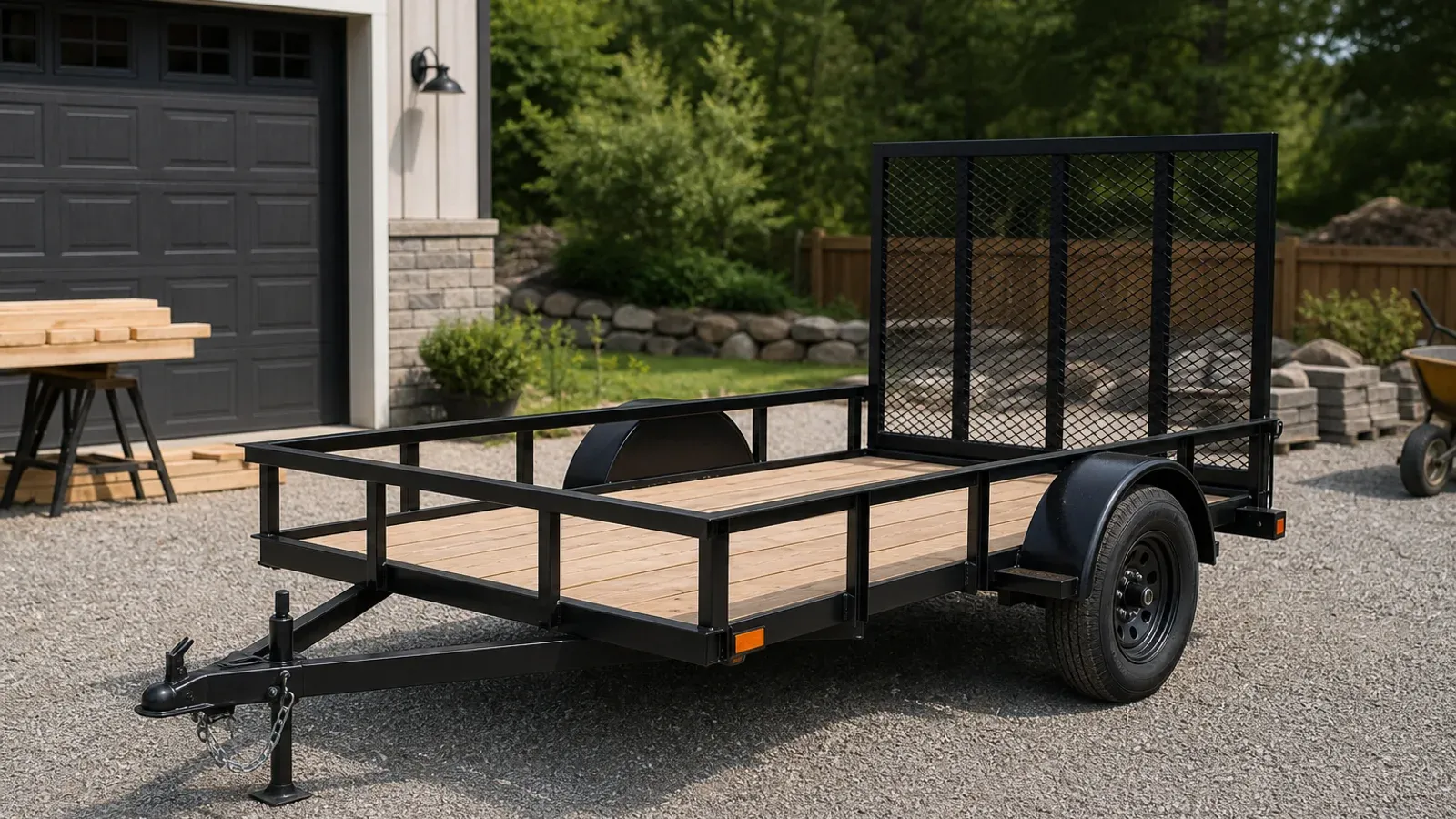
Single-axle is where the whole trailer world starts. One axle centered under the deck, two tires, and everything kept simple on purpose. The 5x8 and 6x10 single-axle utility is the most-sold trailer configuration in America, the one behind half the SUVs at the landscape supply on Saturday, and it earns that popularity with minimum price, minimum weight, and minimum fuss.
One axle buys you a lot. Empty weights run 700 to 1,100 pounds, light enough to move by hand across a driveway and easy on the tow vehicle's rating. Prices open under $2,000. You service one set of bearings, replace two tires, and get a trailer nimble enough to pivot almost in place, backing included. Short trailers do punish sloppy steering faster than long ones, so keep your inputs small.
What it doesn't buy is redundancy. A blowout on a single-axle is an immediate event, because the trailer drops onto the failed corner with no second axle to share the load, and you change it with a jack under a loaded frame. Capacity is the other limit. The class tops out around 3,500 pounds GVWR, roughly 2,000 to 2,600 usable after empty weight. Brakes are optional at these ratings in most states, which is legal but worth a hard look when the tow vehicle is a crossover.
The single versus tandem question is really the whole buying decision at this end of the market, and it comes down to weight and miles. Light loads on local trips say single. Regular highway miles or loads crowding 3,000 pounds say the tandem is worth the premium.
One axle, two tires, and the physics
The axle carries everything, so its rating is the trailer's real ceiling. Common single-axle ratings run 2,000, 2,990, and 3,500 pounds, and the GVWR is capped by whichever gives out first, the axle, the tires, or the frame. That 2,990 rating is no accident. It ducks under the 3,000-pound line where many states start requiring trailer brakes, which is why so many single-axles wear exactly that number, a spec written by the legislature as much as the engineer.
Tires work harder here than anywhere in towing. Two of them split the entire load, so load range matters double and so does inflation. An underinflated single-axle tire is carrying half your cargo on a compromised sidewall. Check date codes at purchase, because lot trailers sit, and check pressure like it's a pre-trip item, because it is.
Tongue weight makes or breaks the tow. The axle sits dead center, so the trailer behaves like a see-saw and load placement sets tongue weight directly. The 10 to 15 percent target is less forgiving with no second axle to damp your mistakes. Too little tongue weight and the trailer sways. Too much and a light tow vehicle's rear squats and steers vague. Load the heavy items over or just ahead of the axle, strap them down, and the little trailer tows like it isn't there.
Suspension is leaf springs on nearly everything, cheap, proven, and rebuildable, with torsion axles showing up on premium builds for a smoother empty ride. The bearings want annual service like any trailer, and at least there's only one axle's worth to do.
Single-axle sizes and honest payload
| Class | Typical GVWR | Typical Payload | Common Fit |
|---|---|---|---|
| 4x6 to 5x8 | 2,000 to 2,990 lb | 1,300 to 2,100 lb | Mowers, dump runs, light hauls |
| 5x10 to 6x10 | 2,990 lb | 2,000 to 2,300 lb | The homeowner standard |
| 6x12 | 2,990 to 3,500 lb | 2,000 to 2,600 lb | ATVs, materials, the class ceiling |
Payload is GVWR minus empty weight, as always, and the class's light frames keep the math friendly. A 900-pound 5x8 at 2,990 GVWR hauls a genuine ton. The ceiling arrives fast, though. A full-size ATV plus fuel and gear crowds a 2,000-pound payload, and a yard of wet topsoil ends the conversation entirely.
Matching a tow vehicle is the class's superpower. Most SUVs and even properly rated crossovers handle a loaded small single-axle, every half-ton yawns at one, and the light tongue weights suit factory hitches. One honest caution: an unbraked 2,990-pound trailer behind a small SUV is legal in most states and still a long stopping distance. If the option sheet offers brakes for a few hundred dollars, the brake math says take them.
Where the single-axle wins and loses
Here's the rule. Be honest about the heaviest load and the longest trip in your next five years, not your next five weekends. If both stay small and local, the single-axle is the best value in towing. If either grows, the tandem premium is cheaper than buying a second trailer later.
Single-axle utility FAQ
How much weight can a single-axle utility trailer carry?
Usually 1,300 to 2,600 pounds of payload depending on class, which is GVWR minus the trailer's empty weight. The 2,990-pound GVWR builds land around 2,000 to 2,300 usable.
Why are so many rated exactly 2,990 pounds?
Brake laws. Many states require trailer brakes at or above 3,000 pounds GVWR, and 2,990 ducks the line. It's legal and common, but worth thinking past behind a light tow vehicle.
Can an SUV tow one?
Most properly rated SUVs handle a loaded small single-axle comfortably. Check the vehicle rating, the hitch class, and the SUV towing math against the loaded trailer, not the empty one.
Single axle or tandem?
Under 2,500 pounds of cargo and mostly local, go single. Heavier, or regular highway miles, go tandem. The full comparison works through blowouts, brakes, and sway in detail.
What happens if a tire blows?
The trailer drops onto that corner right away, with no second axle to share the load. Slow down smoothly, don't stab the brakes, and get off the road. A mounted spare and a jack rated for the loaded frame are mandatory.
Do single-axle trailers sway?
Poor loading sways any trailer, and the single-axle's see-saw geometry is less forgiving of it. Keep 10 to 15 percent of the load weight on the tongue and the heavy items over the axle, and it tows planted.