Tandem-Axle Utility Trailers Explained.

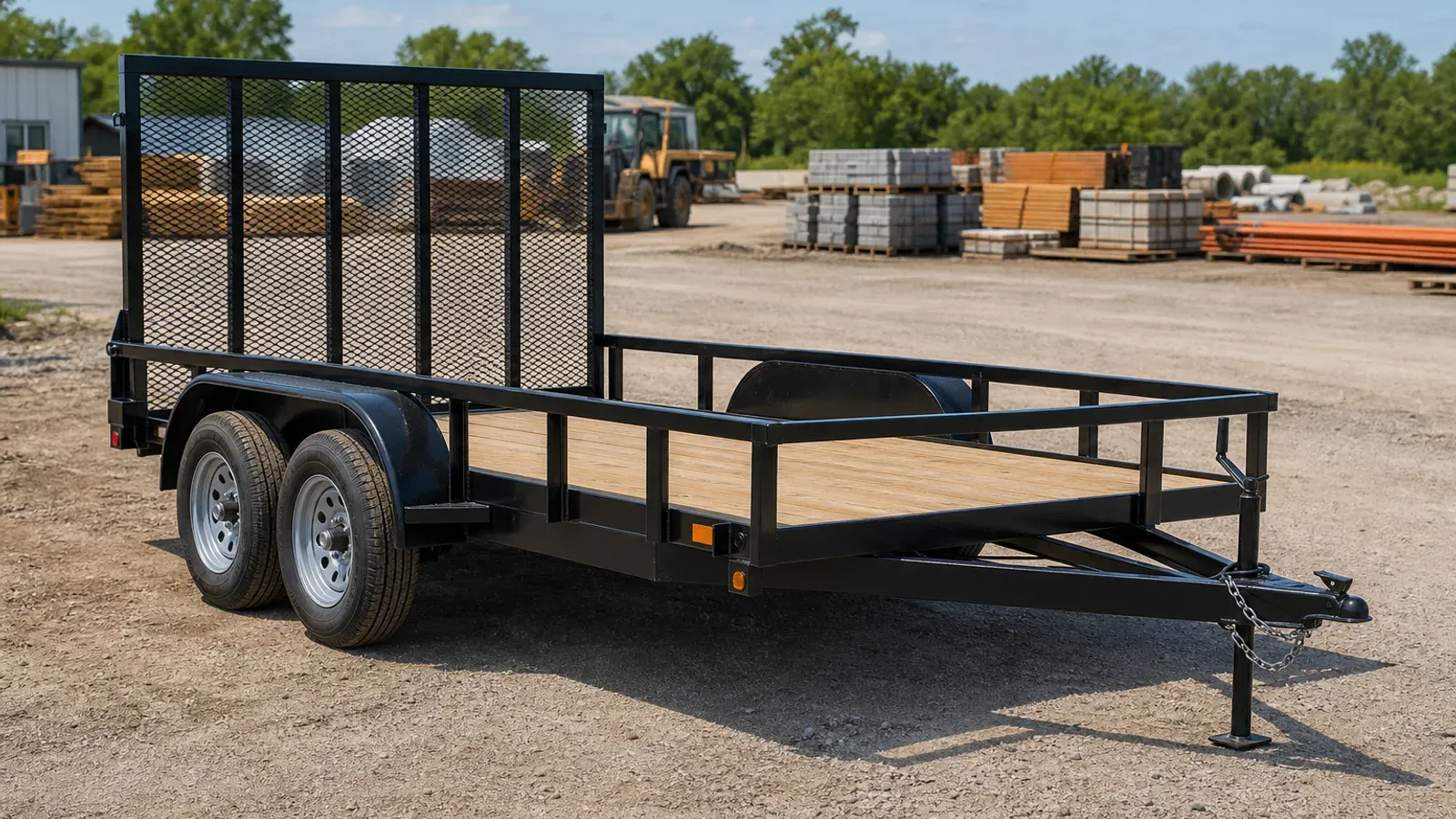
A tandem-axle utility trailer runs two axles and four tires, which buys real payload, highway stability, brakes as standard, and a blowout that's an inconvenience instead of an emergency. The 6x12 and 7x14 at 7,000 pounds GVWR are the working standards. It costs more than a single-axle and turns stiffer at walking speed. For loads past 2,500 pounds or regular highway miles, it's the answer.
What a tandem-axle utility is
Tandem-axle means two axles set close together under the deck, four tires sharing the load, and a trailer that has graduated from errands to work. Where the single-axle tops out around 3,500 pounds GVWR, the tandem utility standardizes at 7,000, and everything about it, frame, brakes, and tires, is spec'd for the difference.
The second axle buys you four things. Capacity comes first, since the 7,000-pound class carries 5,000-plus usable pounds, real material loads, real machines, real work. Stability comes second, because two axles resist pitching and porpoising, damp out sway inputs, and track highway crosswinds with a composure the single-axle never learns. Redundancy comes third, since a blown tire leaves three still carrying and the trailer limps to the shoulder instead of dropping a corner. And brakes come standard, electric on at least one axle at this rating in nearly every state, with both-axle brakes the spec worth demanding.
It costs you more, in a few ways. Purchase price runs roughly 60 to 100 percent over a comparable single-axle. Empty weight lands at 1,400 to 2,200 pounds, which the tow vehicle carries every mile. Maintenance means double the bearings and tires plus a brake system to service. And the low-speed manners suffer, because twin axles scrub sideways in tight turns, chirping tires on pavement and demanding wider arcs, the tandem's one genuinely annoying habit.
The buyer profile is anyone whose loads got serious. Side-by-side owners whose machines outgrew single-axle payloads, tradespeople hauling daily, movers of households, and everyone who read the single versus tandem math and landed on the honest side of 2,500 pounds.
Two axles, equalizers, and brakes
The two axles share load through an equalizer. Leaf-spring tandems link them with a pivoting equalizer bar that rocks load between them over bumps, keeping all four tires planted and the weight split even. It's a simple system that works for decades with occasional bushing attention, and it's why a tandem rides ruts a single-axle crashes through. Torsion-axle tandems replace the springs with rubber-cushioned independent arms, smoother and lower, at more cost and with one caution: torsion pairs don't equalize the same way. Quality builds account for that, cheap ones just bolt two on.
Brakes are the class's standard equipment and its quiet advantage. Electric drums on one axle satisfy most state minimums at 7,000 GVWR, brakes on both axles shorten stops meaningfully, and either way the truck needs a brake controller wired and tuned. The breakaway kit, battery and switch, rides along by law. Test it at purchase and yearly after, because it's the system nobody checks until the day it earns its keep.
Four tires split the load and cut the drama. Per-tire loading drops against the single-axle, load range C or D covers the class honestly, and matched tires matter, because mixed ages and pressures make the equalizer's job harder and wear odd. The scrub in tight turns eats shoulder tread over the years, part of the class's tire budget, so rotate and watch it.
Tongue weight rules still govern, 10 to 15 percent, but the tandem forgives loading errors the single-axle punishes, because the paired axles damp the see-saw effect. Forgives, not ignores. A rear-loaded tandem still sways, it just gives you more warning first.
Tandem utility sizes and honest payload
| Class | Typical GVWR | Typical Payload | Common Fit |
|---|---|---|---|
| 6x12 tandem | 7,000 lb | 5,000 to 5,400 lb | The versatile standard |
| 6.5x14 to 7x14 | 7,000 lb | 4,900 to 5,400 lb | UTVs, materials, trade use |
| 7x16 | 7,000 to 9,900 lb | 4,800 to 7,300 lb | Long loads, two machines |
| Heavy-duty 7x16 to 7x18 | 9,900 to 14,000 lb | 7,400 to 10,800 lb | The bridge to heavy-duty |
The 7,000-pound GVWR dominates because it stacks two 3,500-pound axles, the industry's favorite building block, and because its loaded weight sits inside half-ton territory. Payload runs 4,800 to 5,400 after empty weight, enough for a full-size side-by-side with gear, two yards of gravel, or a serious household move.
Length is the free variable. The 6x12 stores easy and does most things, the 14-footers take a UTV with margin or two ATVs nose-to-tail, and the 16-foot decks stretch for lumber and pairs of machines while starting to demand real parking. Between two sizes, take the longer deck. Capacity by length costs little and solves your loading Tetris for good.
The truck math stays friendly through the standard class. A loaded 7K tandem grosses inside most half-ton ratings with tongue weight counted honestly. The 9,900-and-up heavy classes start the three-quarter-ton conversation, covered on the heavy-duty page.
Where the tandem wins and loses
The rule mirrors the single-axle's. If your loads run regularly past 2,500 pounds, or machines, materials, or highway miles are in the plan, the tandem premium buys safety and capacity you'll use. For light local errands forever, keep the difference.
Tandem-axle utility FAQ
How much can a tandem-axle utility trailer carry?
The standard 7,000-pound GVWR class carries 4,800 to 5,400 usable pounds after empty weight. Heavy-duty tandems at 9,900 to 14,000 GVWR carry 7,400 to 10,800.
Do tandem trailers need brakes?
At 7,000 GVWR, nearly every state requires brakes on at least one axle, and both-axle brakes is the better spec. The truck needs a wired controller either way.
Why does my tandem chirp tires in tight turns?
Axle scrub. The paired axles drag sideways through sharp arcs by geometry. It's normal and harmless in moderation, and it's why tandems ask for wider turns and eat shoulder tread over the years.
Can a half-ton tow a loaded tandem utility?
The standard 7K class, yes, comfortably within most half-ton ratings with honest tongue weight. The 9,900-plus heavy classes start the bigger-truck math.
Torsion or leaf-spring axles?
Leaf springs for cost, simplicity, and true load equalizing between axles. Torsion for ride and height at a premium. The axle page runs the full debate.
Is a tandem harder to move by hand?
Yes, with double the weight and four tires that resist pivoting. Plan parking that doesn't require shoving it, or budget a tongue dolly and a friend.