Hydraulic Full Tilt Trailers Explained.

The hydraulic full tilt puts the whole deck under powered control. You raise it, lower it, and stop it anywhere, all on a pump-and-cylinder setup borrowed from the dump world. There's no balance point to find the way there is on a gravity tilt, so you can load anything parked anywhere. You pay for that in a higher purchase price, battery care, and hydraulic upkeep. Daily loaders and heavy-machine owners get their money back. If you only load once a week, price the gravity version first.
The deck with a button
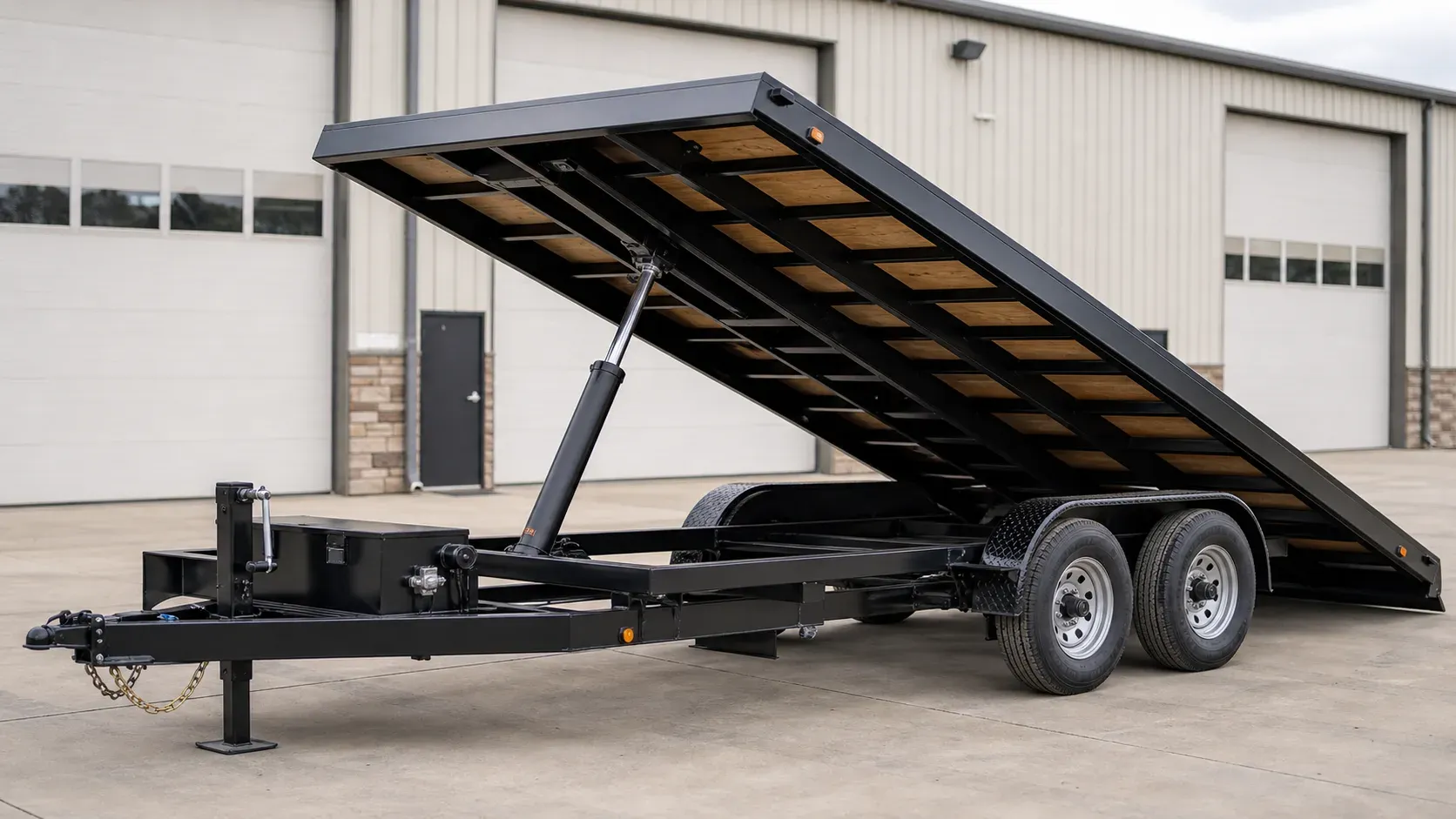
The hydraulic full tilt is the powered flagship of the tilt family. Instead of balancing the deck on physics, a hydraulic cylinder drives it, run by a 12-volt pump, a deep-cycle battery, and a remote. Press up and the deck tilts, press down and it levels, and you can stop it anywhere in between. Finding the balance point, the whole ritual of the gravity version, is gone.
Here's what the button actually buys. You get total position control, so the deck can stop mid-motion for an awkward load or lower a machine that parked wrong. You get load-position freedom, because the cylinder does the leveling the balance point used to demand, which brings back the tongue-weight tuning fixed decks enjoy. The deck also tilts empty, for a winch load or a hand-rolled machine, without needing a vehicle's mass to trip the balance. And you get speed, because pressing a button beats hunting a balance point on every cycle of every day.
Under the deck it's dump-trailer architecture, the same power pack the dump guide covers: pump, battery, remote, and a charge line from the truck. The upkeep comes with it, fluid, seals, terminals, and a battery tender between jobs. The tilt guide puts it plainly. The hydraulics are what you're buying and what you'll maintain.
So who should pay the premium? Daily-cycle operations, rental yards, landscapers, and equipment movers, anyone whose loading count spreads the cost across payroll. Heavy-machine owners near the family's weight ceiling, where wrestling a balance point under five tons stops being fun. And the mixed-cargo buyers the gravity version turns away, since pallets and hand loads are finally welcome on a deck that levels itself.
Pump, cylinder, and total position
The hydraulic circuit is straightforward. A 12-volt pump draws from a deep-cycle battery and pressurizes a cylinder mounted between the frame and the deck, and the control valve holds position anywhere in the stroke. The remote, wired or wireless, runs the whole thing. That one cylinder handles both jobs the gravity design split in two, damping the motion and driving it.
Battery care is the same as on any dump trailer. Repeated cycles pull heavy current, so the truck's charge line feeds the system while you drive and a tender covers the gaps when it's parked. The one classic failure is the dead-battery morning, which good habits prevent. Every quality build includes a manual release for when it happens anyway. Find it and cycle it at the dealer, the same check the hydraulic dovetail guide recommends.
The mechanical rules of the tilt family still apply. Grease the pivot pins on schedule, and engage and check the travel latch before every tow. Hydraulic pressure holds the deck in motion, but the mechanical lock is what holds it on the highway, two jobs handled by two parts. Keep the fluid clean and topped off, inspect the cylinder rod for scoring and weeping, and put the whole system on the same schedule as your wheel bearings.
Loading comes down to a short routine. Drop the deck with the button, drive the machine aboard, roughly where you want it since the button forgives, then level the deck, latch it, and chain it down using the securement fundamentals. Then you're gone. That rhythm is what sells the system to anyone who loads for a living.
Hydraulic tilt sizes and payload
| Class | Typical GVWR | Typical Payload | Common Fit |
|---|---|---|---|
| 18 to 20 ft, 10K | 9,900 to 10,400 lb | 6,700 to 7,500 lb | Compact machines, daily cycles |
| 20 to 22 ft, 14K | 14,000 lb | 9,100 to 10,000 lb | The powered standard |
| 22 to 24 ft, 16K | 15,000 to 16,000 lb | 10,300 to 11,600 lb | Heavy machines, the ceiling |
| Deckover tilt | 14,000 to 21,000 lb | 9,500 to 15,000 lb | Full width, per its page |
The powered deck lives at the family's heavy end, the classes where machine weights make a balance point unwise and daily cycles turn the button into payroll. Remember that the payload subtraction counts the pump system's weight on top of the pivot's. On the towing side, the 14K class puts you in three-quarter-ton territory, and above the table the hydraulic dovetail carries the same idea into gooseneck weights.
The hydraulic tilt's ledger
The buying rule is simple. Count the cycles and weigh the machines. If you load daily or move iron near the class ceiling, the buttons earn their keep. If you tow well-behaved vehicles once a week, the gravity version banks the difference.
Hydraulic tilt FAQ
What does the hydraulic tilt do that gravity can't?
It stops mid-motion, tilts empty, lowers a badly parked load, and levels under cargo no matter where it sits. Position control does away with hunting for a balance point.
How much more does it cost?
A real premium over the gravity equivalent. The pump system and cylinder are the difference, and only cycle count pays it back.
What maintenance does the system add?
Everything a dump trailer needs, battery care with a tender, clean fluid, and cylinder inspection, plus the family's usual pivot grease and latch checks.
What happens when the battery dies?
The manual release lowers the deck under control, and every quality build includes one. Find it and cycle it at the dealer. The charge line and a tender keep that morning from happening in the first place.
Can it lift a machine already on the deck?
Yes, within its rating. The position control works loaded or empty, which is exactly the repositioning that gravity owners borrow trucks to do.
Is the latch still required with hydraulic hold?
Always. Hydraulic pressure holds the deck during loading, but the mechanical latch is what holds it on the highway. That rule doesn't change with the upgrade.