Hydraulic Dovetail Trailers Explained.

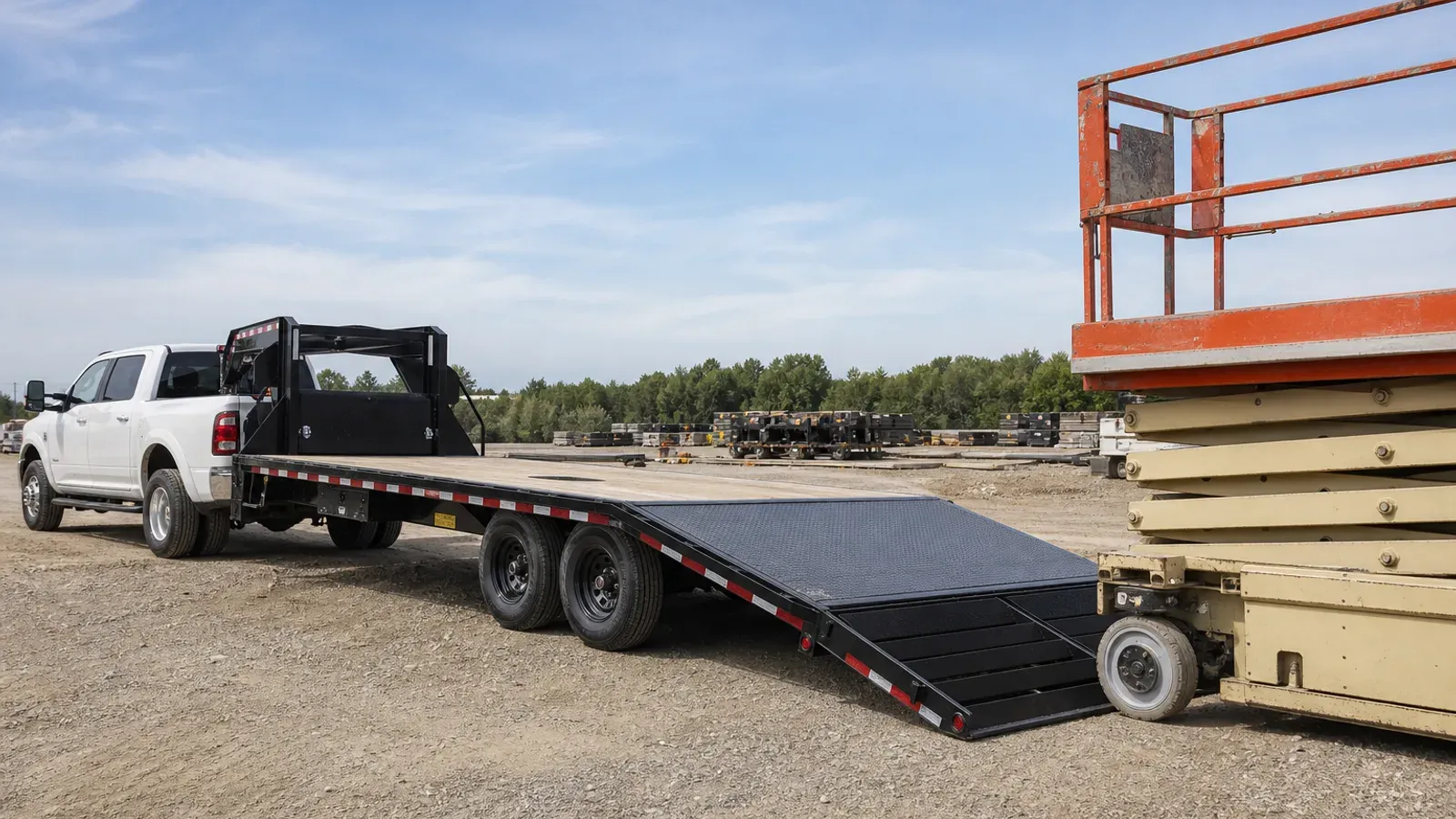
A hydraulic dovetail folds the trailer's rear deck to the ground under power, turning the loading angle from a climb into a walk for low-clearance heavy equipment. It's the gooseneck world's premium loading system, thousands of dollars over flip-over ramps and with hydraulics to maintain. For scissor lifts, pavers, and low iron you load regularly, it's the only tool that makes the job routine.
What a hydraulic dovetail is
The hydraulic dovetail, hydrotail in the trade's shorthand, is the rear 8 to 12 feet of a gooseneck deckover put on a hinge and driven by cylinders, folding from deck level down to the ground at the push of a button. Deployed, the tail makes a ramp of 5 to 8 degrees, gentler than anything hinged steel can manage. Stowed, it locks level and the trailer is a full-length deck again.
The problem it solves is iron that can't climb. Think scissor lifts with 3 inches of clearance, pavers and rollers, forklifts with low masts, sweepers, and any machine whose belly rules out every angle the ramp world offers. For that list, the choice isn't dovetail versus ramps, it's dovetail versus not loading at all, and that's what justifies the premium.
The second group it suits is the solo heavy operator. A hydrotail loads at the speed of a button with nobody spotting ramp alignment, and equipment movers running daily cycles buy the minutes and the safety margin the same way tilt-deck owners do one weight class down. The hydrotail is basically the tilt idea grown up to gooseneck scale.
The costs are the steepest option line in the category. You pay thousands over flip-over ramps on the same deck. A hydraulic system, pump, cylinders, and battery join your maintenance calendar. Several hundred pounds of tail steel come off your payload, and the rear overhang drags on grade breaks when stowed. Your machine list either covers this cost easily or it shouldn't be on the table at all.
Cylinders, sequences, and the flat tail
The mechanics are a folding deck done seriously. One or two hydraulic cylinders drive the tail through its arc, powered by a 12-volt pump and a deep-cycle battery, the same setup the dump world uses for its lifts at similar duty. The hinge line carries every loaded crossing on pins sized to match. Two-stage designs add a folding tip to the main tail, which stretches the effective ramp and softens the angle further, at the cost of more pins and a longer sequence.
The operating sequence rewards respect. Deploy on ground the tail can actually reach, load with the machine centered and the tail fully grounded, and never crest a half-deployed tail. Stow and lock before towing, and check the mechanical latches, because hydraulic pressure only holds the tail in motion while the locks hold it on the highway. The button makes it easy and the checklist keeps it boring, which is exactly what you want with ten tons on a hinge.
Maintenance is the usual hydraulic routine plus the tail's own items. Keep the fluid clean and topped off, inspect the cylinders for weeping and scoring, keep the battery on a charger and a tender, and grease the hinge pins on the same schedule as the axle bearings. The tail's underside collects road grime right at the hinge line, so a regular rinse pays off across the board. Neglect shows up first as sag, slow cycles, and a tail that drifts, the cheap warnings before the expensive ones.
The manual backup matters at purchase. Good systems include a hand pump or bypass for the day the battery dies, and your walk-around should find it, cycle it, and price its absence honestly. A hydrotail that only works on electric power is a very long flat deck the day the battery quits.
Hydrotail sizes and payload
| Class | Typical GVWR | Typical Payload | Common Fit |
|---|---|---|---|
| 30 ft, tandem 10K | 22,000 lb | 14,200 to 15,600 lb | The working standard |
| 32 to 34 ft, tandem 12K | 23,000 to 25,900 lb | 15,400 to 17,800 lb | Bigger iron, longer decks |
| 36 to 40 ft, tandem dual or triple | 25,900 to 30,000+ lb | 17,000 to 20,500 lb | Max loads, multi-machine |
The configuration lives almost entirely in the gooseneck heavy tiers, since the machines that need flat-tail loading weigh what the neck exists to carry. The family's math applies in full: pin weight at 15 to 25 percent into a one-ton dually, empty weights of 7,000 to 9,000 pounds once you count the tail's steel, and the CDL line crossed by design. The regulations are the ones for this tier, commercial from the first quote.
Count the tail honestly when you do the deck math. The tail is deck when stowed and ramp when deployed, but low machines park on the flat main deck, so your effective cargo length is the deck ahead of the hinge for the loads that bought the tail in the first place. A 36-foot hydrotail with a 10-foot tail carries its paver on 26 flat feet. Size from that number.
Where the hydrotail wins and loses
The buying rule comes back to the machine list. If anything on it has under 6 inches of clearance and outweighs what ramps can handle, the tail earns its price. If everything climbs fine on its own, the flip-over ramps and the thousands you saved were the right call.
Hydraulic dovetail FAQ
What angle does a hydrotail load at?
Usually 5 to 8 degrees with the tail grounded, gentler than any hinged ramp, which is the whole reason the system exists. Two-stage tails run gentler still.
How much does the option cost?
Thousands over flip-over ramps on the same deck, the steepest option line in the open-trailer world. Either your machine list justifies it or nothing will.
What maintenance does it add?
Hydraulic fluid, cylinder inspection, battery care, and hinge-pin grease on the same schedule as the bearings. Neglect shows up as sag and slow cycles well before it costs you real money.
Is it safe to tow with the tail stowed?
Yes, once you've checked the mechanical locks, because that's their job. Hydraulic pressure is for motion and the locks are for the highway, so verify them at every hookup.
What happens if the battery dies?
Good systems include a hand pump or bypass. Find it and cycle it at the dealer, because its absence is a spec problem you want to catch now, not later.
Hydrotail or tilt deck?
Same idea, different weight classes. The tilt serves through the mid-teens GVWR, while the hydrotail owns the gooseneck heavy tiers where the low machines weigh ten tons.