Equipment Tilt Trailers Explained.

The equipment tilt loads machines up a single tilted plane instead of over ramps, which cuts out the ramp handling, the crest breakover, and the solo operator's sketchiest minutes. Partial-tilt designs keep a fixed front deck for attachments while the rear tilts. It costs more than ramps and asks for pivot maintenance, but it pays daily loaders back in minutes and margin. Your machine list and cycle count decide, as always.
Machines up the tilted plane
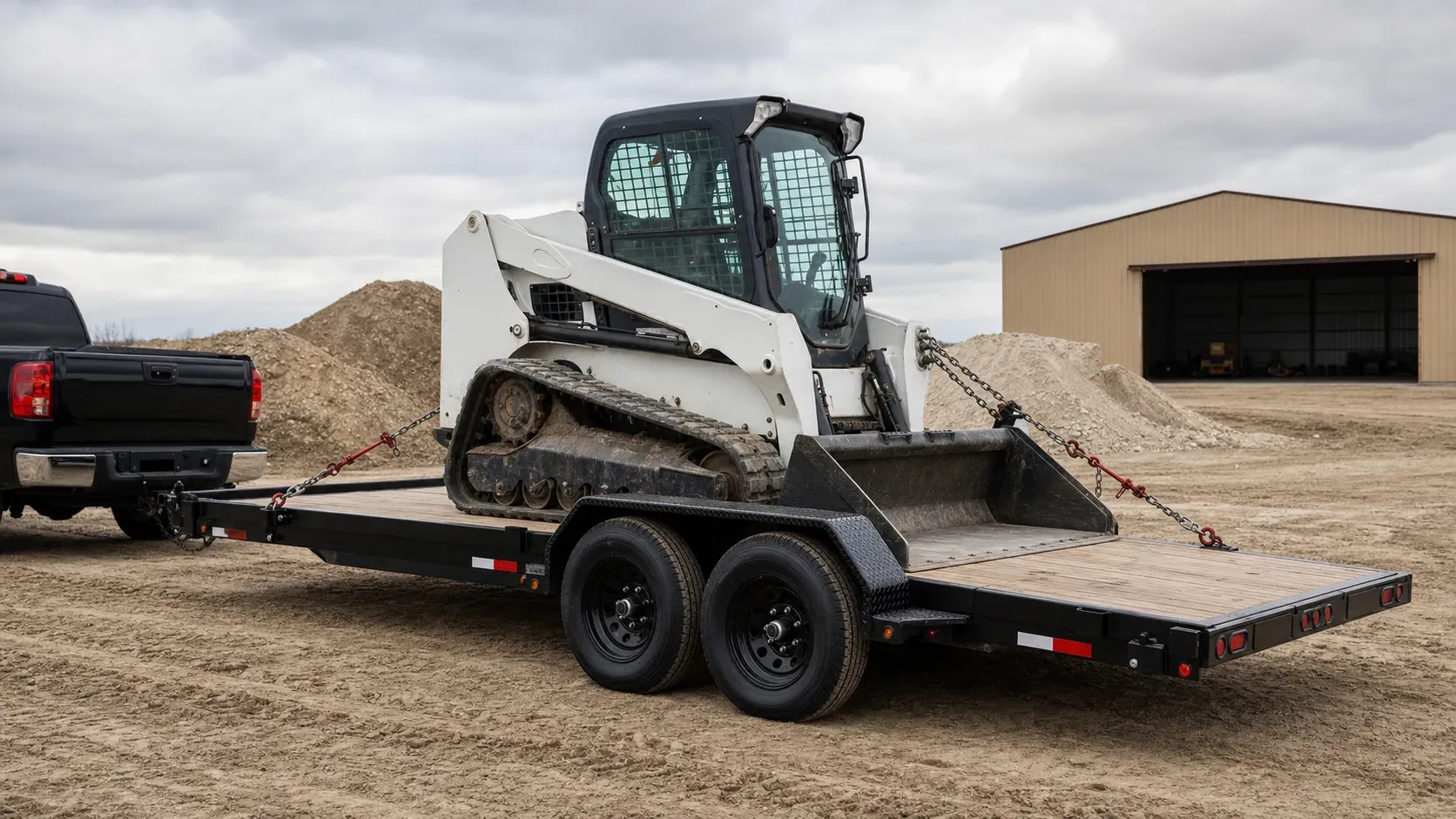
The equipment tilt takes the tilt idea and applies it to the equipment trailer's job. Skid steers, mini excavators, compact tractors, and lifts board a deck that lays itself into a ramp instead of asking the operator to build one. Everything the tilt-versus-ramp comparison weighs, the single-plane approach, no crest breakover, and no ramp handling, matters most here, where the cargo is heavy, tracked, and loaded by one person on a schedule.
The configuration's signature is the partial tilt. Full-tilt decks pivot end to end, but the equipment market's favorite splits the deck instead. A fixed 4-to-6-foot front section always rides level while the rear 12-to-18 feet tilts, so the bucket, pallet forks, and attachments ride the stationary front while the machine boards the moving rear. The layout solves the tilt family's diffuse-cargo weakness inside one trailer, with machines on the plane and attachments on the shelf.
Both mechanisms serve. Gravity suits the weekly-loader tier and hydraulic suits the daily and heavy tiers, the same split the family runs, and the partial-tilt layout pairs with either. The buyers are the equipment world's usual crowd, owner-operators, landscapers on the skid-steer crossover, rental yards, and the compact fleets whose loading count makes the premium easy to justify.
Loading machines on the pivot
The loading procedure rewrites the ramp chapter and keeps the rest. With the deck tilted, the machine climbs the single plane in low gear, tracks or tires centered. It crosses the pivot as the deck levels under it on gravity builds, or after the button on hydraulic ones, and parks at the deck mark that keeps tongue weight honest. There's no ramp alignment, no crest to negotiate, and no spotter walking backward, and that's the solo-operator dividend the configuration sells.
Securement runs the equipment standard with one asterisk for the pivot. Run four-corner chains with rated binders to the deck anchors, lower attachments to the fixed front or the deck, and lock the parking brake and hydraulics. The asterisk is simple. Tension the chains with the deck level and latched, never mid-tilt, because the pivot needs the deck's geometry settled before the binders load it. Verify the travel latch every tow, the way the family law demands, and the machine's mass makes that habit non-negotiable here.
The structure earns inspection at the equipment scale. Pivot pins and bushings are sized for point loads that arrive in tons, crossmembers sit at 16-inch centers under the track paths, and the deck surface has to grip under wet rubber and steel tracks. Inspect the cushion or drive cylinder as the brake-grade component it functionally is. The maintenance rhythm from the guide, grease, fluid, and latch, just runs at the machine world's cadence.
Equipment tilt sizes and payload
| Class | Typical GVWR | Typical Payload | Common Fit |
|---|---|---|---|
| 18 to 20 ft, 10K | 9,900 to 10,400 lb | 6,700 to 7,500 lb | Compact tractors, small skids |
| 20 to 22 ft, 14K | 14,000 lb | 9,000 to 9,900 lb | The skid-steer standard |
| 22 to 24 ft, 16K | 15,000 to 16,000 lb | 10,200 to 11,500 lb | Mini excavators, the ceiling |
The classes track the equipment world's bumper-pull tiers, and the pivot's weight tax shows up in the payload subtraction. The machine math runs the standard discipline, machine plus attachment plus margin against the honest scale ticket. Partial-tilt builds list their sections separately, so check the fixed front's length against your attachment inventory and the tilting rear's against your longest machine, both measured before the deposit.
Truck math holds the equipment ladder. The 10K classes ride behind stout half-tons at the honest edge, the 14K standard moves into three-quarter-ton territory, and above the table the gooseneck equipment world takes the machines the receiver can't.
The equipment tilt's ledger
The buying rule is the one from the comparison, applied here. If you load machines monthly, ramps serve for less. Load them weekly or daily, and the tilt's minutes and margin pay off, with the partial-tilt layout carrying the attachment inventory along.
Equipment tilt FAQ
What's a partial tilt versus a full tilt?
Full tilts pivot the whole deck. Partials fix a 4-to-6-foot front section level and tilt the rear, so the fixed front carries the attachments and diffuse cargo the moving deck can't.
Can a skid steer load on a gravity tilt?
Within the class ratings, yes. The machine's concentrated weight crosses the balance point cleanly. Daily cycles and the heaviest machines argue for the control of a hydraulic build.
How do I chain a machine on a tilt deck?
Four corners with rated binders, and get the deck level and latched first, never mid-tilt. The securement fundamentals apply once the pivot's geometry is settled and before the binders load.
Equipment tilt or ramps?
Use the frequency rule from the comparison. Monthly loading keeps the savings of ramps, and weekly-plus buys the tilt's minutes. Your machine list breaks ties.
What's the working class for skid steers?
The 14K tier. Its 9,000-plus payload carries the popular classes with attachment margin, and the skid-steer page runs the full math.
What wears out on an equipment tilt?
Pivot pins and bushings under point loads, the cylinder's seals, and the latch's adjustment. They all live on the grease-and-glance calendar the machine world already keeps.