Enclosed vs. Open Trailers. Which One to Buy.

The enclosed trailer protects, the open trailer adapts. Walls buy you weather protection, security, and a rolling workspace, but they cost roughly double the price, hundreds of pounds of empty weight, and the towing manners of a sail. The open deck hauls more shapes for less money and asks straps and tarps to do the walls' job. If your cargo is valuable, weather-sensitive, or theft-tempting, buy the box. Everything else keeps the deck.
Enclosed vs. open at a glance
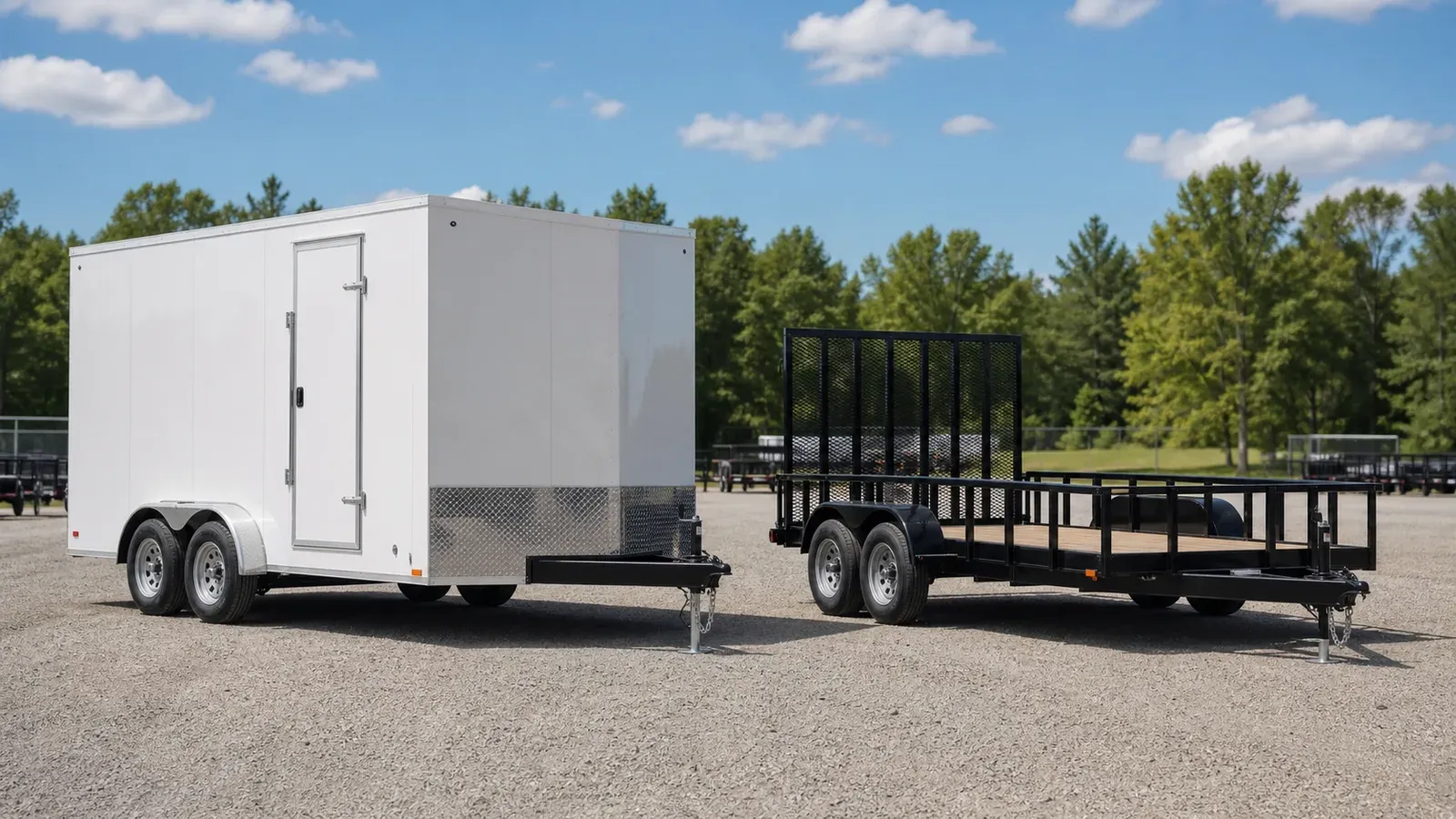
| Enclosed | Open | |
|---|---|---|
| Weather and road spray | Sealed away | Tarps and luck |
| Security | Locked walls | Padlocks and visibility |
| Price, comparable size | Roughly double | The baseline |
| Empty weight | 1,000-plus lb more | Light |
| Payload per GVWR | Loses the difference | Wins it |
| Oversize and odd loads | Wall-limited | Anything that straps |
| Wind and fuel | The sail tax | Slips through |
| Second life | Storage, workspace | Just a trailer |
The enclosed cargo trailer and the open trailer, whether that's a utility, a car hauler, or a flatbed, split the towing world roughly in half. The same decision repeats across every cargo type on this site, and the cargo itself almost always knows the answer.
Protection is the product
The enclosed trailer sells three things no strap can. Weather comes first. Rain, road spray, and sun age everything they touch, and cargo that can't take water, furniture, electronics, finished goods, paper, most of a household move, rides in a box or rides at risk. Security comes second. Walls and locks turn a gas-station stop from an honesty test into a non-event, which is the argument that sells enclosed trailers to every trade that ever lost a generator. Privacy comes third. Nobody inventories what they can't see.
The box has a second act, too. Parked, an enclosed trailer is dry, lockable storage. Outfitted, it becomes a rolling workshop, a race-weekend garage, or a business platform, second lives no open deck offers. For trades and traveling operations the walls are the workspace, and the comparison stops being about hauling at all.
The costs are those same walls. You pay roughly double the price of a comparable open trailer, and you spend a thousand-plus pounds of empty weight on structure instead of payload. Then there's the sail tax, the wind resistance that drinks fuel and the crosswind manners that demand respect behind smaller tow vehicles. The full guide walks the whole ledger.
Versatility per dollar
The open trailer's argument is everything the walls prevent. Oversize loads, odd shapes, machines with height, lumber past the deck's end, and crane-or-forklift loading that walls block, the deck takes whatever you can strap to it, which is most of the physical world. Per dollar, nothing in towing matches an open trailer's usefulness across the catalog of things a household or business eventually moves.
Weight and money run the same way. The open trailer's lightness comes back as payload inside the same GVWR, easier towing behind half-tons and SUVs, and better fuel every mile. Its lower price leaves thousands in your pocket that walls would have eaten. For cargo that shrugs at weather, machines, materials, dirt-anything, the box premium buys nothing at all.
The downsides are the weather bet and the strap labor. Tarps work, badly, in exactly the conditions that matter most, and every open load is a securement project the box's walls would have handled for free. Cargo value is the tipping point. The day the open trailer carries something the weather or a thief could take, the walls start writing their own justification.
Which one you actually need
Buy enclosed when the cargo's value, weather sensitivity, or theft appeal is the story. That covers household goods, tools and trade inventory, motorcycles and vehicles worth protecting, and any operation where the trailer doubles as storage or workspace. The premium is the insurance and the second life together.
Buy open when shape, weight, and versatility rule. Machines, materials, powersports that shrug at weather, and the mixed catalog of general hauling. Keep the thousands, spend a little on straps and a good tarp, and tow lighter forever.
The households that genuinely split usually resolve on one question, what's the most valuable thing the trailer will carry in its first year. If the answer makes you wince at the word rainstorm or the phrase motel parking lot, the box was already chosen. And fleets eventually own one of each, which is the honest answer to a question this evenly matched.
Enclosed vs. open FAQ
How much more does an enclosed trailer cost?
Roughly double the comparable open trailer, size for size, with frame material and build tier moving the multiple. You're paying for the walls, roof, doors, and liner.
How much harder is an enclosed trailer to tow?
The box adds 1,000-plus empty pounds and a wind profile that drinks fuel and feels crosswinds. The same class rules apply, the box just uses more of the margin. Behind smaller vehicles the difference is real.
Can't I just tarp an open trailer?
For occasional weather, yes, tarps and discipline work. For cargo that can't ever get wet, or valuable loads parked overnight, tarps are hope with grommets. Frequency and value decide.
Which holds resale better?
Both resell well. Enclosed boxes hold strong demand from trades and movers, open trailers sell to everyone. Condition and honest specs beat category either way.
What about hauling a car?
That's the classic version of this whole question, and it gets its own treatment in the car hauler world, open for price and ease, enclosed for protection and security. Vehicle value decides.
Is there a middle option?
Canvas-top and stake-side conversions exist at the margins. Practically, the market says pick a side, and fleets that need both buy both.