Best Trailers for a Mobile Business.

A mobile business runs on an enclosed cargo trailer converted into a storefront, workshop, or kitchen, and the shell is the cheap part. Budget it at a third of the project or less. Size it by the work happening inside: 7x16 for most service builds, 8.5-wide for food. Then call your county about codes before you call a dealer. You're really choosing a floor plan, not a trailer.
What the trailer actually has to be
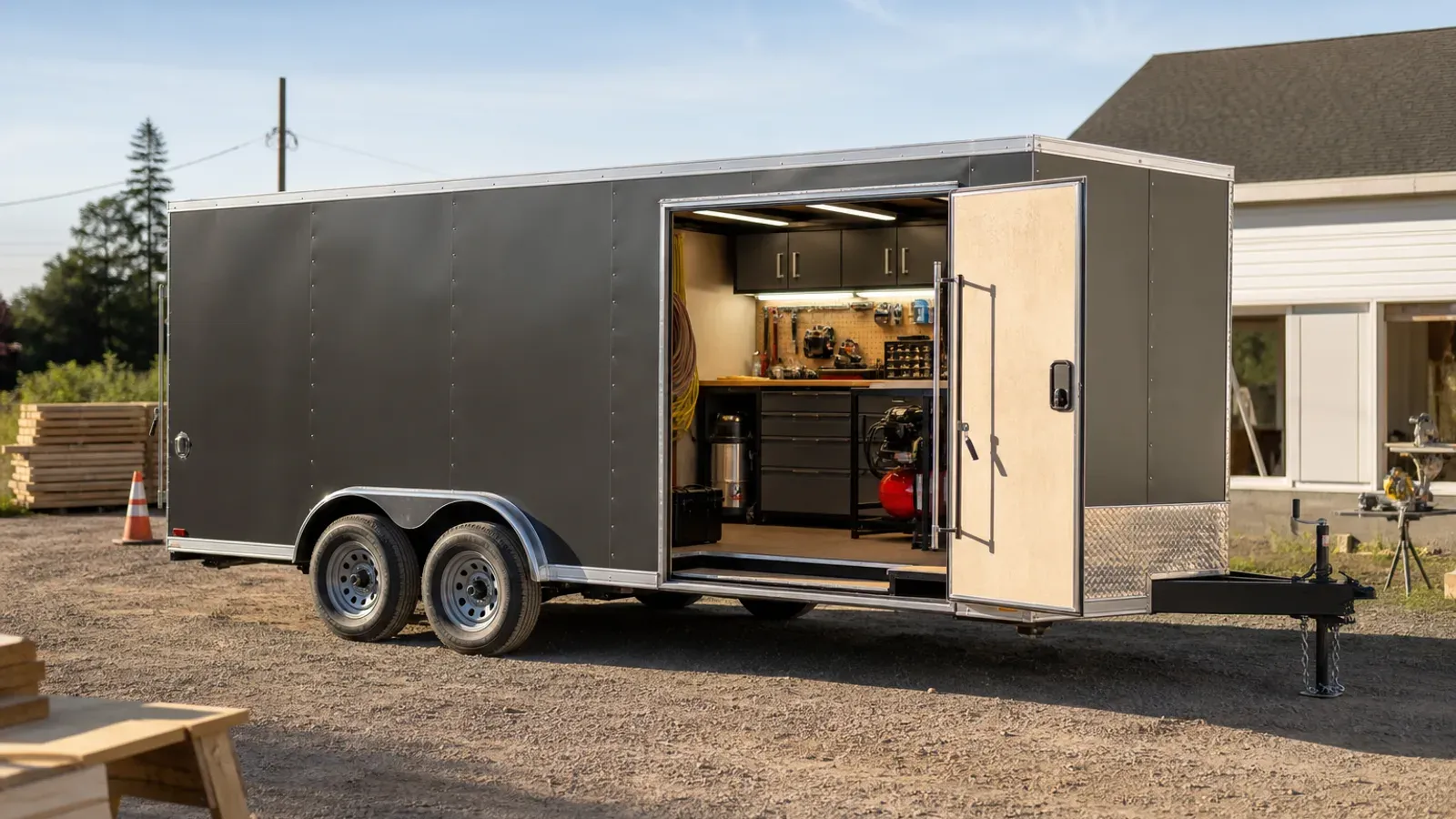
A mobile business trailer isn't hauling cargo, it's hosting commerce, and that changes the spec sheet. The enclosed cargo shell becomes a building. The walls carry shelving and equipment, the floor carries workstations and foot traffic, and the roof carries vents and sometimes AC. All of it has to flex down the road between sites without shaking the business apart.
The type of business sets the demands. Concession and food builds are the biggest slice, and they get their own page. They need 8.5-foot widths, serving windows, commercial power, water systems, and a health-code conversation before anything else. Service builds, like mobile detailing, pet grooming, sharpening, and bike or small-engine repair, want workbench walls, tool power, and ventilation, mostly on 7-wide shells. Retail and vendor builds for markets, events, and pop-ups need display walls, an entry customers actually use, and looks that sell. Here the trailer is the sign.
A few things every build shares. You need interior height for people working upright, 6.5 feet minimum and 7 for real comfort. You need structure rated for permanent equipment loads, which means wall posts on 16-inch centers and a floor that takes anchor bolts. Put the side door where the workflow wants it, not where the option sheet defaults it. And plan the electrical from day one: a power inlet, a panel location, and wall chases roughed in before the liner closes. Retrofitting power into a finished trailer means paying for it twice.
The weight budget sneaks up on people. Equipment, cabinetry, water, and inventory routinely add 1,500 to 3,000 pounds to the shell, so your payload has to cover it with margin to spare. A loaded food build on a 7,000 GVWR shell is often over before the ice goes in. Spec the 9,900-pound tier more often than feels necessary.
Best shells by business type, ranked
The service-business standard is the 7x16 tandem at 7,000 to 9,900 GVWR. It gives you enough floor for a workbench wall and a customer's project, enough payload for a trade's equipment, and it tows behind the half-ton most operators already own. The contractor-build page covers the interior systems, shelving, power, and lighting that service builds share with the trades.
The food and concession standard is the 8.5x18 to 8.5x24 at 9,900-plus GVWR. The width buys a working kitchen line, the length holds equipment plus prep plus the serving window's queue zone, and the payload carries water, propane, and everything stainless. Concession shells built that way at the factory, with window framing, reinforced roofs, and power chases, beat retrofitting a plain cargo box by more than they cost.
The vendor and retail lane runs lighter, on 6x12 to 7x14 shells with display-focused buildouts. The V-nose point makes a natural cash-wrap or display nook, one of the shape's better business cases. Frame material comes down to the steel versus aluminum math, with a business thumb on the scale. High-mileage vending circuits and coastal routes lean toward aluminum harder than hobby use ever would.
Buildout, codes, and the road between gigs
Handle codes before cabinets. Food builds answer to county health departments, and their rules vary wildly across sinks, surfaces, water capacity, and suppression. Some jurisdictions license the trailer like a restaurant. Service and retail builds have to meet event-venue and fire-marshal expectations: extinguishers, egress, and electrical done right. The builds that go smoothly all started with a call to the authority having jurisdiction. The horror stories all started with a finished interior that failed inspection.
Treat power and water as systems, not accessories. You want a shore-power inlet and a proper panel, generator placement with the exhaust thought through, and battery banks for quiet operation where events demand it. Food builds add fresh and gray water tanks sized to the health code's arithmetic. And watch the weight again: water runs 8.3 pounds a gallon, so a 40-gallon system is a passenger nobody counted.
The road leg still has rules. A loaded build wants tongue weight at 10 to 15 percent, with equipment anchored like the cargo it is. An oven or compressor that shifts becomes a wrecking ball. Loaded 8.5-wide food classes run honest three-quarter-ton math, brakes earn their keep under commercial weights, and commercial use brings commercial rules: plates, insurance, and inspections that vary by state. The trailer is the business, so tow it like payroll depends on it, because it does.
Mobile business trailer FAQ
What size trailer for a food business?
The 8.5-wide classes at 18 to 24 feet are the working standard. The width buys a kitchen line and the length covers equipment plus the window zone. Your health-code equipment list drives the whole floor plan, so get that list first.
How much does a mobile business trailer cost all-in?
The shell is typically a third of the project or less. Buildout, power, water, equipment, and compliance carry the rest, and food builds run the steepest multiple of all.
Can I convert a used cargo trailer?
We cover new only, and for business builds the premium earns itself twice over. You get a structural warranty under permanent equipment loads and a shell spec'd for the buildout at the factory, with window framing, power chases, and a reinforced roof.
What GVWR does a business build need?
More than the cargo math suggests. Equipment, water, and inventory add 1,500 to 3,000 pounds to the shell, so spec the 9,900-pound tier for most food and heavy service builds.
Do I need permits for the trailer itself?
The build usually, the parking spot often, and food always. County health departments license mobile kitchens under rules that are intensely local. Call the authority before the dealer, the way every successful build did.
What truck tows a business build?
Service builds in the 7-wide classes suit a half-ton. Loaded 8.5-wide food builds are three-quarter-ton work once you run the payload math honestly.