V-Nose Enclosed Trailers Explained.

A V-nose enclosed trailer angles its front wall into a wedge, adding 2 to 4 feet of triangular interior space and shaving a little aerodynamic drag. The fuel savings are modest but real, the nose storage is genuinely useful, and the flat bulkhead is what you give up. It's the majority choice in the enclosed market. Buy it for the space and treat the mileage as a bonus.
What a V-nose actually is
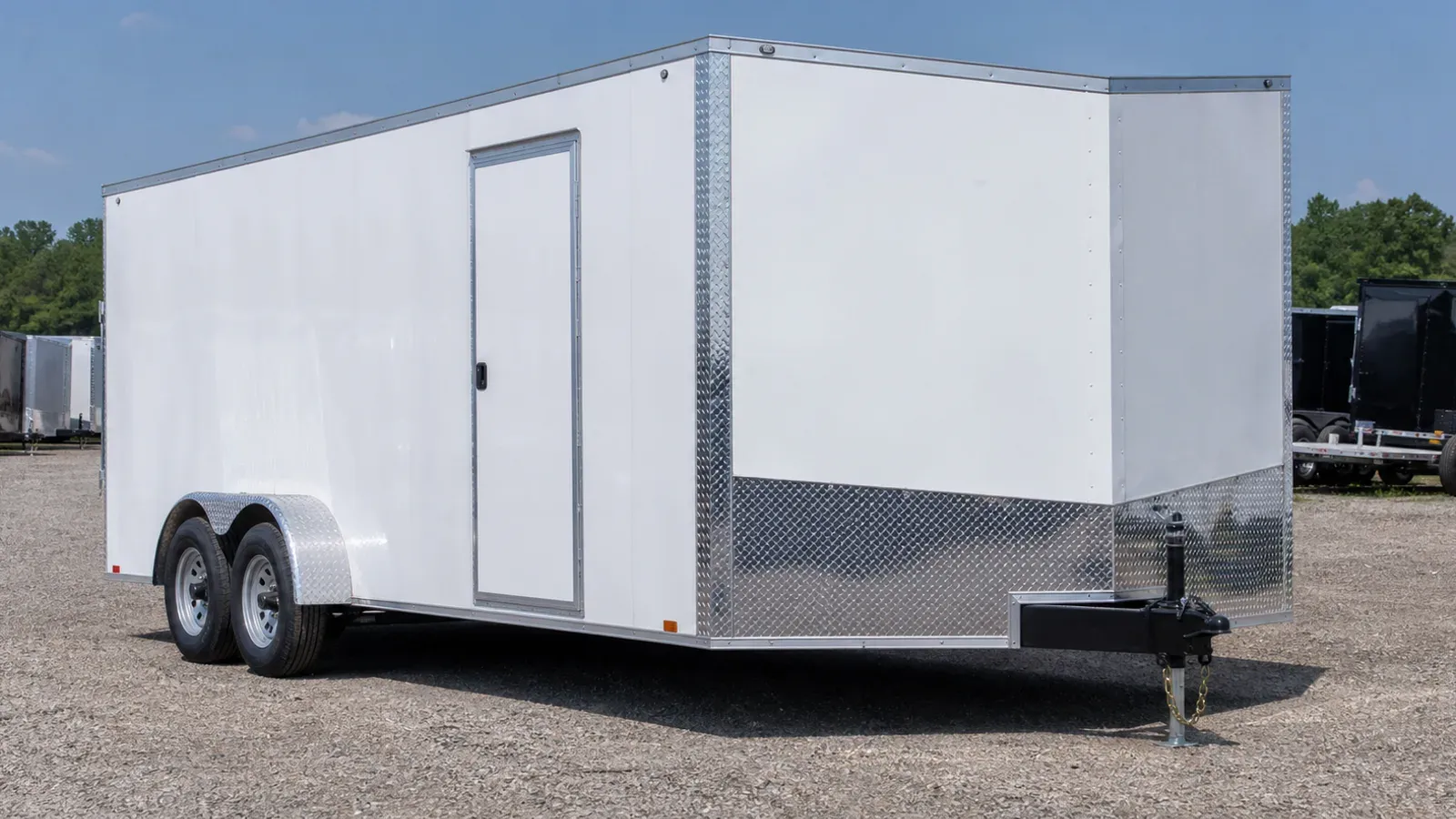
The V-nose replaces the enclosed trailer's flat front wall with two angled panels meeting at a point, a wedge that leans into the wind and adds a triangular room to the front of the box. Depth runs 24 to 48 inches depending on trailer width and builder, and the shape has quietly become the default across most of the enclosed cargo market, to the point that the flat front now feels like the option.
The marketing story is aerodynamics, and it's true at a modest scale. A tall box behind a pickup tows in the truck's turbulent wake, and the wedge smooths what the flat wall would slam into. Real-world reports cluster around a half to one mile per gallon of improvement, worth real money over a high-mileage trailer's life and not worth much over a low-mileage one's. The wind-noise reduction is the change owners actually notice first.
The better story is the space. The V adds 15 to 25 square feet of floor that comes almost free, because builders price the nose modestly and length badges typically measure the box, not the point. That triangle swallows exactly the stuff that clutters a work trailer: spare tires, generators, fuel cans on a shelf, a cabinet run, or the chest of straps every trailer accumulates. Racers and car haulers treat the nose as the standard home for tires and tools, and contractor builds cabinet it floor to ceiling.
The wedge costs you the flat front bulkhead. That single best wall in a flat-front trailer for stacking boxes and anchoring E-track becomes two angled panels that stack nothing square. Odd corners collect odd cargo, and buyers whose loads are all rectangles, movers, freight, box-stackers, are the flat front's remaining natural constituency. Our comparison page works through it in full.
Aerodynamics, structure, and using the triangle
The aero math deserves honest framing. Drag on a towed box comes from frontal area, shape, and the gap turbulence between truck and trailer, and the V-nose addresses only the shape term, and only partially, since the tow vehicle has already disturbed the air the nose meets. That's why the gains run modest rather than dramatic, and why they grow with highway speed and shrink behind tall trucks that punch the hole first. A half mpg at 15,000 annual miles is real fuel money, at 2,000 miles it's a rounding error, so run your own numbers.
Structurally, the V is sound when it's built right. The angled panels frame like walls, posts on centers, skinned and lined, and the point gets a stone-guard treatment on quality builds, diamond plate or ATP sheet up the lower nose, because the wedge leads the trailer down every gravel road. The roof transition matters too. The nose cap where wedge meets roofline is a molded piece on good builds and a collection of seams on cheap ones, and seams are where a roof starts to leak. Look up and inside at the front corners before buying.
Using the triangle well is its own small craft. Shelving across the V turns awkward floor into dense storage, a transverse cabinet squares the space for the rectangular world behind it, and spare-tire mounts love the point. Tongue-area weight sits right over the coupler, so the nose is also where tongue weight gets tuned. Load the triangle heavy and the scale at the ball shows it, which is useful running light and a warning running heavy.
One practical note on length badges. A 7x16 V-nose is typically 16 feet of box plus the nose, but not every builder measures alike, and some include the V in the advertised length. Interior floor length, point to rear door, is the number that matters, so get it from the spec sheet, not the badge.
V-nose sizes and payload
| Class | Typical GVWR | Typical Payload | Common Fit |
|---|---|---|---|
| 5x8 to 6x10 V-nose | 2,990 lb | 1,700 to 2,100 lb | Gear, bikes, small trades |
| 6x12 tandem | 7,000 lb | 4,600 to 5,200 lb | The all-purpose standard |
| 7x14 to 7x16 tandem | 7,000 lb | 4,400 to 5,000 lb | Trades, toys, light freight |
| 8.5x20 and up | 7,000 to 14,000 lb | 4,600 to 9,800 lb | Car hauling, big builds |
The nose spans the whole enclosed size range, and the class math is unchanged from the guide: GVWR minus real empty weight, with the V adding modest steel and skin to the empty number. Frame material moves that number more than the nose does, and the steel versus aluminum decision dwarfs the nose decision on weight.
Tow math follows the class. The 6 and 7-wide V-noses loaded suit half-tons with the wind-profile honesty every enclosed page owes, and the 8.5-wide classes graduate to three-quarter-ton territory loaded. The V's aero help is real and does not change the ratings math, so buy the truck for the box and enjoy the nose as a discount on fuel.
Where the V-nose wins and loses
Here's the rule. If your cargo includes gear, tools, tires, or anything that shelves, the V-nose is the better box and the market agrees. If your cargo is wall-to-wall rectangles, read the flat front page before following the crowd.
V-nose FAQ
Does a V-nose really save fuel?
Modestly, typically a half to one mpg at highway speed, and more noticeable in wind noise than at the pump. Real money at high annual miles, a bonus at low ones.
How much space does the V add?
Two to four feet of depth across the trailer's width, or 15 to 25 square feet of triangular floor, usually priced well below what equivalent box length costs.
Is a V-nose stronger or weaker than a flat front?
Neither, inherently. Build quality decides, and the V adds two details worth inspecting, the nose cap's seams and the stone guard on the point.
Does the V count in the advertised length?
It depends on the builder. Most badge the box and add the nose, some badge overall. Compare interior floor length between quotes, because it's the only honest number.
What goes in the nose?
Spare tires, generators, cabinets, shelving, and strap chests, the awkward-gear hall of fame. Racers and contractors build the triangle out as standard practice.
V-nose or flat front?
V for gear, storage, and the market default. Flat for pure box-stacking and bulkhead anchoring. The comparison runs the full case.