Flat-Front Enclosed Trailers Explained.

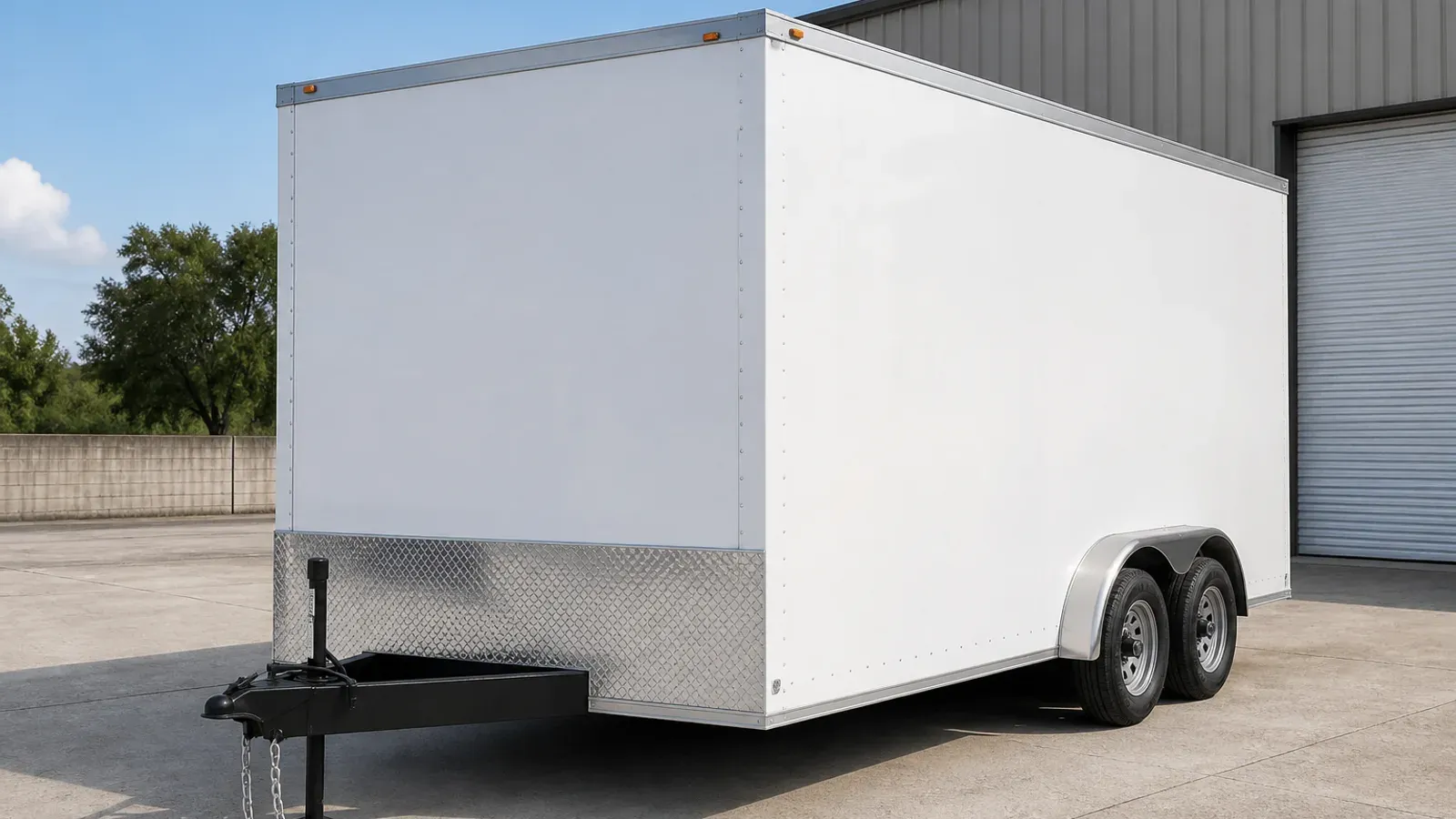
A flat-front enclosed trailer is the original box. It has four square walls, every cubic foot rectangular and stackable, and a front bulkhead that anchors cargo like a warehouse wall. It packs denser than a V-nose and prices slightly lower, and it gives up the nose's storage triangle and small aero gain. Buy it for rectangles, freight, boxes, vending stock, and maximum packing efficiency per foot.
What a flat front actually is
The flat front is the enclosed trailer in its original form, a rectangular box with a vertical front wall. In a market the V-nose now dominates, it has become the deliberate choice rather than the default. The buyers who choose it deliberately share one trait. Their cargo is square.
The bulkhead is the product. A flat vertical front wall stacks boxes to the ceiling with no wasted geometry, anchors E-track and cabinets across its full width, and takes the forward thrust of a braked load the way angled panels never quite do. Movers, freight runners, vendors hauling stock in cases, and mobile businesses racking inventory all pack against that wall daily. For them, the V's triangle is just the part of the trailer where boxes go to lean.
The efficiency math is simple and honest. Every foot of a flat front's advertised length is full-width rectangular floor, packing calculations run on clean multiplication, and load bars and decking systems span wall to wall at any station. Fleet buyers notice, because identical boxes load identically, and the flat front stays quietly overrepresented in rental fleets and freight work for that reason.
What it gives up. You lose the nose triangle's nearly free storage, about a half-mpg of highway fuel, some wind-noise refinement, and increasingly, resale value, since the V-nose now outsells it broadly and used buyers follow the crowd. None of those losses touches a buyer whose box is always full of rectangles, and that's the whole decision. The comparison page runs it both directions.
Bulkheads, packing, and square-wall logic
The front wall works harder than any other panel in the trailer. Under braking, the whole load leans on it, which is why quality flat fronts frame the bulkhead on tight post centers and why E-track mounted across it turns the wall into a proper restraint system rather than a suggestion. Check the wall's framing spec against the sides. On good builds it matches or beats them, and on cheap ones it's just the panel that faces forward.
Packing logic is the flat front's daily dividend. Tier loading starts square at the bulkhead and stays square to the door, load bars lock between walls at any depth, and the geometry never asks a box to be a triangle. Height matters as much as footprint here. Interior heights of 6.5 to 7 feet turn the same floor into meaningfully more cargo, and the flat roofline carries that height all the way forward, where the V's nose cap tapers.
Aerodynamics deserve an honest word. The flat wall tows in the truck's wake like a billboard, so fuel and wind noise both take a hit, and the penalty against a V-nose runs the same modest half-to-one mpg the V's gain does, only in reverse. Behind a tall truck the gap narrows, behind an SUV it widens, and at local speeds it barely exists. If you run serious annual highway miles, weigh it. Everyone else should weigh the packing.
One structural footnote lands in the flat front's favor, and that's simplicity. There's no nose cap, no wedge seams, and no point leading into gravel. The forward end is just a wall, a stone guard strip, and fewer places for water to work in. Fewer seams is never the wrong direction on a box that lives outside.
Flat-front sizes and payload
| Class | Typical GVWR | Typical Payload | Common Fit |
|---|---|---|---|
| 5x8 to 6x10 single | 2,990 lb | 1,750 to 2,150 lb | Gear, deliveries, rentals |
| 6x12 tandem | 7,000 lb | 4,650 to 5,250 lb | Moving, vending stock |
| 7x14 to 7x16 tandem | 7,000 lb | 4,450 to 5,050 lb | Freight, trades, fleets |
| 8.5x20 and up | 9,900 to 14,000 lb | 6,700 to 10,000 lb | Commercial box work |
The class math holds from the guide. Payload is GVWR minus real empty weight, and the flat front runs marginally lighter than the same-badge V-nose, with no nose framing or skin, a small credit toward cargo. The frame-material decision, steel or aluminum, still moves the empty number most.
Advertised length means what it says here. A 16-foot badge is 16 feet of rectangular floor, which makes flat fronts the easiest quotes to compare in the enclosed market. Tow math runs the standard enclosed table. The 6 and 7-wides load behind honest half-tons, the 8.5-wide commercial classes move into three-quarter-ton territory, and the flat wall's wind profile argues for the sane speeds every tall box wants anyway.
Where the flat front wins and loses
The buying rule. Cargo that stacks square, freight, boxes, cases, and racks, buys the flat front on math. Cargo that includes gear, tires, and toolboxes buys the V's triangle. Match the box to the shape of what goes in it, and that's the whole decision.
Flat-front FAQ
Why buy a flat front when everyone buys V-nose?
Square cargo. The flat front packs rectangles denser, anchors loads on a true bulkhead, and prices a little lower. If your box is always full of boxes, it's the better tool.
How much fuel does the flat wall cost?
Typically a half to one mpg at highway speed against a comparable V-nose, and less behind tall trucks and at local speeds. Weigh it by your annual miles.
Is the flat front cheaper?
Usually a little, thanks to less framing and skin up front. The gap varies by builder and rarely decides on its own.
Does it tow differently?
You get slightly more wind noise and buffet than a V, but the ratings math and the class-based truck requirements are the same. Load placement and honest speeds matter more than the nose shape.
Is advertised length measured the same as V-nose length?
Flat fronts are the honest ones, since badged length is floor length. V-nose badging varies by builder, so cross-quotes are worth checking on interior floor numbers.
Which resells better?
The V-nose, broadly, because it's the market default. Flat fronts find their buyers among freight and fleet users, and condition and spec still rule the price.